


In 2002, while in primary four, Daniel Belton Nkansah heard a voice telling him to pick up a piece of firewood and carve a shape in the form of a Coca-Cola bottle. He was then seven years old.
Curious, he went to his school's canteen, picked up a piece of firewood and a broken blade and began carving. But instead of the bottle he had been instructed to make, the wood took the shape of a human head and body.
Even though it had no details, that first attempt marked the start of an over two decades’ journey into wood carving, specialising in miniature wood-carving.
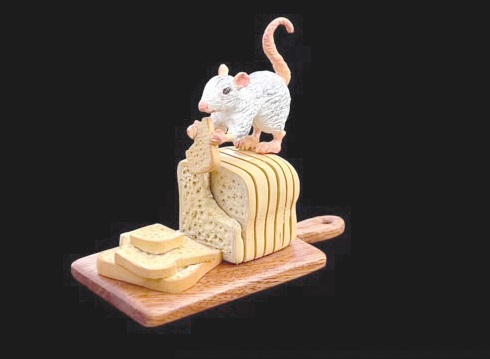
Mr Nkansah creates art pieces in tiny representations of people, animals, cultural objects, and, increasingly, Ghanaian foods.
In an interview with The Mirror in Ashalaja, Accra, on Wednesday, Mr Nkansah recalled another unusual experience during a Christmas vacation at his grandmother's house, when he heard another voice directing him to the backyard. There, he found a “Sese” tree, took a branch and began carving.
He added that around the same period, he watched a TV documentary about a young schoolboy who had carved a woman carrying a pot on her head and a baby on her back. In the documentary, it appeared the baby and the pot were falling.

Inspired by what he had seen, he created his own version of the scene, carving a woman carrying a pot and a baby, but with both safely in place.
Mr Nkansah explained that he uses an Exacto knife, super glue, resin, engraving tools and paint in his work.
With these tools and pieces of false rubber tree wood, locally known as “Sese”, he transforms familiar objects into miniature works of art. He operates under the brand name: Nkansah’s Mini Carvings.
The carver’s food-themed creations include popular Ghanaian meals such as fufu and light soup, kenkey and fish, banku and okro stew and waakye, which he creates as keychains and souvenirs.
Asked how his business was faring, the artist said that, among other things, it helped him build a self-contained house in September 2024, where he lives with his wife, Mrs Abigail Nkansah, and their daughter, Nyhiraba Ganunong Nkansah.
After reflecting on the difficulties he had encountered while in school, he said he decided to take a different path.
“After going through all those struggles in school, I decided to face the world myself and embraced my gift in wood carving,” he explained.
Although carving had been part of his life since childhood, Mr Nkansah’s focus on miniature work became more deliberate in 2020.
According to him, encouragement from a friend and an opportunity he came across on Facebook reignited his interest and pushed him towards developing miniature carving as a specialised craft.
“I created some mini carvings of some white people I had encountered and they took me international. They told their people in Canada,
Germany and Holland and they also placed orders. I felt really fulfilled,” he said.
Promoting Ghanaian food
For a country with a rich food culture, Mr Nkansah said he envisioned its promotion through miniature art as a random idea.
“I was eating fufu one day and it just dawned on me. I later created that fufu carving, posted on my socials and it blew up,” he said.
He noted that he got ideas from people on social media to turn the creations into key holders and fridge magnets.
The food keychains sell for between GH₵50 and GH₵100, depending on the design, while his other artworks are priced according to the nature of each request.
Born on September 6, 1993 at Kwahu Dan in the Eastern Region, Mr Nkansah said he is the son of Alex Frimpong and Vida Afansa, both traders.
He is the first of four siblings and attended Extra Preparatory School, Blessed Assurance Preparatory School, Bannerman School and Happy Souls Academy before entering Kinbu Senior High School in 2009, all in Accra.
At Kinbu, he studied woodwork and completed in 2012. However, his education was not without challenges.

He struggled with subjects, including English Language, Mathematics and Physics, and did not progress to college after completing senior high school.
Away from his carving tools, Mr Nkansah noted that he enjoys singing, drawing and playing football. He also shares his Christian faith through activities at church.
Expressing his dream for the future, he said that he would love to establish a miniature museum in Ghana one day, where he could showcase his wood carvings.
“Such a space would offer an opportunity for people to appreciate the skill involved in producing objects at such a small scale, and to see how everyday Ghanaian subjects could be interpreted through miniature art,” he added.
Writer’s email:
