

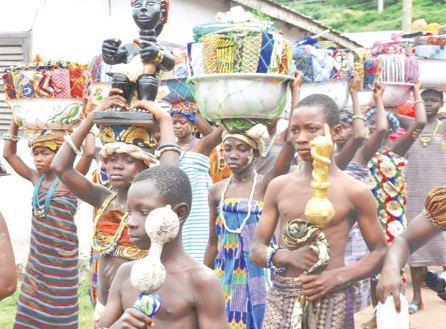
You can tell a Ghanaian festival is approaching when the town suddenly develops a memory.
People who have not visited home for months — sometimes years — begin asking for the date. The WhatsApp groups become unusually busy.
Auntie in Accra is asking who is driving. Uncle in Kumasi wants to know whether there is a place to sleep.
The hometown association starts collecting contributions. The chief's palace is being polished. And somewhere, someone is already rehearsing the drums.
Then the big day arrives.
The chief appears in magnificent regalia. Linguists raise their staffs. Drummers announce the arrival of royalty.
Women parade in beautiful cloth. Young men dance with an energy that suggests they have been secretly training for months.
Food appears in quantities that could feed a small army. And visitors, cameras and smartphones in hand, begin asking the obvious question:
With more than 70 ethnic groups and a rich variety of cultural traditions, Ghana is a country of festivals.
Almost every region has its own calendar of celebrations, each carrying stories about the people, the land and their relationship with the spiritual world.
Traditional restrictions on fishing, hunting or other activities during festival periods have served environmental purposes. They give natural resources time to regenerate.
Long before sustainability became fashionable in conference rooms and PowerPoint presentations, some communities had already incorporated periods of rest into their relationship with nature.
The land, the sea and the people who depend on them may be ritually cleansed. Communities seek spiritual renewal.
Those who died during the year may be remembered and mourned. So, beneath the drumming and dancing is a serious business of resetting communal life.
The previous year's performance is reviewed. Relationships are renewed. Disagreements are settled. Chiefs and traditional authorities are honoured. Religious and social commitments are reaffirmed. Plans are made for the coming year.
It remembers the dead but celebrates the living. It honours tradition while creating room for contemporary life.
It brings together chiefs and politicians, farmers and academics, old residents and young people who have spent most of the year somewhere else.
Most importantly, it brings people home. That is one of the greatest powers of Ghana's festivals. For many Ghanaians, the festival is not really about the day itself. It is about homecoming.
The visitor who arrives for the durbar may stay in a hotel, eat at a local restaurant, hire a taxi, buy crafts, employ a tour guide and visit historical attractions.
The festival may lead that visitor to a castle, museum, waterfall, sacred grove, market or nearby heritage site.
One drumbeat can therefore generate a surprisingly long economic echo.
This is why festivals should not be treated merely as colourful additions to Ghana's tourism calendar. They are economic assets.
They create opportunities for accommodation providers, transport operators, caterers, artisans, musicians, photographers, tour guides and small businesses.
They can extend visitor stays and distribute tourism spending beyond the traditional hotspots.
Festivals can become platforms for community development. When thousands of people return home, the hometown meeting is already assembled.
Development projects can be announced. Contributions can be mobilised. Residents, traditional authorities, businesses and hometown associations can discuss schools, roads, health facilities, water and other needs.
Government officials understand this very well. A festival crowd is also an unusually convenient public meeting. But the greatest tourism asset on display may not be the chief's gold ornaments or the spectacular dancing.
It is identity. The arts make that story visible. Costumes, drumming, dance, food, symbols and ceremonial objects become living archives.
They teach history, culture and social studies without requiring a classroom.
A community that values its heritage is more likely to preserve it. A community that is proud of its town is more likely to welcome visitors.
And a visitor who feels genuinely welcomed is more likely to stay longer, spend more and return.
We must not turn festivals into staged performances designed only to satisfy tourists. The moment a community begins performing its culture solely for outsiders, something important can disappear.
Our tourism industry therefore needs to look beyond the spectacular photograph. The real product is the story, the people, the landscape and the lived experience.
Ghana has hundreds of festivals, but we have not always packaged them with the imagination they deserve. Some remain poorly promoted, difficult to access and disconnected from nearby attractions.
There is room for better calendars, visitor information, transport links, accommodation packages, trained local guides, digital storytelling and carefully designed festival circuits.
Imagine planning a holiday around a sequence of festivals, moving from one community to another and discovering the history and landscape along the way.
That would be more than festival tourism.
So, when the drums begin and the crowds gather, let us look beyond the dancing.
