

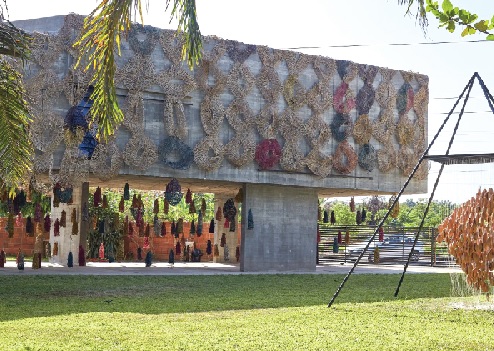
In Ghana, we are good at celebrating anniversaries. Churches mark their silver and golden jubilees, schools roll out drums and kente, and hometowns turn festivals into colourful reunions.
But when an art house turns 20, the celebration deserves a different kind of applause.
This is because it is about counting the imaginations nurtured, the talents discovered and the cultural doors opened.
That is the story of Nubuke Foundation, which is marking two decades of helping Ghanaian art find its voice, its audience and increasingly, its place on the international stage.
Founded in 2006, the Accra-based, Ghanaian-owned and managed not-for-profit institution set out with an ambitious mission: to nurture talent and advance the careers of young artists.
Its anniversary celebrations, which began in March this year, offer an opportunity to reflect on how far that vision has travelled.
Nubuke's journey has been one of persistence and calculated daring in a country where the arts can sometimes struggle for the attention and investment they deserve.
Its programmes, including Independence/Independence, Young Ghanaian Artists (YGA) and Ghana Must Go, have helped create opportunities for artists to develop professionally, exchange ideas and engage critically with their work.
Many artists supported in the foundation's earlier years have since become internationally recognised practitioners.
That is no small achievement. An artist needs more than inspiration and a paintbrush, a lump of clay or a brilliant idea.
There must also be platforms for exhibition, opportunities for professional growth and audiences willing to look beyond the familiar. Nubuke has worked to provide precisely that ecosystem.
This Art House’s story, however, is not confined to Accra's art scene. In the Upper West Region, the foundation established the Nubuke Foundation Centre for Textiles and Clay, supporting women weavers and clay artisans while creating opportunities for contemporary textile and fibre artists.
It is a significant departure from the tendency to concentrate cultural investment in major cities.
The annual Woori Festival, established a decade after the foundation's beginnings, has taken that idea further. Weaving meets music, poetry, literature, fashion and visual art in a multidisciplinary celebration of creativity and community.
Textiles produced in the Upper West have travelled to exhibitions in the United Kingdom, Austria and Poland.
For tourism, this is a compelling lesson. A woven cloth is not simply merchandise to be purchased and packed into a suitcase. It can tell stories of identity, technique, community and generations of inherited knowledge.
Nubuke's purpose-built, 500-square-metre gallery in Accra is another expression of this vision: a space where artists and audiences can meet, question, interpret and discover.
The foundation is celebrating its anniversary with an exhibition by Frederick Ebenezer Okai, titled Repair as an Ode to the Unearthed, opening on October 17 and running until April 2027.
Curated by Ngoné Fall, the exhibition explores ceramic traditions, almost-forgotten cultural knowledge and the possibilities of contemporary sculpture.
Okai, a multidisciplinary artist and one of Ghana's outstanding ceramic practitioners, draws on traditions encountered in pottery communities across Ghana and West Africa. His sculptures rework forms associated with religious, funerary, fertility and everyday practices, bringing inherited knowledge into conversation with contemporary artistic expression.
The message is powerful: tradition need not be embalmed to be preserved. It can be remade, reinterpreted and carried into the future.
The timing is particularly significant, as the exhibition period coincides with Ghana's 70th anniversary of independence in March 2027.
Beyond the political meaning of independence lies another question: How independent are we in defining, interpreting and presenting our cultural identity?
Artists such as Okai challenge narrow ideas of what art should look like, while institutions such as Nubuke create the space for those challenges to be seen and discussed.
There is a tourism lesson here, too. Ghana's attractions are not limited to castles, beaches, waterfalls and wildlife.
Galleries, craft communities, festivals and contemporary cultural spaces can enrich the visitor experience and encourage travellers to explore beyond the conventional itinerary.
They can also connect visitors with the people whose creativity gives Ghanaian culture its vitality.
For that promise to be fully realised, however, cultural institutions need sustained support, stronger links with tourism operators and greater visibility in destination marketing.
Schools, hotels, tour guides and travel companies could do more to introduce visitors to Ghana's contemporary artists and creative communities.
Nubuke's 20-year milestone is therefore both a celebration and a reminder of what patient cultural investment can accomplish. Its newly launched website documents the journey and the people who have helped shape it.
Twenty years on, the foundation's greatest achievement may not be the gallery it has built, the exhibitions it has mounted or the festivals it has established. It may be the belief it has helped nurture: that Ghanaian artists deserve the space, support and freedom to imagine boldly.
And when art flourishes, a country gains more than beautiful objects. It gains stories to tell, identities to explore and new reasons for the world to come visiting. That is how an art house becomes a place worth going places for.
Congratulations to Madam Odile and Team!
