
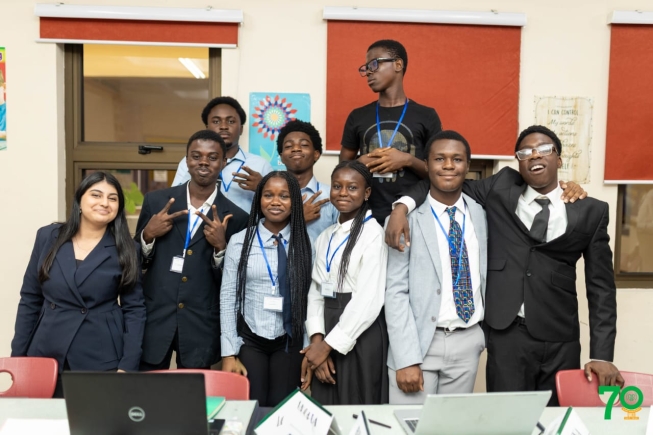
ARISMUN 2026 was an unforgettable experience filled with diplomacy, debate, confidence and collaboration. The three-day conference included fun and educational activities designed to ensure that delegates extracted the maximum benefit from the event.
As a student delegate representing Ghana from Ghana International School, I was placed in the International Labour Organisation’s Committee and had to research two topics. I addressed the General Assembly on both.
The first was ensuring fair access to reskilling as AI transforms the workforce. The second was balancing migrant workers’ rights with global labour shortages.
These topics were specifically tailored to ensure that delegates could come up with solutions to problems the world currently faces. This truly embodies the spirit of MUN, which is to train the next generation to solve real-world problems.
As well as helping me build my confidence and teaching me research skills, this conference opened my eyes to measures Ghana has put in place to combat several worldwide issues that I never even knew about. The main issue is that most Ghanaian workers are in the informal sector, commonly estimated at around 70 to 80 per cent of employment. These workers have no employer to pay for training and no safety net if AI replaces their tasks. Ghana has invested $270 million towards solutions for people whose jobs have been taken by AI. Ghana has made its stance clear: no one should lose their job to AI or a machine without a route to a new one. Ghana has put in place the National AI Strategy and the One Million Coders programme, which all combat this issue.
That was a real eye-opener for me. When I found out that I would be the delegate of Ghana and saw that the topic largely revolved around AI, I was a little scared. This was because, in my mind, Ghana had done nothing concerning AI. However, I was pleasantly surprised to find out that Ghana has actually invested a lot to try and combat issues concerning millions of people losing their jobs because of AI transforming the modern workforce.
Similarly, to combat the issue of migrant workers’ rights not being balanced, Ghana has put in place structures such as bilateral migration agreements as well as launching the Nationwide Labour Migration Readiness Campaign. In addition to this, stringent oversight on foreign contracts was also introduced.
After each topic’s discussion elapsed, ‘blocs’ — essentially countries that allied during the discussion — each came together to present solutions to the problem. As the delegate of Ghana, I partnered with a fellow West African nation, Nigeria, and a few other European nations: Britain, Sweden and France. As a collective unit, we all came together and presented our draft resolution.
This conference revealed to me that Model United Nations is one of the best ways for a student to grow into a confident, capable leader. You don't have to plan on working at the UN, because the skills you gain are useful in science, business, law, health, technology and politics. In MUN, you learn to research real global problems, speak up with confidence, negotiate with people who disagree with you, and write solutions that others can support. You also learn to see the world from another country's point of view, which builds understanding and respect.
Overall, this was an amazing experience that I would definitely recommend to all students who have this opportunity available to them.
