
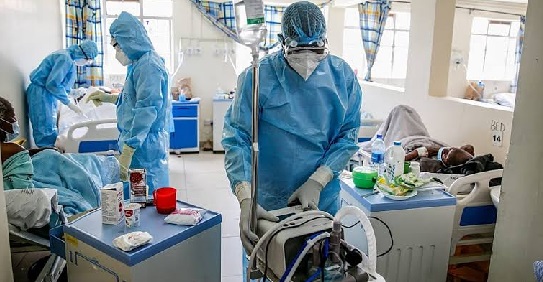
Kenyan health authorities have quarantined 10 people who came into contact with a man who died of Ebola, as efforts intensify to trace 57 others potentially exposed to the virus.
The patient, who travelled from the Democratic Republic of Congo (DRC), died at a hospital in Nairobi on Monday, marking Kenya’s first confirmed Ebola case.
The development has raised concerns about the effectiveness of screening measures after it emerged that the patient travelled through several locations in the DRC, Uganda and eventually Kenya while reportedly ill for about a month.
Director-General of the Africa Centres for Disease Control and Prevention (Africa CDC), Jean Kaseya, said the patient travelled from Buta in northern DRC to Kisangani by road, flew to Beni, travelled by road to Uganda and then flew to Nairobi.
“We know that he left Buta, a city in [northern] DR Congo, to drive to Kisangani. And from Kisangani, he took a flight to Beni. From Beni, he drove to Uganda. And from Uganda, he took a flight to Nairobi,” Mr Kaseya told the BBC’s Focus on Africa programme.
“What are symptoms he was presenting? Why was he not detected?” he asked.
Ebola spreads through direct contact with infected bodily fluids, including blood and vomit.
The current outbreak in the DRC, which began in May, has been linked to the Bundibugyo species of Ebola, a relatively rare strain for which there is currently no approved vaccine or treatment, although clinical trials are underway.
Mr Kaseya said the Africa CDC was investigating the case in collaboration with Congolese authorities, while a team from the organisation was expected to meet Kenyan health officials.
Kenya’s Health Ministry official, Patrick Amoth, said the patient may have passed through screening after taking medication that masked his symptoms.
After arriving at Nairobi’s airport, the man was transferred by a relative to a hospital in the capital, where he later died. He was buried on Tuesday in accordance with health safety protocols.
Kenyan authorities have urged the public not to panic, assuring citizens that surveillance has been intensified at airports and border crossings.
However, Dr Dennis Miskellah, a representative of Kenya’s main doctors’ union, said the case exposed weaknesses in the country’s border screening systems.
He told the BBC’s Newsday programme that he had witnessed “lapses” at various border points, including those with Uganda and Tanzania, as well as at Kenya’s main airport.
“How could you have been sick for almost a month plus in DR Congo, come all the way to the country through not just any small border point, but the main entry point, the main gateway into the country and pass unnoticed?” he asked.
The Health Ministry said it had intensified containment measures through a joint response involving county administrations, humanitarian partners and other stakeholders.
President William Ruto said surveillance and rapid-response teams had been deployed, building on systems established following the outbreak in the DRC in May.
His spokesperson said Kenya had the capacity to detect, isolate and manage suspected cases, adding that more than 650,000 travellers had so far been screened and 267 samples tested.
Four major hospitals have been designated to manage Ebola patients, including Nairobi Hospital, where the first confirmed patient died.
Meanwhile, the Kenyan government is considering converting an Ebola treatment facility planned for a military base in Nanyuki into an infectious disease hospital.
The proposed facility sparked public concern in June over the risk of cross-border infection and was subsequently halted by the courts.
Health Minister Aden Duale told local television station NTV on Wednesday that, pending the outcome of the court case, the government was considering turning the facility into the “first” infectious disease hospital in the region to manage outbreaks such as Ebola.
