
The international community needs us in the resolution of the Russia-Ukraine conflict.
Meeting the United Nations (UN) Secretary-General, Antonio Guterres, in the Kremlin before the Russian invasion of Ukraine, the President of the Russian Federation, Vladimir Putin, unfolded the history and the circumstances leading to the US-led NATO military action against Kosovo and the US air strikes against Iraq.
The central argument rested on Russia’s preventive diplomacy.
Russia and the then-UN Secretary-General, Kofi Annan, had united efforts to stop the US-led NATO military action in Kosovo and Iraq.
The same diplomatic efforts were employed to avert the US air strikes against Iraq.
International peace
The President, in one way or another, was seeking justification for the impending Russian invasion. In the context of international peace and security and the Charter of the UN, no Secretary-General of the UN will support any invasion of a sovereign state by another sovereign state.
The UN does not command countries but rather acts as an intermediary between Member States when there is a conflict.
The Secretary-General is a mediator between warring parties, so even though the meeting between the Secretary-General and President Putin to avert the war was a fiasco, nevertheless the Secretary-General has performed his duties.
The two leaders
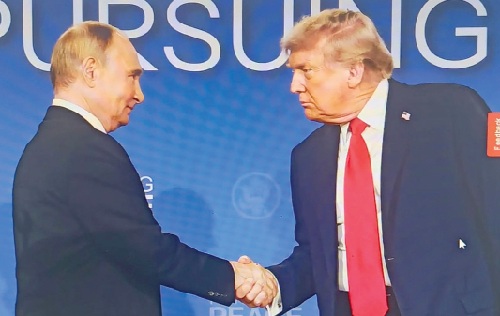
President Donald Trump and President Vladimir Putin met for their first in-person summit in Alaska regarding the Russian-Ukrainian war.
During this meeting, no immediate ceasefire or final deal was reached.
The two world leaders have had their usual meetings that dealt with bilateral relations, arms reduction, and economic cooperation, so a personal chemistry has already been established between President Trump and President Putin.
These are the traditional features of US-Russia relations.
Upon assuming office for his second term in 2025, President Trump expressed a strong interest in resolving the Russia-Ukraine war.
His initial proposal was poorly received by Ukraine and its Western allies, drawing fierce opposition.
While this plan did not reflect the views of many members of Congress, as President of the United States, he utilised his strong executive powers to advance his proposals.
US Foreign policy
The action of the President did not contradict the US foreign policy on the Russian-Ukrainian war.
The US foreign policy aims at ending the war in Ukraine.
The US takes no interest in the continuation of the conflict, according to the foreign policy, so there is no contradiction between the US foreign policy and the President’s initial action to end the war.
The US has been offering military assistance in terms of high technology and arms to support Ukraine.
Ukraine has benefited from US intelligence, which enables it to detect incoming Russian missiles. Ukraine is a weakling compared to Russia’s military might, though there is no declaration of victory on either side.
President Trump
Under so many and so great discouragements, President Trump remains a key figure in whom the international community can place considerable trust to lead a negotiation for a peaceful settlement of the conflict.
The tremendous hurdles should not obstruct the President’s goodwill. The two warring parties should meticulously study any proposal that comes from the President.
Even if they do not accept it immediately, a tactical and diplomatic approach to receiving his proposals would boost his morale to continue negotiations for a peaceful settlement.
The President remains the hope for the international community and should press resolutely towards a peaceful settlement.
The President must be concerned with what is solid and useful for the two parties and for international peace and security.
President Trump's credentials
President Trump is the President of the United States of America, the only superpower after the collapse of the Soviet Union.
The two invasions, Kosovo and Iraq, were all under the inspecting eyes of the Presidents of the United States. President Trump, who is currently the President of the United States of America, would have been disqualified by President Putin for wearing the same gown as his predecessors.
The President attacked Iran; the conflict caused huge devastation to the people of Iran and caused regional instability. Here we see Trump, who is breaking ground for mediation between the two warring parties. He has become an Ambassador of peace in the perception of President Putin.
Putin sees Trump not through the prism of a traditional American President, Bill Clinton in Kosovo and George Bush in Iraq.
The problem Trump is facing is the content of the proposal from Putin for a lasting solution to end the war.
There are two groups of international observers: those standing for human rights, respect for the territorial integrity of Ukraine, respect for international law, and the other group is preserving allegiance to ethnic ties, defending the minority, and adhering to history to set the record right.
European peace and stability
The European Union and the Organisation for Security and Cooperation in Europe (OSCE) should change their strategies for the resolution of the Russian-Ukrainian conflict.
There must be an emphasis on peace talks rather than the supply of arms and financial assistance to Ukraine.
The escalation of the conflict will have a corresponding increase in the influx of refugees into neighbouring countries such as Poland.
UK accepts Ukrainian refugees; Poland holds the second-largest number of Ukrainian refugees in Europe, roughly 850,000 to 970,000.
This is the number registered under temporary protection status (Radio Free Europe/ Radio liberty, 2026).
Ukrainian refugees
Germany hosts approximately 1.29 million Ukrainian refugees, representing the largest group of war refugees from Ukraine in the European Union. (Statista, 2026). 10.6 million Ukrainians, or about 25 per cent of the country's pre-war population, are estimated to be displaced by UNHCR, the UN Refugee Agency.
While 6.9 million refugees are still receiving shelter abroad, 3.7 million have been displaced within Ukraine.(UNHCR, 2026).
The influx of refugees into neighbouring countries and other parts of the world will continue as long as the war escalates.
We continue to urge all countries to offer humanitarian assistance to Ukrainian refugees.
