
Reading about China and witnessing first-hand the initiatives and interventions that have steadily driven its development and progress since the launch of economic reforms in 1978 have been truly enlightening.
Since the founding of the People’s Republic of China on October 1, 1949, the country has undergone an extraordinary transformation from a largely agrarian economy to becoming the world’s second-largest economy.
It has been an intentional journey hinged on steady and visionary leadership, reform, discipline, and adapting to innovation and achievable development plans as the main drivers of its industrialisation, urbanisation, and technological advancement.
The Belt and Road Initiative launched in 2013 which has further added to China’s economic influence, improving infrastructure networks and investments opportunities in Africa, Asia and Europe.
The initiative is a massive global infrastructure and economic cooperation strategy launched by the Chinese government to connect China with Asia, Europe, Africa, and beyond.
Spanning roughly 150 partner countries and involving over $1 trillion in cumulative spending and contracts, it focuses on building trade routes, energy links, and digital and physical infrastructure.
As an answer to President Xi Jinping’s call for an ‘advanced Chinese modernisation’ which aligns with the broader vision of building a modern system that focuses on collective prosperity, political stability, promotion of cultural heritage, environmental sustainability and opening up the country to the world, the various sectors that drive the Chinese economy have also been aligning to heed that call.
Read China, reach China
One of the sectors that has benefited significantly from this process of Chinese modernisation is the publishing industry, which has emerged as a major player in the country's development drive.
The industry is currently the second-largest in the world, behind only the United States, with six Chinese companies featuring among the world's leading publishing firms.
Encapsulated in the phrase, “Read China, Reach China”, the publishing industry has been at the forefront of preserving the country's past, documenting its present and shaping its future.
Policymakers in the sector have sought to ensure that publishing not only reflects China's development ambitions but also plays a meaningful role in advancing them.
In line with the country's five-year development agenda, industry leaders have unveiled a strategic plan for the publishing sector covering 2026 to 2030, anchored in the vision: “Read China, Reach China”.
Through this, the leaders of the country’s publishing industry are not just printing or publishing books, but going beyond their borders to promote China’s literary works, as well as partner with other publishing firms around the world to work on books and publications that benefits them by making the world see China through such works.
The plan
At an international training programme for representatives of countries who are members of the Belt and Road Publishing Cooperation Community, the CICG, through its Institute of International Studies and Advanced Training, presented the country’s five-year development plan for the publishing industry.
The plan includes promoting quality and efficiency in the industry by building an effective team and industry to lead the drive; advancing deep digital integration of publishing, continuously supplying premium content, which has been the foundation of the industry; as well as directing the production structure for all kinds of publishing works for education, academia and social reading.
Also, the publishing industry will lead the charge to preserve Chinese culture and history through the deliberate publishing of works. For instance, as a first step, the industry has published the updated version of the Chinese Encyclopedia, which catalogues the country’s history.
For the newspaper industry, policymakers recognise the growing shift towards digital platforms as more people turn to the Internet for news and information.
The sector is therefore positioning itself to adapt to this changing media landscape as part of its 2026–2030 five-year plan.
They also recognise the scale of the digital shift, noting that China currently has more than one billion internet users and millions of generative AI users.
Thus to brace up for the change and impact within the next five years, they are going to improve coordination and structure to improve the works, build online channels in new media as well as accelerate intelligent transformation and digitisation, ensuring that the barriers are broken down to achieve data connectivity.
Already, 500 newspapers have built unified data and data transition for a smooth implementation.
Again, the leaders are going to strengthen the National Conference on Reading, which was instituted in 2022 on the recommendation of President Jinpeng.
The initiative has the first week of April set aside as the National Reading Week, which has been scheduled to coincide with the World Reading Day on April 23.
During that period, everyone is encouraged to read a book and reading competitions and clinics are held from the provincial to the national levels. They are also encouraged to discuss and share their experiences from the books they have read.
Recognising the impact of technology in the near future, the plan is expanding from physical channels to online bookstores to make this project accessible to all.
China's commitment to environmental sustainability has also been extended to the publishing industry, with efforts to minimise pollution through the adoption of environmentally friendly production methods and technologies.
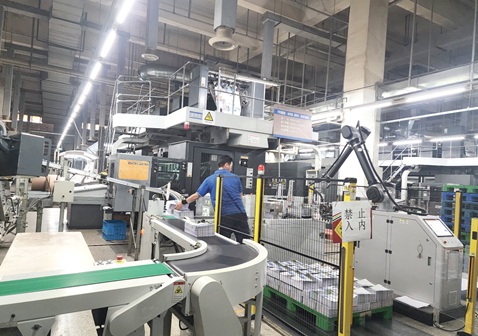
During a tour of some publishing companies, participants were introduced to the various methods and equipment being deployed to reduce the industry's environmental footprint.
One observation was that the policymakers were very intentional about being more Chinese by using everything Chinese: content, quality, equipment and labour.
While the plan seeks to strengthen the industry internally, policymakers also recognise the importance of international cooperation and knowledge-sharing, an approach reflected in the Belt and Road Initiative.
One of the projects promoted under the initiative is the ‘Biography of the Silk Road Cities’ series, which seeks to foster cultural exchange and mutual learning among the diverse urban communities and civilisations along the Belt and Road.
China has long been renowned for its industrialisation and manufacturing prowess, but it is determined to expand the world's perception of the country beyond these strengths, with the publishing industry deliberately positioned at the heart of that ambition.
With all intents and purposes, the Chinese have mastered the craft of being the best or among the best, and the elaborate plan for the publishing industry, just like the others, will have them dominating.
