
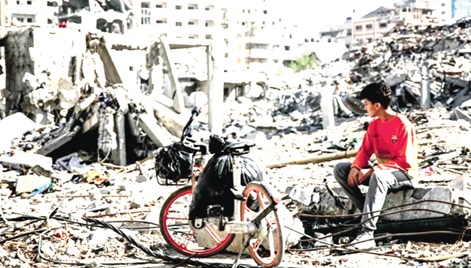
The threat has not vanished because the guns fell quiet.
Israel’s pursuit of Hamas fighters unfolds in crowded neighbourhoods, shattered buildings and underground routes.
No Israeli government can ignore another October 7.
But method matters.
A campaign that kills militants, while deepening civilian catastrophe, weakening the ceasefire and fuelling recruitment could leave Israel less secure.
The October 7 imperative
The trauma shaping Israeli calculations is measurable.
On October 7, 2023, Hamas-led attackers killed about 1,200 people in southern Israel and abducted around 250, according to Israeli figures reported by Reuters.
The assault breached the border and struck communities and military positions, exposing a catastrophic failure of warning, readiness and response.
Preventing a repeat is a core national-security requirement.
Yet, the mission is not simply to eliminate individuals.
It is to prevent Hamas from rebuilding the capabilities behind the assault: command structures, weapons stocks, recruitment, cross-border intelligence and coordinated armed units.
Israel says Hamas has been rearming and violating the year-old ceasefire; Hamas denies rebuilding its arsenal or launching attacks.
That dispute is central.
The test is whether it reduces Hamas’s threat without foreclosing a political settlement.
Reuters reported on November 1, 2026, that Israeli strikes left at least eight Palestinians dead in two attacks, including five police officers in Khan Younis.
Israel’s military said it struck militants there; Gaza medics and the Hamas-run interior ministry reported the deaths.
Police status alone does not establish whether someone was a combatant, just as a military claim does not independently prove a target’s role.
A battlefield without a front line
Gaza’s urban geography gives Hamas a defensive advantage and makes Israeli operations exceptionally difficult.
Fighters can move through streets, damaged buildings and concealed passages, then disappear into civilian surroundings.
Homes, schools, mosques and medical facilities may stand close to weapons stores, firing positions or command infrastructure.
The Israeli military says it has found extensive tunnel networks and thousands of entrances in northern and southern Gaza.
These are Israeli assessments, not independently verified measurements.
The underground dimension changes everything.
Tunnels shelter personnel, connect positions, store weapons and enable movement beyond aerial surveillance.
Neutralise the network
Destroying an entrance does not necessarily neutralise the network.
Clearing a building does not secure a neighbourhood if fighters can emerge elsewhere.
The result is a layered fight: identify the fighter, locate the network, isolate the objective, protect noncombatants and hold cleared ground against repeated re-infiltration. Israeli troops must combine intelligence, engineering, infantry protection and surveillance in a battlespace where the visible street is only one layer.
Civilian concentration compounds the danger. Reuters reports Gaza has more than two million residents and nearly all now live in the remaining third of the territory, amid ruins, tents and damaged buildings, while Israeli forces control about two-thirds.
This compression makes separating fighters from civilians harder and magnifies the consequences of strikes, raids and evacuation orders.
Displacement also disrupts access to food, water and medical care, while leaving civilians uncertain whether escape routes are safe.
The tactical and moral trap
Israeli forces face a brutal dilemma. Move slowly and Hamas fighters may escape, regroup or attack troops.
Use heavy firepower and civilian deaths and infrastructure destruction become more likely.
Raids expose soldiers to ambushes, booby traps, improvised explosives and close-range fire.
Aerial surveillance can be defeated by tunnels, rubble and civilian movement.
In a shifting urban environment, intelligence can become stale within minutes.
The humanitarian cost is immense.
Gaza authorities report more than 74,000 Palestinians have been killed in the wider Israeli campaign since October 2023; Reuters attributes the figure to Palestinian authorities, not an independently audited count.
Gaza health officials say at least 1,500 have died in Israeli attacks since the ceasefire.
These totals include civilians and combatants; they are not verified combatant tallies. Israel says four of its soldiers have been killed since the ceasefire.
International humanitarian
International humanitarian law does not prohibit urban combat, nor does civilian presence automatically immunise a military objective.
But parties must distinguish civilians from combatants and civilian objects from military objectives.
Attacks expected to cause excessive incidental civilian harm are prohibited and all feasible precautions must be taken.
Warnings do not cancel these duties.
Alleged Hamas use of civilian sites does not release Israel from its obligations.
Hamas, too, is bound by the law: using human shields or launching indiscriminate attacks is unlawful.
This is an operational and strategic test. Civilian casualties can destroy local trust, undermine international support, complicate intelligence gathering and strengthen recruitment narratives.
Precision requires reliable identification, careful timing, suitable weapons, credible warnings and the ability to cancel an attack when circumstances change. Where those conditions cannot be met, restraint is disciplined force, not weakness.
Security requires more than pursuit
The ceasefire’s weakness is now part of the battlefield.
Reuters reports that the US-brokered agreement envisages reconstruction, but negotiations remain stalled over Hamas disarmament and Israeli withdrawal.
Israel says Hamas is rebuilding; Hamas denies it. Meanwhile, most Gazans remain in a narrow, devastated area and reconstruction has barely advanced.
A ceasefire without monitoring, security arrangements and a political horizon is a pause, not a settlement.
Israel is right to insist Gaza must not again become a launchpad for mass attacks.
But sustainable security cannot rest on recurring raids alone.
It requires border monitoring, prevention of weapons transfers, accountable local governance, intelligence cooperation and arrangements that stop armed factions rebuilding military infrastructure.
Any settlement must also protect Gaza’s civilians.
Otherwise, the conditions for renewed insurgency will persist.
The lesson is stark
Hamas’s armed networks pose a genuine threat; Gaza’s density and destruction make dismantling them exceptionally dangerous; civilian protection is both a legal obligation and a strategic necessity.
Israel can pursue those responsible for October 7 and disrupt preparations for another attack.
It cannot bomb its way to lasting security.
Success will be measured not by targets struck, but by whether Israelis become safer, civilians are protected and Gaza escapes the cycle of militant rule and endless war.
