
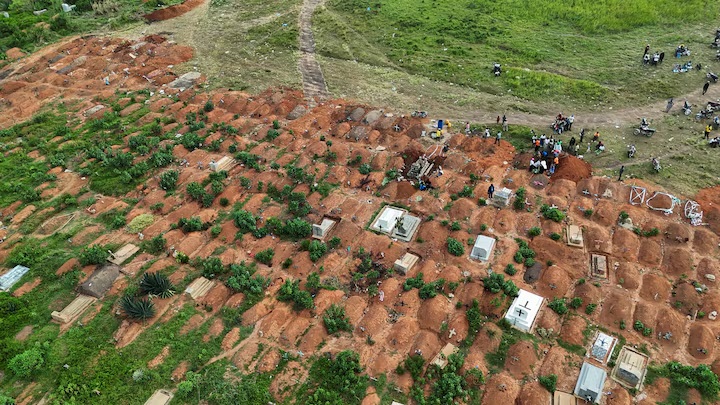
Gravedigger Salomon Mugisa stood in the shade of a tree at Nyamurongo cemetery, a shovel resting at his feet, sweat rolling down his cheeks in the mid-July heat.
At the beginning of the year, there were two or three burials a day at most at this site in Bunia, he said. But the numbers began ballooning in late April, when an Ebola epidemic started to spread through the city in eastern Congo.
“We were doing 5, 10, 15 burials a day. It kept increasing,” Mugisa said, sweeping his arm across a vast expanse of land dotted with mounds of freshly turned red earth.
When Reuters visited the cemetery in July, Mugisa said about 600 people had been buried there since the April surge began.
Yet at that time, Congolese health authorities had recorded fewer than 200 Ebola deaths in all of Bunia, the epicentre of an outbreak that was formally declared on May 15 and has since infected more than 11,500 people and killed over 5,500 across the country.
A Reuters analysis of satellite imagery of Nyamurongo and Bunia’s two other main cemeteries showed the same pattern: Far more new graves have been dug than can be explained by official Ebola death tallies, pointing to a large undercount of the disaster.
Reuters estimated the number of deaths linked to the virus in Bunia by comparing the count of new graves dug in 2026 against the preceding epidemic-free year, to reach a figure health officials refer to as “excess deaths”. That was then contrasted with the official Ebola death toll. While the gap has narrowed over time, in early November the city’s excess deaths of more than 1,000 remained over 50% higher than the Ebola tally of 707.
Not all excess deaths can be directly attributable to the disease and could include indirect effects of the outbreak, such as people with other illnesses who avoided hospitals for fear of getting infected by the virus, which has no treatment or cure.
The findings of the Reuters analysis, the first detailed attempt to quantify the undercount, are nonetheless consistent with estimates from the World Health Organization, which suggested in July that the outbreak was two to four times larger than available data suggested.
Excess-death studies are a common method used by public health officials during crises such as COVID-19 when death statistics are delayed, incomplete or unreliable. Reuters’ estimate of Ebola victims in Bunia is likely conservative, as it didn’t capture smaller burial sites dotted around the city.
Congo’s health ministry didn’t respond to requests for comment on the analysis.
Jean-Jacques Muyembe, head of Congo’s National Institute for Biomedical Research, said an early discrepancy between recorded Ebola deaths and the true toll was “logical” because the outbreak was detected late. He cautioned that estimates based on excess mortality should be confirmed by inquiries into precise causes of death.
Yap Boum, head of emergency preparedness and response at Africa Centres for Disease Control and Prevention, said the findings were broadly plausible. Excess mortality is often highest early in an outbreak before testing, surveillance and response systems are fully in place, he said.
COUNTING THE DEAD IN GOLD MINING TOWN
Tracking gaps between excess mortality and official death tolls can help gauge the effectiveness of surveillance and testing systems over time. When deaths are missed, contacts are often missed, too, making it harder for health workers to control an outbreak, the experts said.
The analysis found the Ebola toll undercount was largest during the outbreak’s early months, a trend that the public-health officials said was typical of many epidemics globally. The narrowing gap over time is consistent with improvements in detection and reporting.
“We continue to find evidence that a proportion of cases and deaths were never detected,” said Olivier Le Polain, head of epidemiology and analytics at WHO’s Health Emergencies Programme.
By late June, Bunia had seen more than 580 excess deaths - seven times more than the official toll, the analysis found. By September, cumulative excess fatalities had risen to about 950, double the official tally.
In Nyamurongo, the largest of Bunia’s cemeteries, an average of 2.4 new graves were dug per day in the year preceding the outbreak. Reuters found that in June, that rate increased to more than nine new graves a day and has since fallen to 4.5 as of early November.
In addition to the three Bunia cemeteries, the Reuters analysis also covered the main burial site in Mongbwalu, a nearby gold-mining town to the north where health authorities believe the outbreak began. Official tallies list more than 750 deaths in Bunia and over 350 in Mongbwalu.
Satellite imagery shows the growth of these cemeteries as the outbreak progressed. The contrast is stark, with large sections of previously open ground transformed into densely packed rows of graves within a few weeks.
Mongbwalu showed a similar pattern to Bunia. Reuters examined satellite imagery from a single cemetery, the largest. By August, the excess deaths there alone were 25% higher than the official Ebola toll for the town and its surrounding villages.
When reporters visited the town in July, cemetery workers and officials had identified several hundred graves across seven other cemeteries they said also belonged to Ebola victims.
‘WE KNEW THERE WAS A PROBLEM’
The flood of patients in Mongbwalu in early May overwhelmed health workers.
Patients kept arriving at the town’s hospital with symptoms that looked like malaria or typhoid fever, said Richard Lokudu, head doctor at Mongbwalu hospital. Instead of recovering, many deteriorated rapidly and died.
“We knew there was a problem, but we didn’t know what it was,” he said.
Some residents blamed a curse that had fallen upon the community after the coffin of a high-profile pastor, whom authorities suspect may have been “patient zero” or an early super-spreader, was damaged and later set ablaze.
Samples were taken and initially tested for the wrong species of Ebola. It was not until mid-May that the first results came back positive for Bundibugyo, a rare form of the virus for which there is no treatment or vaccine.
“We detected it late,” said Lokudu. “That’s why we had so many deaths.”
By the time Congolese officials formally declared an outbreak in mid-May, local health authorities had already recorded 100 unexplained deaths in the town in the preceding six weeks, many with symptoms associated with Ebola, according to a health ministry situation report obtained by Reuters.
Many of those patients were buried without ever being tested, according to Jean-Leonard Binziliese Goite, Mongbwalu’s civil registrar. The number of Ebola deaths was underestimated in the early months of the outbreak in the town, whose gold mines draw transient workers from across the country who have no relatives locally to declare deaths, he said.
The disaster was also spreading across Ituri province. People fled Mongbwalu as deaths mounted, residents said, many heading to the provincial capital Bunia and other major cities in the region.
‘WE DON’T EVEN KNOW THEIR NAMES’
After the outbreak was declared, the health ministry rolled out testing and surveillance programs. Stricter controls on burials also meant fewer people could be laid to rest without authorities being informed.
But gaps remained, exacerbated by a US retreat from overseas aid.
“Many people were scared to go to health facilities because they saw people going there and dying,” said Faustin Ngabu Belo, a local official in Mongbwalu’s Njebi neighbourhood. Others turned to traditional healers, Lokudu said.
Surveillance remains a major challenge, with overstretched health teams tasked with finding and investigating suspected cases and deaths in the face of vehicle shortages, difficult terrain and misconceptions about the disease.
Reuters couldn’t determine whether the degree of undercounting observed in Bunia and Mongbwalu was reflected elsewhere in eastern Congo. WHO’s Le Polain said under-detection was likely to be worse in remote and hard-to-reach areas, particularly where there are security constraints. Response efforts would be deployed comparatively slowly versus Bunia, a major urban centre with the highest number of recorded cases and deaths.
Data presented by Africa CDC on November 5 suggests detection remains weak and that the outbreak is not yet under control, six months on. More than 60% of Ebola deaths were still occurring outside of health facilities and fewer than 15% of new confirmed cases originated from known contact lists, suggesting many chains of transmission remained unidentified.
Some burials have continued to be unreported to local authorities, according to Richard Larozulo, an official responsible for registering deaths in Mongbwalu’s Saio neighbourhood, which hosts another cemetery.
“We don’t even know their names,” Larozulo said.
