
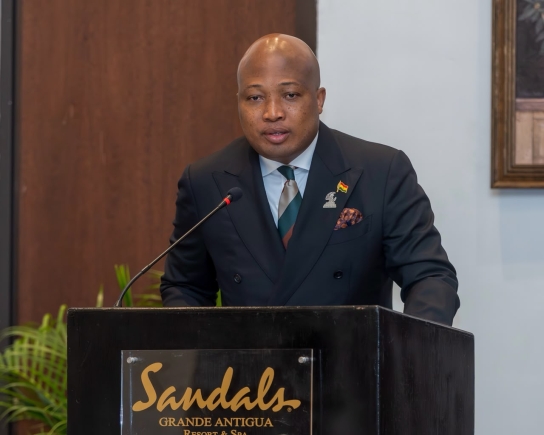
The Minister of Foreign Affairs, Samuel Okudzeto Ablakwa, has backed the proposed Fossil Fuel Treaty, which demands the reduction of fossil fuels and cutting emissions, urging that the global energy transition must be just, equitable and sensitive to the different national circumstances of developing countries.
Mr Ablakwa said a transition that leaves developing countries behind could not be truly just, stressing that it must be founded on partnership rather than prescription; cooperation rather than coercion; and shared responsibility rather than disproportionate sacrifice.
He was speaking at a High-Level Breakfast Meeting on the Fossil Fuel Treaty Initiative for Commonwealth Ministers of Foreign Affairs in St. John, Antigua and Barbuda on Monday, November 2, 2026, on the sidelines of the Commonwealth Heads of Government Meeting.
Mr Ablakwa said Ghana was proud to join what he described as an elite group of countries working on the consequential treaty, even as an oil and gas-producing country.
Climate threat, national realities
The Minister affirmed that climate change posed an increasingly grave threat to human security, livelihoods and sustainable development, with small island developing states, including hosts in the Caribbean, facing especially acute consequences. While Ghana recognised the imperative of collective climate action, he maintained that the transition must account for differences in national capacities, energy needs and historical contributions to greenhouse gas emissions.
He said oil and gas development had contributed significantly to Ghana’s economic transformation through employment, foreign exchange earnings and public revenues.
Petroleum receipts channelled through the Annual Budget Funding Amount had supported education, health, infrastructure and renewable energy development, he said.
He stressed that natural gas from domestic fields also played a central role in electricity generation, while associated gas processing supported the supply of Liquefied Petroleum Gas for cooking, demonstrating why an orderly transition was essential.
"Energy must remain affordable and reliable for households and industry, even as Ghana progressively expands cleaner sources," Mr Ablakwa stated.
Reset agenda
Mr Ablakwa said Ghana’s approach was informed by President John Dramani Mahama’s reset agenda, which placed emphasis on economic transformation, industrial diversification, energy security and sustainable development. He explained that petroleum revenues, if prudently managed, could help finance renewable energy investments, strengthen the national energy mix and support industrial development.
The Minister added that a diversified energy system could stimulate new enterprises and employment, while dependable electricity could support value addition in strategic minerals, including lithium and silicon, and the growth of emerging green industries.
He, however, cautioned that investment in petroleum development remained sensitive to global transition policies, regulatory and fiscal conditions and geopolitical uncertainty. He said inadequate emissions abatement could diminish access to export markets, while carbon-related trade measures may undermine the competitiveness of energy-intensive manufactured products.
Call for equity, financing
Mr Ablakwa said the proposed Fossil Fuel Treaty must go beyond articulating ambition to move away from fossil fuels and establish credible arrangements to manage the economic, financial and social consequences of that transition. "Ghana considers equity, climate justice and the principle of common but differentiated responsibilities and respective capabilities in the light of different national circumstances indispensable. A uniform timetable or pathway inattentive to those concrete realities would risk undermining both sustainable development and effective climate action," he stressed.
He said climate justice demands not merely that the world pursues a common destination, but that it recognises the unequal circumstances from which nations must undertake the journey. He said the treaty should help countries by providing dedicated funding for clean energy projects, debt relief and affordable loans from development banks. Such financing, he added, must be accompanied by practical technology transfer, technical assistance, investment mobilisation and support to retrofit or repurpose oil and gas infrastructure for cleaner energy applications.
"A just transition must also be human-centred. Training, economic empowerment and alternative livelihood programmes are necessary to ensure that workers and communities dependent on petroleum activities are not left behind," he said.
Mr Ablakwa reaffirmed Ghana’s commitment to multilateralism and the objectives of the Paris Agreement, saying the Commonwealth, which brings together climate-vulnerable states and energy-producing economies, is well placed to foster understanding. He drew parallels with Ghana’s commitment to multilateral treaties, recalling that on September 26 last year, the government deposited its instrument of ratification for the Treaty on the Prohibition of Nuclear Weapons at the United Nations.
