
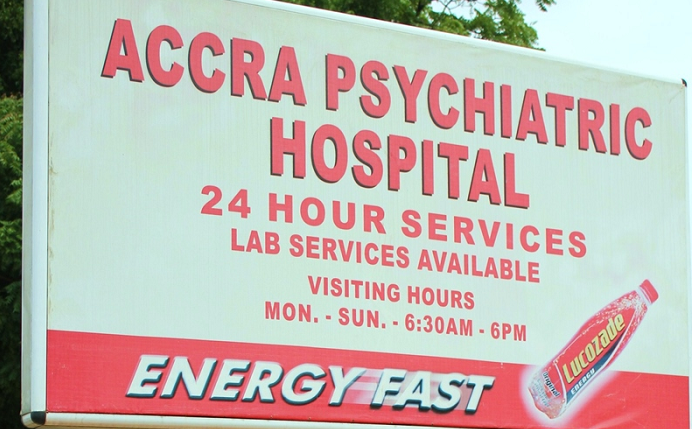
It is news I have received with a heavy heart – that the Accra Psychiatric Hospital is no longer admitting patients because of its financial challenges.
Cash strapped and indebted to suppliers, with unreliable patient food supplies, dilapidated infrastructure, squalid wards and drugs nearing expiration, it is déjà vu all over again. We have seen and heard this before – long before the passage of Ghana’s much acclaimed mental health act. I am left wondering whether we, those of us who embarked upon a campaign of intense advocacy for the passage of the law, have made any difference at all in the final run. Has anything really changed? Is it not the same cycle of stresses building up till unable to be contained no more, bubbling over into the public space?
A recent report by Citi FM is particularly concerning.
“For some time now, the hospital has been challenged in terms of funding. Mostly our source of funding depends on the subvention from the government of Ghana. There is no money, there is no food. In a day, you need about ten Ghana cedis to spend on a patient and we have close to five hundred patients. For now, management has decided they are not going to take any admissions”, said Dr Pinaman Appau, the Director of the Accra Psychiatric Hospital.
Other gory details emerge – patients sleeping outside wards on beds, mats and mattresses due to over crowded wards (four to six patients in a 10 by 12 cubicle), roofs with holes, non-functional occupational therapy departments, kitchen with leaking stoves, among other equally depressing narratives.
The issue then seems to be one of sustainable funding mechanisms for mental health care in the country. This leads me to the specific funding mechanisms outlined in the Mental Health Act 2012, Act 846. There, I see that five funding streams are outlined aimed ultimately at ensuring that mental health care is free as is health care in the case of a mentally ill patient suffering from a physical condition e.g. chest infection.
These funding streams identified for the administration of mental health care by the Mental Health Authority are as follows: “monies approved by Parliament, monies derived from fees,donations, grants and gifts, monies derived from investments, and any other monies that are approved by the Minister of Finance.”
Of course, for monies to be approved by Parliament, it presupposes that a formal request would have been made by the Finance Ministry on behalf of the Mental Health Authority. This also presupposes that as stipulated by the Act, the Board of the Authority, in the preparation of the 2016 national budget, submitted “detailed budget estimates … not later than three months before the end of the financial year.” And that these ‘so called’ detailed budget estimates duly factored in all these outstanding payments from 2013 as revealed by hospital authorities.
If the board did submit these detailed budget estimates on time, but government, for whatever reasons, was unable to make adequate financial provision for it, then the time has come to question both the above funding mechanisms in place and also whether contrary to claims, whether mental health care is a true priority for a government that touts its social democratic credentials.
We do need to verify these processes further, both at the level of the Board of the Mental Health Authority, the Ministry of Finance and the government as a whole in order to determine where the ball keeps getting dropped.
There are other opportunities within the law that are not being leveraged fully. In a sense, by talking about absolutely “free mental healthcare” and simultaneously admitting the need for “monies derived from fees”, the law is being somewhat two- faced. If adequate provisions are made for truly free mental health care, why then would there be the need for fees? The point really is that our good intentions notwithstanding, we are clearly unable to sustain this free mental health care promised and the role of fees needs to be carefully examined.
My point – let us move away from this illusion of financial freedom in free mental health care. Among the first mental models to sacrifice is this somewhat latent assumption that only poor people that cannot afford the cost of care suffer from mental ill health. This of course is a fallacy that is probably deeply rooted in our stigmatisation of the disease. In effect, therefore, we appear to have advocated for free care solely on the basis of the disease condition without regard to the financial capabilities of the sufferer of the disease condition. Without doubt, we do need to do a much better job of targeting patients who truly cannot afford mental health care while instituting a system of charging appropriate fees for others.
Perhaps, we may pick a cue from ongoing discussions on the reform of the national health insurance scheme. In particular focus is the recommendation of the technical committee for a guaranteed maternal and child health care package at the primary level. This is a good time for the Board of the Mental Health Authority to situate itself in that conversation at the level of the Ministry of Health seeking to define that guaranteed primary level package. The question will be what in the view of mental health experts is that basic affordable package that should be guaranteed at the primary level?
Beyond this primary level, we may need to evolve different payment mechanisms for mental health care, especially at the level of higher facilities at the level of the Accra Psychiatric Hospital. These may include payment of higher health insurance premiums, resort to private commercial health insurance schemes, subsidised fees etc.
Among arguments favouring the establishment of a Mental Health Authority, as an agency of the Health Ministry, rather than as a fully integrated division of the existing service, was the ability of the authority’s board to independently source funding through big grant proposal writing. How much of this has been realised over the last three years? There is ample evidence of huge global grants available within the mental health innovation space and I doubt that Ghana is fully leveraging the opportunities that abound.
We can find quick money to salvage our immediate financial stresses at the Accra Psychiatric Hospital, reduce unwelcome public attention, while awaiting the next bout of financial crises, or make some fundamental changes. The choice is that of those of us who advocated for the passage of the Mental Health Act. As we are clearly not getting the improved mental health fortunes we dreamed of, we have to do something different.
