
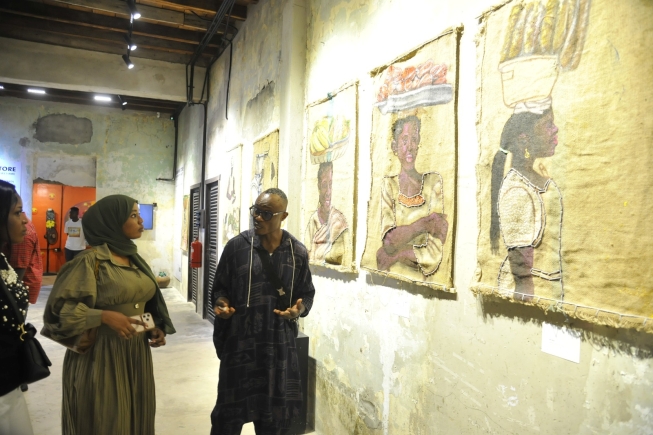
In the heavy traffic of Accra, where street hawkers often go unnoticed or are viewed as a nuisance by motorists, Ghanaian artist Nicholas Tettey Wayo sees something different: resilience, ingenuity and an essential service that keeps the city moving.
Popularly known as Nico Wayo, the internationally recognised, largely self-taught artist is bringing the lives and livelihoods of Ghana’s street hawkers into focus through his thought-provoking exhibition, Apampam Store, which opened at the Christiansborg Archaeological Heritage Project Centre in Osu, Accra.
Translated as “Shop on the Head”, the month-long exhibition celebrates the men and women who navigate the city’s busy roads with goods balanced on their heads, providing convenient access to food and refreshments for motorists and passengers caught in traffic.
From sobolo and kelewele to groundnuts, pawpaw, FanYogo, popcorn, bofrot, meat pies and plantain chips, these vendors have become a familiar feature of Accra’s urban landscape. Yet, beyond their daily transactions lies a story of perseverance, survival and economic enterprise that often receives little attention.
“We call them hawkers. I call them life savers,” Wayo says in his exhibition statement. “This work archives their hustle as art. They don’t just sell in traffic. They save us in traffic.”
Turning everyday hustle into art
Wayo’s inspiration comes from his everyday encounters with street vendors while riding through Accra on his motorbike. These encounters have fostered an artistic appreciation for people whose determination to earn a living takes them into some of the city’s busiest and most challenging spaces.
For the artist, Apampam Store is not an appeal for sympathy. Rather, it is an invitation to recognise the agency, creativity, resilience and dignity of people who work under difficult conditions to support themselves and their families. “You may be hungry. You may be thirsty. They are always there to serve you, to save you. They keep running, following cars. We need to respect them,” he says.
The exhibition challenges visitors to look beyond the familiar image of a hawker approaching a vehicle in traffic and consider the individual behind the merchandise: a person working to make a living and contributing to the informal economy.
Discarded sacks become historical records
One of the exhibition’s most distinctive features is Wayo’s decision to paint on discarded jute sacks rather than conventional canvases. The sacks, which previously served as packaging for commodities, retain their original printed names, ink stains and other markings. Instead of removing these traces, the artist incorporates them into the finished works.
“I like the natural look because it speaks of what the sack has served as. You can still see the names in ink. I deliberately don’t clean them away,” Wayo explains. “Each sack becomes both a canvas and an archive.”
This approach connects the materials used in the artwork with the stories being told. The discarded sacks bear evidence of their previous uses, while the paintings give them a new purpose as artistic records of everyday Ghanaian life. By transforming an overlooked material into a medium for documenting street hawkers, Wayo brings together upcycling, social observation and contemporary Ghanaian art.
The result is an exhibition that invites audiences to reflect on the relationship between art, labour, identity and the everyday experiences that shape urban life.
Heritage, art and community engagement
The exhibition is hosted by the Christiansborg Archaeological Heritage Project (CAHP), a non-profit organisation based in Osu. CAHP focuses on community engagement and transformative change through archaeology, heritage, art and education. Its work emphasises community development, revitalisation, diversity, inclusion and dialogue as foundations for building a more resilient future for Osu.
The exhibition provides a platform for artistic expression that engages with the experiences of ordinary people and encourages audiences to reconsider aspects of society that are often taken for granted.
The Director of CAHP, Professor Rachel Engmann, said the organisation was delighted to host Wayo’s first solo exhibition at the centre. She said the artist’s practice resonated deeply with their commitment to community-engaged work, particularly in making visible the people, histories and everyday experiences that are often overlooked.
An invitation to see differently
At its heart, Apampam Store is about recognition. Street hawkers are often encountered briefly through car windows, during traffic jams or at busy intersections. Their work is visible, but their personal stories, determination and contributions can easily be overlooked.
Wayo’s exhibition challenges that indifference, asking viewers to look more closely at the people who have become part of Accra’s daily rhythm. His message is captured in a simple but powerful statement: “Society looks past them. I look at them.”
Through this exhibition, Wayo transforms the ordinary into something worthy of attention, reminding visitors that the people who serve a city every day deserve to be seen, understood and respected.
