
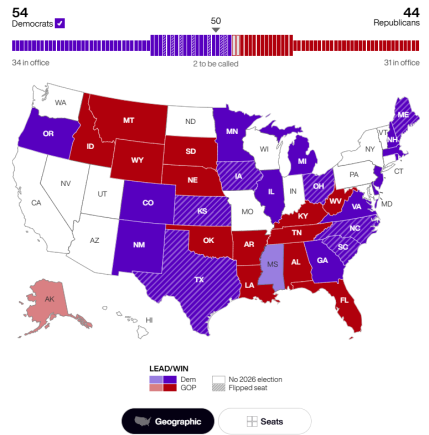
The November 3, 2026, United States midterm elections delivered a sweeping structural rejection of the governing executive coalition, handing the Democratic Party commanding majorities in both the House of Representatives and the U.S. Senate.
However, these elections transcended conventional referendum politics, evolving into a systemic constitutional realignment. Driven by domestic economic anxieties, persistent inflation pressures, and widespread voter fatigue regarding unilateral executive maneuvers, the electorate awarded the Democratic Party control of the House of Representatives and engineered a striking majority in the Senate. Surprising insurgent and mainstream Democratic victories across traditional red-state battlegrounds; including historic Senate pickups in Texas (James Talarico), Ohio (Sherrod Brown), Kansas (Adam Hamilton), North Carolina (Roy Cooper), Iowa (Josh Turek), and Maine (Troy Jackson) shattered the assumption of an unassailable populist conservative coalition.
In the study of American statecraft, domestic electoral shifts are rarely isolated from external posture. Foreign policy is the domestic projected outward; a shift in legislative authority alters the perceived credibility, financial pipeline, and legal ratification of U.S. international commitments. Applying a neoclassical realist framework, this piece argues that the 2026 midterms close the window on unchecked executive discretion, forcing a recalibration toward institutional inter-branch bargaining. Consequently, foreign partners and adversaries alike face a paradoxical United States: an executive branch eager to project strength abroad, chained to a legislative branch wielding the power of the purse and the constitutional privilege of 'Advice and Consent' (art. II, §2).
Neoclassical Realism and Institutionalism in Divided Government
To comprehend how a post-2026 Congress impacts foreign policy, one must move past crude dichotomies of 'isolationism' versus 'internationalism.' Instead, international relations must be viewed through the lens of neoclassical realism, which posits that systemic pressures (such as the rise of China or instability in Europe and the Middle East) are filtered through domestic state structures, elite cohesion, and institutional friction (Lobell, Ripsman, & Taliaferro, 2009). When control of Congress flips against a sitting president, the 'two-presidencies' thesis; first articulated by Aaron Wildavsky (1966) undergoes severe stress. While Wildavsky argued that presidents enjoy broader latitude in foreign policy than in domestic policy, subsequent scholarship demonstrates that divided government reasserts legislative power precisely when foreign commitments require sustained multi-year fiscal appropriations or formal treaty ratifications (Lindsay, 1994).
Furthermore, liberal institutionalism (Keohane, 1984) provides insight into how committee chairs in the Senate Foreign Relations Committee and House Committee on Foreign Affairs can institutionalize norms, compel executive transparency, and block arbitrary pivots away from multilateral security architectures like NATO. The 2026 outcome ensures that international agreements will no longer be treated as personal extensions of executive whim, restoring a procedurally cumbersome yet structurally resilient constitutional design.
How a Democratic Congress Restrains Executive Command
The constitutional mechanisms available to the 110th/120th Congress under Democratic control are profound and immediate. They manifest across three primary vectors: the power of the purse, advice and consent for appointments, and rigorous structural oversight.
Article I, Section 9 of the U.S. Constitution vests Congress with the exclusive power of appropriation. Executive foreign policy announcements, whether regarding emergency security assistance, defense modernization, or foreign aid packages—are toothless without statutory authorization. A Democratic-controlled House and Senate can mandate baseline funding floors for European defense cooperation and Ukraine’s multi-year resilience, re-channel or condition discretionary executive funds earmarked for unilateral border enforcement or extra-legal operational maneuvers, and utilize line-item authorization hearings to audit executive spending in contested theaters.
With the Senate under Democratic leadership, executive nominations for ambassadorships, assistant secretaries of state, and defense-related positions face heightened ideological and procedural scrutiny. Controversial nominees who favor retrenchment, transactional bilateralism, or executive aggrandizement will encounter committee stalls, filibusters, or outright rejections. Moreover, any formal or informal security pacts negotiated by the executive require legislative backing to survive transition cycles, preventing short-term electoral shifts from permanently dismantling long-standing alliances.
Congressional committees possess subpoena power that can expose internal executive deliberations, intelligence assessments, and back-channel diplomacy. Post-election committees are poised to launch rigorous oversight into past executive entanglements, immigration enforcement overreaches, and opaque commercial dealings involving executive aides (CNBC, 2026). This constant oversight imposes an 'institutional tax' on executive time and political capital, limiting the administration's bandwidth for bold, uncoordinated foreign adventures.
Transatlantic, Middle Eastern, and Indo-Pacific Reorientations
During the pre-election phase, European capitals braced for potential U.S. disengagement from NATO or the curtailment of collective defense guarantees. The 2026 Democratic congressional victory fundamentally stabilizes the transatlantic bridge. Bipartisan and Democratic majorities in Congress have historically codified support for Article 5 commitments. Legislative resolutions will likely reaffirm ironclad backing for NATO’s eastern flank. While Congress will insist that European allies assume a greater share of conventional deterrence costs, the wholesale unilateral withdrawal of U.S. intelligence, logistical, and nuclear umbrella assets is off the table. European defense planners can project multi-year procurement cycles with renewed confidence in American legislative backing.
The Middle East remains a volatile nexus of asymmetric conflict, maritime chokepoints, and shifting regional alignments. Ongoing security challenges in the Strait of Hormuz and Red Sea require steady naval presence and congressional authorization for sustained kinetic operations. A Democratic-led Congress is positioned to demand strict adherence to the War Powers Resolution of 1973, reining in undeclared or mission-creep military engagements. Rather than uncritical alignment with maximalist regional strategies, congressional foreign policy committees will push for a dual-track approach: robust deterrence against non-state actors and renewed diplomatic engagement concerning humanitarian corridors and regional de-escalation frameworks.
Unlike European policy, where partisan splits occasionally surface over aid sequencing, the strategic competition with the People’s Republic of China (PRC) remains one of the few areas of profound bipartisan consensus in Washington. Congressional funding for the AUKUS submarine pact, semiconductor supply chain security (CHIPS-related extensions), and Indo-Pacific maritime posture will proceed with robust cross-aisle backing. A Democratic Congress, however, is likely to re-inject human rights metrics, labor standards, and climate-security cooperation into the broader China competition strategy, moving away from pure transactional tariff hostility toward a more institutionalized, multilateral alliance network involving Japan, South Korea, Australia, and ASEAN partners.
Hegemonic Credibility and the 'Dual-Track' Paradox
The central tension of American foreign policy in the wake of the 2026 midterms is the structural divide between an executive eager to project immediate, personalized authority and a legislature demanding institutional predictability. In International Relations theory, credibility depends on two variables: capability and resolve (Schelling, 1960). While U.S. material capabilities remain unrivaled, the resolve of the American state has been called into question by erratic domestic polarization. Allies and adversaries alike observe a state at war with itself—where executive decrees can be starved of funds or investigated into paralysis by a hostile Congress.
This dynamic creates a dual-track foreign policy: an Executive Track characterized by high-visibility rhetoric, summitry, and attempts to use executive orders or emergency declarations to shape foreign outcomes; and a Legislative Track characterized by slow, deliberate budgetary restraint, statutory conditionality, human rights vetting, and alliance reinforcement. Rather than weakening American power, this friction can be reinterpreted through a functionalist lens as a stress-test that prevents catastrophic, unconstrained overreach. As historical precedents from the post-Watergate and post-1994 congressional eras demonstrate, a resurgent Congress often forces the executive branch to build broader domestic consensus before committing blood and treasure abroad.
Conclusion
The 2026 U.S. midterm elections have re-imposed the founding architects' design of separated institutions sharing power. By handing control of both chambers of Congress to the Democratic Party, the American electorate rejected unchecked executive dominance and set new boundaries for U.S. global engagement.
For the remainder of the Trump presidential term, American foreign policy will not be defined by radical isolationism nor by imperial unilateralism. Instead, it will be forged in the crucible of institutional negotiation. European allies will find a reliable legislative anchor; Indo-Pacific strategies will maintain structural momentum while incorporating multilateral standards; and Middle Eastern policies will be subjected to rigorous legislative oversight and War Powers discipline. Ultimately, the 2026 outcome reaffirms an enduring truth of American grand strategy: the durability of U.S. foreign policy depends not on the unchecked will of a single leader, but on the enduring constitutional equilibrium of the republic.
References
Associated Press. (2026). Live results: 2026 U.S. midterm elections and balance of power in Congress. AP News. https://apnews.com/article/midterm-election-house-senate-democrats-republicans-trump
British Broadcasting Corporation [BBC News]. (2026). Live updates: Democrats win US House and Senate in midterm elections. BBC. https://www.bbc.com/news/live/cj1dw0ydn595t
CNBC Election Desk. (2026). Midterm elections 2026 live updates: Democrats flip Congress as voters deliver stark rebuke. CNBC. https://www.cnbc.com/2026/11/04/2026-midterm-election-results-live-updates.html
Keohane, R. O. (1984). After hegemony: Cooperation and discord in the world political economy. Princeton University Press.
Lindsay, J. M. (1994). Congress and the politics of U.S. foreign policy. Johns Hopkins University Press.
Lobell, S. E., Ripsman, N. M., & Taliaferro, J. W. (Eds.). (2009). Neoclassical realism, the state, and foreign policy. Cambridge University Press.
NBC News. (2026). U.S. Senate and House Election 2026 live results: Democrats win majority. NBC News. https://www.nbcnews.com/politics/2026-elections/senate-results
Rose, G. (1998). Neoclassical realism and theories of foreign policy. World Politics, 51(1), 144–172.
Schelling, T. C. (1960). The strategy of conflict. Harvard University Press.
Schweller, R. L. (2006). Unassailable power: The politics of security and the rise of major powers. Cornell University Press.
Wildavsky, A. (1966). The two presidencies. Trans-Action, 4(2), 7–14.

Lord Mawuko-Yevugah
The author, Lord Mawuko-Yevugah is a Cambridge educated Commonwealth Scholar and globally recognized expert of international relations and comparative political economy. He is currently an Associate Professor at the Ghana Institute of Management and Public Administration (GIMPA) where he previously served as the founding Head of Department for Public Management and International Relations. He is the Founder and Lead Researcher of the Pan-Africanist Centre for African Diplomacy and Global Engagement (Afro-global). He is also the Founder and Convener of the International Relations and Diplomacy Network Ghana (IRDNGhana). He is the author of many ground-breaking intellectual works, including Independency: Political Independence and Economic Dependency in Ghana (2025); Theories of International Relations: Contending Approaches to Global Politics (2026); and Elements of Foreign Policy Analysis: Actors, Theories and Cases (2026).
