
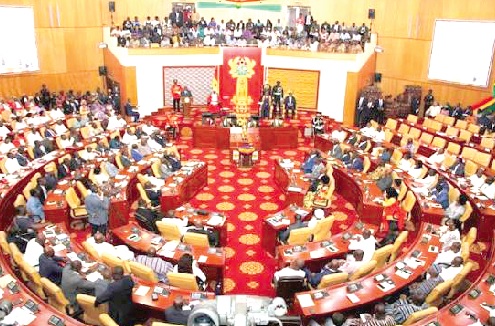
FOLLOWING deliberation by the Committee on Constitutional, Legal and Parliamentary Affairs, the Tribunals Bill 2026 received approval on July 17, 2026, paving the way for the reintroduction of tribunals.
Legal experts express differing opinions on the bill’s potential consequences. It remains to be seen whether President Mahama will sign the bill into law.
Parliament’s approval of the Tribunals Bill 2026 has reignited discussions regarding the reestablishment of a justice system that was prevalent during the Provisional National Defence Council (PNDC) era.
Tribunals are controversial due to painful historical memories of human rights abuses, modern fears of political weaponisation, and intense parliamentary division following the bill’s passage.
Proponents argue that tribunals are constitutionally backed and will relieve the heavily backlogged mainstream court system.
Critics fear they create a parallel, compromised justice system. The primary difference between the old and new tribunals is that modern public tribunals operate as part of the constitutional judiciary, whereas PNDC-era tribunals operated as a parallel, extra-judicial system.
Public Tribunals and the PNDC
Many Ghanaians associate the original ‘people’s tribunals’ with rapid, arbitrary executions, asset seizures and intimidation.
Critics contend that the ‘people’s tribunals’ subverted due process: explicitly dismissive of ‘legal technicalities’, the tribunals allowed people to be convicted on the sole testimony of a single witness, which led to widespread institutional injustice.
Public tribunals were instituted under PNDC Law 24 in 1982. They functioned alongside the regular courts, addressing cases related to economic crimes, corruption and offences against the state.
According to a January 1982 report in West Africa magazine, the PNDC’s aim was that the tribunals would ‘try crimes against the state … [which] would not be fettered by technical rules, which in the past prevented the course of justice and enabled criminals to go free’.
The PNDC leader, Jerry John Rawlings, claimed that the tribunals’ work would be public and the ‘dispensation of justice would be democratised’.
PNDC-era tribunals were established to deal with three problems in the administration of justice: sluggishness, cumbersome procedures and inflexibility.
Addressing a workers’ rally in Koforidua in February 1982, PNDC member Chris Atim claimed that the judicial system was discriminatory, favouring the rich. He stated that ‘there cannot be any confidence in a judicial system which commits a poor man who steals a few cedis to jail, and sets free a rich man who steals millions … We will not allow ourselves to be bamboozled with legal arguments by lawyers anymore’.
According to the late political scientist, Emmanuel Hansen, Atim’s view of the legal system was shared by many ‘ordinary’ Ghanaians who believed that courts were not centres of the administration of justice but mechanisms for enforcing class principle and instruments by which the ruling class held on to power.
Public Tribunals and the Mahama government
During PNDC military rule in the 1980s and early 1990s, public tribunals were completely independent of the traditional courts, lacked standard judicial oversight, and were heavily criticised for political manipulation and human rights abuses.
The Tribunals Bill 2026 seeks to establish the capacity to alleviate court backlogs within the democratic framework of the 1992 Constitution.
Thus, a key difference between the PNDC-era tribunals and those of today is that the former were not bound by a democratic constitution, while the modern ones are.
Despite the democratic context of the Tribunals Bill 2026, historical anxieties have been reignited.
The Minority caucus in Parliament has strongly rejected the bill, staging a parliamentary walkout and calling it a ‘backward step’.
Opposition figures and the New Patriotic Party communication team have publicly warned that the current government could use these tribunals to bypass traditional courts and target political opponents.
Critics have urged President John Mahama not to sign the bill into law to protect national unity and prevent a regression into selective justice.
Controversy likely to continue
The National Democratic Congress (NDC) sees things differently. NDC Deputy Director of Elections, Rashid Tanko, has defended the bill’s passage, asserting that the new tribunals are intended to tackle contemporary justice challenges.
According to Mr Tanko, ‘The tribunals that happened during the PNDC era are not what is going to happen now. In fact, every Ghanaian must be happy it is coming back’.
Mr Tanko elaborated that the reinstated tribunals would alleviate the burden on the conventional courts and facilitate faster access to justice for particular types of cases that pertain to public interest and state issues.
Despite attempts to assuage the fears of the NPP and others opposed to the bill, the controversy surrounding the Tribunals Bill 2026 is likely to persist as Ghanaians seek to understand how the new tribunals could reconcile the need for expedited justice with the principles of judicial independence and safeguarding of citizens’ rights.
The writer is Emeritus Professor of Politics, London Metropolitan University, UK
