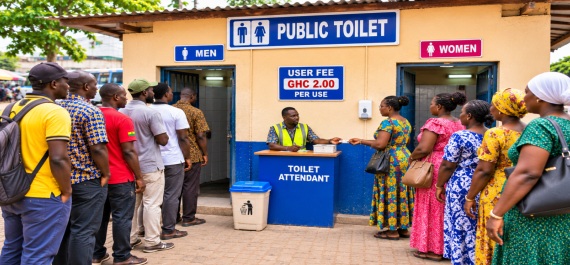
The real measure of a decent home is not simply the roof over its occupants’ heads, but whether the household can meet its most basic needs safely, privately and with dignity. Ghana’s sanitation challenge therefore requires more than additional public toilets. It requires a change in the way we understand the relationship between housing, health and personal responsibility.
One of the popular Fante proverbs captures the cultural meaning of sanitation with admirable simplicity: “Fie pa yɛ ahotɔ fie” — a good home is a home of comfort and cleanliness. It expresses a principle that should sit at the centre of Ghana’s sanitation transformation: a home cannot fully offer comfort when the people who live in it have no safe and dependable place to relieve themselves.
If a good home is indeed a home of comfort and cleanliness, then a toilet should be regarded as part of the essential fabric of that home, not as a facility to be found somewhere outside it. Ghana must gradually move from the familiar question, “Where is the nearest public toilet?” to a more fundamental expectation: “Where is the toilet in this house?”
That change may appear modest, but its implications are considerable. It challenges an established pattern of domestic sanitation in which households depend on facilities owned or managed by others, and in which public toilet provision is sometimes treated as an acceptable substitute for adequate housing. The issue is not that public toilets have no place in a modern society. They are indispensable in markets, transport terminals, parks and other public spaces.
The difficulty arises when they become the default answer to the everyday sanitation needs of entire households.
The question, therefore, is not simply how many public toilets a municipality can build. It is whether the country is creating the conditions in which every household can access a safe, functional, affordable and appropriate toilet of its own.
The 2021 Population and Housing Census provides a more detailed picture of the challenge than a single national headline figure can convey. Of approximately 8.36 million households covered in the Ghana Statistical Service sanitation analysis, 17.7 per cent had no toilet facility, while 23.1 per cent mainly used public toilets. A further 59.3 per cent used household toilet facilities. Yet, even within this last group, more than half shared their facility with other households.
These figures point to a problem that extends beyond open defecation. A substantial number of Ghanaian households remain dependent on toilets they neither own nor fully control. Shared facilities may provide an important service, but they do not always offer the privacy, convenience, reliability or degree of household control associated with a toilet within the home.
This distinction matters for policy. If success is measured only by the reduction of open defecation, important dimensions of the sanitation challenge can remain hidden. The national objective must be broader: to establish household access to safe, functional and appropriate sanitation as an ordinary feature of decent housing.
The geographical distribution of the challenge reinforces the point. GSS reports that 31.3 per cent of rural households practise open defecation, compared with 8.9 per cent of urban households. The lower urban percentage should not be mistaken for a negligible problem. Given the size and density of urban populations, the census reported approximately 449,849 urban households without toilet facilities and about 1.3 million urban households using public toilets.
The census also looked beyond the simple category of households without toilets. Its expanded sanitation questionnaire recorded whether people used chamber pots, polythene bags, beaches or water bodies, or bush, open fields and gutters. In most regions, bush, open fields and gutters were the predominant locations. In some coastal regions, beaches and water bodies also featured prominently. The picture is therefore not uniform; the form of deprivation varies across communities and requires responses informed by local conditions.
There is an economic argument for household toilet ownership that deserves greater attention. Public toilets often require users to pay at each visit. Consider a household of six in which each member pays GHS2 for one visit a day. The household would spend GHS12 daily, approximately GHS360 in a 30-day month and GHS21,600 over five years. This illustration excludes inflation and additional visits.
The calculation does not, on its own, establish that constructing a household toilet will always cost less; construction costs, maintenance, household circumstances and the suitability of the technology must also be considered. It does, however, expose an important policy question. Repeated payments for an essential daily service can become a substantial and continuing burden, particularly for low-income households.
Household sanitation expenditure should therefore be understood not merely as a recurring cost, but as a potential investment in domestic infrastructure. Where a suitable system can be safely installed and maintained, the household gains an asset that offers greater control over access and reduces dependence on repeated user charges. The economic case is not simply about money saved; it is also about the value of convenience, time, privacy and reliability.
The health case is equally important. High-use communal facilities can face persistent hygiene and maintenance difficulties, particularly where water, cleaning materials, handwashing facilities and effective management are inadequate. Household toilets can give residents greater control over cleanliness and availability, although ownership must always be accompanied by proper use, cleaning, maintenance and safe management of waste.
The benefits are especially significant for children, older persons, persons with disabilities and people who are unwell. A facility that is close, accessible and suitable for the needs of household members can reduce the physical and practical difficulties associated with travelling to a distant or crowded public toilet.
Privacy and personal security provide another compelling reason. A toilet within or immediately adjacent to the home reduces the need to walk to a separate facility, particularly after dark. For women, girls and other vulnerable household members, that proximity can reduce exposure to unsafe routes and poorly lit surroundings. Sanitation must therefore be understood as part of personal security and human dignity, not merely as the management of human waste.
A toilet is, in this sense, more than a piece of infrastructure. It is a daily expression of whether a home has been planned around the basic needs of the people who occupy it. The absence of one can affect health, privacy, household expenditure and the dignity with which ordinary life is lived.
Several interconnected factors continue to sustain dependence on public toilets. The first is weak enforcement of housing and sanitation standards. Where rental accommodation is provided without adequate toilet facilities, tenants may have little choice but to depend on public or shared services, often at considerable recurring cost. Metropolitan, municipal and district assemblies must therefore treat household sanitation as an integral element of housing regulation, rather than as an environmental health matter to be addressed only after occupation.
Landlord accountability is central to this effort. Designated toilet spaces should not be converted into additional bedrooms or commercial areas simply to increase rental income. Building approvals, inspections and enforcement must work together to ensure that the provision of adequate sanitation is not sacrificed to short-term property interests.
The second constraint is geographical and engineering-related. In low-lying coastal communities and other flood-prone settlements, shallow groundwater and unstable soils can make conventional pit systems unsuitable or unsafe. In parts of northern Ghana, rocky or hard soils can make excavation costly. These realities make a uniform national technology prescription impractical. Sanitation systems must be selected in response to local hydro-geological conditions, available space, water access and the capacity to manage the resulting waste safely.
The third constraint is affordability. Many households understand the value of having a toilet but cannot meet the upfront cost of construction. Inflation, transport charges, material prices and limited access to sanitation-specific credit can widen that gap. The policy challenge is to make appropriate household systems financially attainable without encouraging poor-quality construction or unsafe disposal.
Ghana’s transition from public toilet dependence to household ownership must begin with a deliberate behavioural reorientation. Communication should present a household toilet as a feature of a dignified, well-managed and protective home. The message should be positive and aspirational, rather than relying principally on shame, blame or fear. The objective is to make household sanitation a widely shared social expectation.
But behaviour does not change through communication alone. Citizens may be encouraged to build toilets, yet their choices will remain constrained if suitable technologies, reliable artisans, finance and effective regulation are unavailable. The institutional environment must make responsible household action possible.
Technology choice should therefore be the second pillar. Compact Biofil-type systems may be considered for suitable urban compounds where space is limited. Sato pans, improved pits and other appropriate options may serve rural and water-constrained communities. These are examples, not universal prescriptions. Each technology must be assessed against soil conditions, groundwater levels, flood risk, maintenance requirements and safe effluent or sludge management. Ghana’s 2021 census recognises a range of containment and user-interface technologies, including septic tanks, KVIPs, pit latrines, biodigesters and other systems.
Flexible finance must form a third pillar. The just ended Greater Accra and Greater Kumasi metropolitan sanitation and water projects demonstrated how public financing can help stimulate household toilet acquisition, particularly among low-income urban residents. The World Bank-supported programme has specifically assisted thousands of household toilets for low-income urban populations. Such interventions point to the value of reducing the upfront financial barrier while supporting the development of household assets.
This approach can be strengthened through appropriately designed sanitation loans, Village Savings and Loans Associations and rural-bank products. Subsidies should be directed towards households that genuinely cannot afford construction, while households with greater financial capacity should contribute according to their means. The purpose of public support should be to close an affordability gap, not to replace household responsibility where that responsibility can reasonably be exercised.
A fourth pillar is landlord accountability. MMDAs should consistently enforce sanitation requirements in rental properties, prevent the conversion of designated toilet spaces and make compliance a meaningful part of housing inspection. Public toilets should remain available where public demand requires them, but they should not become permanent substitutes for adequate domestic facilities.
The fifth pillar is data-driven accountability. Ghana’s 2021 Population and Housing Census provides useful information on toilet types, sharing arrangements and reported defecation points. This offers a foundation for more systematic household-level monitoring. Environmental Health Officers can use geospatial tools to identify communities with persistent service gaps, track the construction and functionality of household toilets, and monitor communities declared open-defecation-free to identify and respond to possible relapse.
The central question for Ghana is no longer simply how many people practise open defecation. It is how many households have access to a safe, functional, affordable and dependable toilet that they can regard as their own. That requires a shift from a narrow focus on open-defecation reduction towards a sustained national movement for household sanitation.
It also requires more careful measurement. A toilet recorded as present is not necessarily safe, functional, accessible or properly maintained. A facility may be shared by several households; another may be unsuitable for the local soil or groundwater conditions. Progress must therefore be judged not only by the number of facilities constructed, but by whether they are used, maintained and safely managed, and whether they meet the needs of the people expected to rely on them.
This is where the responsibilities of national institutions, MMDAs, landlords, households, financial institutions, technology providers and environmental health professionals converge. No single intervention will deliver the transformation. Behaviour change without finance will leave poorer households behind. Construction without technical guidance can create unsafe systems. Laws without consistent enforcement will remain declarations on paper. Data without follow-through will describe the problem without resolving it.
Ghana does not need to abolish public toilets, nor should it underestimate their importance in genuinely public places. It needs to clarify their proper role. Public facilities should serve public spaces; household facilities should meet the everyday domestic needs of families. That distinction is essential to a sanitation system built around dignity, responsibility and sound public health.
The ambition should be to make access to a safe and functional toilet an ordinary component of decent housing. By 2040, or thereabout, every Ghanaian household should be able to access an appropriate facility, with household toilet ownership recognised not as a luxury or status symbol, but as a basic element of public health, personal security and human dignity.
Ultimately, the transition from public latrines to private dignity is about more than where people relieve themselves. It is about the kind of homes, communities and society Ghana wishes to build. A country that expects families to live with dignity must ensure that the basic conditions of dignified living are within their reach. The true test of sanitation progress is not merely the number of public toilets provided, but how many households can meet this most personal of human needs safely, privately and dependably.
The writer is a Fellow of the West African Postgraduate College of Environmental Health (WAPCEH)
E-mail: