
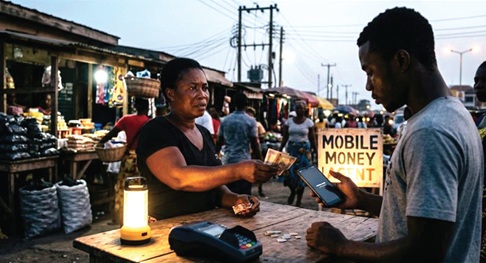
There is a question I have carried through twenty-two years of trading fuel in West African markets and years of living abroad: What is money when everything around it fails?
I studied money formally in Basel, and I have traded it in the markets of West Africa. The two taught me the same lesson.
We are told there will be no more paper currency.
The prediction is probably right about the direction. But a prediction about the form of money tells us nothing about its substance, and that is where the thinking should begin.
A promise you cannot hold
Hold a cedi note up to the light. It is paper, worth almost nothing as material.
It is accepted only because everyone believes everyone else will accept it. Money, at bottom, is shared belief with a government stamp on it.
Now move that belief onto a screen. The belief is the same, but you can no longer hold it.
It exists only as an entry in a ledger that someone else keeps, on a network someone else runs, under rules someone else can change.
You do not possess digital money in the way you possess a note.
You hold a permission, and permissions can be withdrawn.
That is the first thing to think about.
In a cashless world, what do you own and who decides?
The test of the dark
I remember the day the Internet went down, and people could not withdraw their money.
Traders stood helpless, and families who needed cash that day had wealth they could see in an app but not touch.
It lasted hours, and it taught more than any lecture on monetary theory.
When the 2024 cable damage hit West Africa, the whole region saw how thin the thread is.
A system that works perfectly until the moment you need it most is not a safe system. It is an untested one.
So here is a question for the designers of the cashless future.
If your system only works when the power, the cables, the servers and the officials all behave, what will you offer the citizen on the day any one of them does not?
The thief who never sleeps
In Ghana, we do not need theory about digital theft.
The "wrong transfer, please return it" message, the false call from the network, the swapped SIM and the dishonest agent are part of daily life.
Convenience and crime came in together.
Digital money is fast, which is its virtue and its danger.
A thief who once needed a night and a crowbar now needs a minute and a phone.
And the victim, once the money has moved, often finds that the system built for speed has no equal gift for recovery.
Should we not insist that safety be built before we ask a nation to give up its safeguard of last resort?
The oldest question in economics
Behind all of this sits a question older than any currency: why does money keep losing its value?
Over the decades, the cedi has fallen against the dollar, and the person who saved faithfully paid for it.
Not because they did anything wrong, but because they were far from the place where new money enters the economy.
The first to receive it spend it at yesterday's prices.
Everyone else meets it later, at higher prices.
This is the quiet mechanism economists call the Cantillon effect: those who hold money pay, those who create it gain, and no invoice is ever sent.
I say plainly what many hesitate to say.
Money whose supply can be expanded at the will of its issuer, with nothing harder than a promise to restrain it, carries a built-in temptation. Sometimes the issuer resists it for decades. Often it does not.
Calling that arrangement a scam is my judgment, and you may call it a design flaw if you prefer.
The saver's loss is the same either way.
The fair objection
Honesty requires that I give the other side its due.
Gold and silver are not magic. Supply is limited by mining, which can punish growing economies with deflation.
Reserves must be stored, audited and guarded by someone, and that someone must be trusted.
Governments have seized gold before. In 1933, Americans were ordered to surrender theirs, and in 1971, the dollar's link to gold was severed when it became inconvenient.
Does that defeat the argument for backed money?
I think it sharpens it.
Those episodes show that backing means little when the institution behind it is unaccountable.
The lesson is not that discipline is impossible, but that discipline needs structure: open reserves, independent audits, and hard limits on what the issuer may create.
The question underneath
Strip away the technology and the debate is not about paper versus screen.
It is about three things.
Who holds the power? A note passes from hand to hand with no one's approval.
Programmable money can be limited, tracked, timed or frozen.
Even if today's officials are wise, we are building a tool that tomorrow's officials will inherit.
Systems should be judged by what they allow the worst people in office to do, not the best.
What stands behind the value? If the answer is only "trust us," then we have changed the container and kept the weakness.
Ghana produces gold, cocoa and oil. A nation rich in real things must ask why its savings should rest on promises alone.
Where is the exit? Every sound system keeps a door open. Cash is that door.
It works offline, without a password and without permission. Remove it, and the citizen's last independent option goes with it.
What should be done
Keep cash as legal tender and forbid its refusal.
Build any digital currency as an addition to cash, with offline function from day one.
Strengthen mobile money fraud protection, with faster reversals and real accountability, before pushing more people into the system.
And begin the national conversation we keep postponing: what should stand behind the cedi?
The last thought
Technology gives us faster ways to move money.
It has never given us a way to avoid the oldest question: whom do we trust and why?
If paper currency disappears, let it be because we have built something more trustworthy, not merely more convenient.
A nation should never be asked to trade its last offline safeguard for a promise it cannot touch.
The screen will go dark again someday, as screens do.
The measure of a monetary system is whether the people are still standing when it does.
