
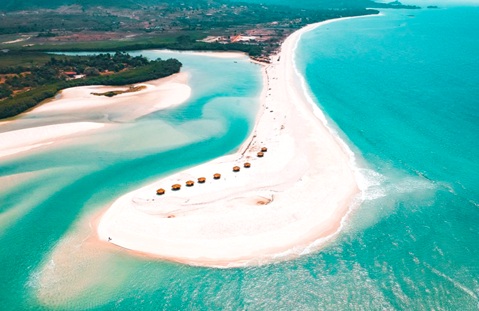
For years, Sierra Leone’s tourism story has largely been told through its beaches.
And rightly so. River No. 2, Bureh, Tokeh and Lumley remain among the most attractive stretches of coastline in West Africa.
But there is considerably more to Sierra Leone than its spectacular beaches.
In recent years, the country has been steadily broadening its tourism proposition, and this year, in particular, is shaping up to be an important one for culture, creativity, gastronomy and Meetings, Incentives, Conferences and Exhibitions (MICE) tourism.
As confirmation of this, over the next five weeks, Freetown and Lungi will host three events that show a destination deliberately reaching beyond sun and sea into music, food, investment and business events.
From November 17 to 18, the West Africa Integration and Investment Summit take place at the Julius Maada Bio International Conference Centre (JMBICC) in Lungi.
From November 25 to 30, Freetown hosts the second edition of the One Nation Reggae Festival. Then, from December 2 to 4, the JMBICC welcomes Africa’s tourism ministers, chefs and policymakers to the 3rd UN Tourism Regional Forum on Gastronomy Tourism for Africa.
A theme for every year
Since 2024, the Ministry of Tourism and Cultural Affairs has given each year a single organising theme: “Tourism for All in 2024, the Year of Ecotourism in 2025 and the Year of Culture and Creativity in 2026.”
The Minister, Nabeela Farida Tunis, explained the thinking at the 9th UNCTAD World Investment Forum in Doha earlier this week.
“Our Tourism for All campaign, 2025 Year of Ecotourism and 2026 Year of Culture and Creativity reflect a deliberate effort to bring communities into tourism and ensure they share in its benefits,” she said.
The first theme built public awareness and a brand.
The second put natural assets on the map, among them Tiwai Island, which was inscribed on the UNESCO World Heritage List in 2025.
The third has made the people themselves, with their music, food, fashion and heritage, the product.
Reggae and the road home
Few capitals carry the story of return like Freetown.
The city was settled from 1787 by formerly enslaved people and their descendants.
They included Jamaican Maroons, whose St John’s Maroon Church still stands in the city centre.
The One Nation Reggae Festival builds on that history, using a music born in Jamaica to reconnect Africa and the Caribbean.
The inaugural edition in 2025 brought Sizzla Kalonji, Christopher Martin and Queen Ifrica to Freetown.
It also hosted a Creative Clinic for cultural custodians, policymakers, creatives and the diaspora. Its conversations became the Creative Clinic Report, a rare example of a festival feeding directly into policy.
Volume 2 raises the stakes, with Busy Signal headlining a line-up that includes Queen Ifrica, Senegal’s Didier Awadi and South Africa’s Nkulee Dube.
With Bunce Island, a former slave-trading fort, a short boat ride away, the festival is as much roots tourism as it is a concert.
Putting food on the map
The Gastronomy Forum may prove the more consequential event. Minister Tunis secured the hosting rights for the second edition in Arusha, Tanzania, in 2025, following the inaugural forum in Victoria Falls, Zimbabwe, in 2024.
It is a smart bet. UN Tourism estimates that gastronomy accounts for more than a fifth of global tourism spending.
A single plate of cassava leaf or groundnut soup involves a farmer, a fisher, a market trader and a cook.
The Year of Culture and Creativity logo deliberately counted local cuisine as a living expression of culture.
The timing is equally deliberate. A visitor who arrives for the reggae festival can stay on for the forum, turning two events into one extended trip.
A venue with a purpose
The common thread is the JMBICC. It was commissioned on July 18, 2026, beside the modernised Freetown International Airport and hosted the 69th ECOWAS Summit the next day.
The airport sits across the estuary from the capital, a problem that long frustrated Sierra Leone’s ambitions for meetings. Delegates can now land and be in a plenary hall within minutes.
“I want people to understand that Sierra Leone is an emerging destination with a lot to offer,” the Minister said of the investment summit.
“It is a good opportunity to continue the conversation and explore multiple opportunities.”
The demand is there. At ITB Berlin in 2025, 220 visitors to Sierra Leone’s stand asked specifically about business events.
Freetown has also become the long-term finish line of the Budapest-Bamako Rally, which brought more than 1,200 participants this year.
Lessons for the region
None of this means the work is done. Air travel within the region remains expensive, road access to provincial attractions is uneven, and hosting a conference is not the same as winning repeat business.
Sierra Leone will need a dedicated convention bureau to package venues, hotels and incentives for meeting planners, a lesson Ghana and other West African nations have yet to fully learn.
But the direction is clear. Under Nabeela Tunis, Sierra Leone has stopped simply asking the world to visit its beaches.
It has started giving the world reasons to come for its music, taste its food, meet in its halls and invest in its future.
For a country once known to the world mainly through hardship, that is a remarkable change of narrative.
Its neighbours would do well to take note.
