
Magine a Ghanaian family selling a house that took three generations to build.
It holds land, concrete, steel, timber, labour and decades of accumulated value.
The buyer pays GH₵2 million.
The seller deposits the money in a bank, believing the wealth has been preserved.
But what has actually been preserved?
The property has changed hands.
The seller now holds a monetary claim denominated in a currency whose purchasing power is not guaranteed.
This is the question Ghana must confront: Why should a country endowed with gold keep selling its permanent assets in monetary units that governments can expand without holding equivalent quantities of physical gold?
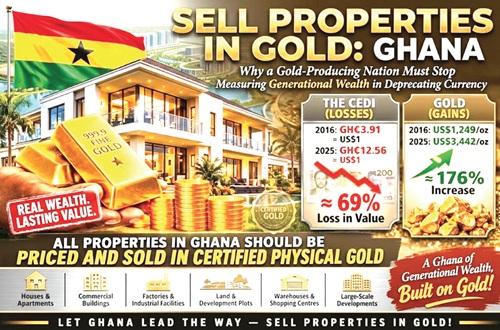
I propose a different approach: ALL PROPERTIES IN GHANA SHOULD BE PRICED AND SOLD IN CERTIFIED PHYSICAL GOLD. This is not a slogan.
It is a proposal for rethinking how Ghana measures, transfers and preserves generational wealth.
Money is not the same as currency
One of the greatest misunderstandings in modern economics is treating money and currency as interchangeable.
Gold and silver have an independent physical existence.
They must be discovered, mined, refined, weighed and authenticated.
No government announcement or central-bank computer entry can increase their supply.
Fiat currency works differently.
The cedi and the US dollar are government-issued and not redeemable for fixed quantities of gold.
Their purchasing power rests on monetary arrangements, productivity, supply, demand and institutional confidence.
Commercial banks also create deposit money through lending, and central banks influence the monetary base and broader financial conditions.
A digital balance is a record of a financial claim.
A banknote is a currency instrument.
Neither automatically represents ownership of physical gold.
A financial number can stay unchanged while the goods and services it buys decline.
Someone with GH₵1 million in the bank today has no guarantee that it will buy an equivalent property in 10 years.
The number is not the wealth.
The purchasing power is.
The 10-year evidence
Consider approximate annual averages between 2016 and 2025.
•Gold: about US$1,249 per troy ounce in 2016 and about US$3,442 in 2025, an increase of roughly 176 per cent in dollar terms.
•The cedi: about GH₵3.91 to US$1 in 2016 and about GH₵12.56 in 2025, a loss of roughly 69 per cent of its dollar value.
•The dollar: US inflation between 2016 and 2025 reduced US$100 of purchasing power to about US$74.56.
Combine gold and the cedi. In 2016, one ounce of gold equalled about GH₵4,883.
In 2025, it equalled about GH₵43,292, roughly an 8.85-fold rise in cedi terms.
These figures do not mean every property rose by the same percentage.
They show something more fundamental: the monetary unit used to measure wealth can change substantially while the physical asset remains.
Ghana must learn to distinguish the value of an asset from the changing value of the currency describing it.
Why sell a house for depreciating money?
A building may last a century. Land may stay in a family for generations.
A factory may produce wealth for decades.
Yet the proceeds of selling these assets usually arrive in fiat currency.
Consider two hypothetical owners in 2016, each holding property worth 100 ounces of gold.
The first sells and keeps the cedi proceeds in a bank account.
The second sells for 100 ounces of certified physical gold and keeps the gold.
Nine years later, each still holds the original proceeds in its original form.
Yet, their exposure to changes in purchasing power is fundamentally different.
The gold owner still has 100 ounces.
The cedi holder has a fixed numerical balance whose purchasing power has shifted.
That is the central wealth-preservation argument.
Why should Ghanaians not be able to transact their most valuable assets using a tangible monetary asset?
The proposed Ghana gold property policy
Ghana should adopt a national framework requiring property prices to be denominated in certified fine gold, with physical gold as the recognised settlement standard.
The policy should cover residential houses and apartments, commercial and office buildings, industrial facilities and factories, vacant land and development plots, warehouses and shopping centres and large-scale real estate developments.
The standard should be 999.9 fine gold, independently assayed and certified. Instead of advertising a property only for GH₵5 million, an owner could offer it for a stated weight of fine gold.
The buyer would pay that quantity through a regulated gold settlement institution, with the transaction independently verified, documented and registered under Ghanaian land laws.
Taxes and statutory charges could still be accounted for in cedis under transparent valuation rules.
This would require amendments to, and coordination with, existing legislation, including the Real Estate Agency Act, 2020 (Act 1047), and relevant land registration and financial regulations.
It must be implemented properly, not introduced by informal declaration.
Gold must be real, not another financial promise
Ghana must not rebuild the same financial architecture it seeks to reform.
A certificate claiming ownership of gold is worthless if the gold does not exist.
A digital gold balance is not physical gold unless it represents identifiable, allocated and independently audited bullion, with enforceable ownership and redemption rights.
The country would need secure vaults, independent assaying, transparent custody records, transaction verification and strict penalties for fraud.
The aim is to make the underlying asset real and verifiable, not to add another layer of financial promises.
The question Ghana must answer
Ghana is one of the world’s important gold producers.
Why should its citizens be discouraged from seeing gold as a monetary instrument for preserving their most valuable assets?
Why should a family sell land accumulated over generations, receive depreciating currency and struggle years later to buy another property?
Why should a gold-producing nation not develop a property market in which physical gold is an accepted, properly regulated means of settlement?
We cannot print another ounce of gold. We cannot legislate its natural scarcity into being.
We cannot create physical gold by adding numbers to a computer.
Gold has outlived kingdoms, empires, currencies and political systems.
Ghana must stop asking only how much money a property can sell for today. It must start asking how much lasting monetary wealth that property can preserve for tomorrow.
The proposal is simple: SELL PROPERTIES IN GOLD.
Not because gold is fashionable, but because Ghana must learn to distinguish tangible monetary wealth from the financial claims and currency instruments used to measure it.
A nation blessed with gold should not remain intellectually dependent on money-printing economies to understand the preservation of wealth.
