
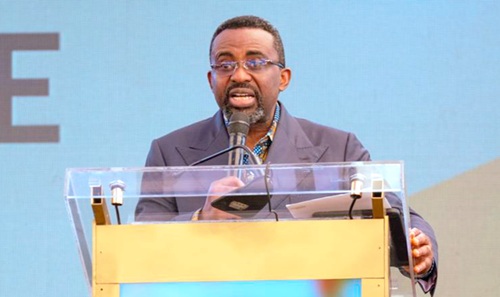
I write in response to the unveiling of the Heritage Series at Bank Square in Accra on Thursday, November 12, 2026.
Since a national currency is among the very few texts that every citizen reads, handles and exchanges daily, the choices embodied in its design deserve the kind of public scrutiny we would bring to a revision of the national curriculum, and it is in that spirit, as a citizen and as a critical discourse and cultural studies analyst concerned with the ways in which public texts construct national identity, that I offer the observations that follow.
Let me first acknowledge that the technical case for the redesign is persuasive.
The notes are printed on reinforced cotton paper and are smaller and easier to handle than their predecessors; the full range of eight denominations from GH¢1 to GH¢200 has been retained with the welcome return of the GH¢2 note, and you have explained that the strengthened security features are intended to make counterfeiting more difficult, while allowing ordinary users to identify genuine notes with greater confidence.
My concern is with what the series leaves out and in, where it locates the nation’s built heritage, two choices which, taken together, sit uneasily with the promise carried by the name “Heritage Series”.
In fairness to the Bank, the selection of portraits is considerably more varied than that of the old series.
The fronts carry Dr Kwame Nkrumah on the GH¢200, Kofi Annan on the GH¢100, Theodosia Salome Okoh, the designer of the national flag, on the GH¢50, Dr Ephraim Amu, composer of “Yɛn Ara Asaase Ni”, on the GH¢20, Justice Annie Jiagge on the GH¢10, Dr James Emmanuel Kwegyir-Aggrey on the GH¢5, Cardinal Peter Porekuu Dery on the GH¢2 and the Accra market trader Agnes Oforiwa Tagoe-Quarcoopome on the GH¢1, so that women, the Clergy, music, the judiciary, education, diplomacy and commerce all find a place, and the figures are drawn from several ethnic communities and from regions as far apart as the Central Region and the Upper West. The decision to place a market trader on the note that changes hands most often deserves particular credit, since it recognises the economic labour of Ghanaian women on which so much of daily life depends.
What the series omits, however, is as consequential as what it includes.
The existing notes carry on their fronts the collective portrait of the Big Six, Dr Kwame Nkrumah, Dr Joseph Boakye Danquah, Ebenezer Ako-Adjei, Edward Akufo-Addo, Emmanuel Obetsebi-Lamptey and William Ofori Atta, whereas the Heritage Series retains only Nkrumah, now elevated to the highest denomination, and removes the other five from the currency altogether.
Michael Billig (1995) used the term banal nationalism to describe the way nationhood is reproduced through ordinary, unremarked objects and habits rather than through ceremony, and banknotes are a textbook instance of that process: because they are handled without reflection, the account of the nation they carry is absorbed without challenge, and the disappearance of five founders from an object every citizen handles daily will, over time, narrow the popular memory of independence to the story of a single man.
The timing compounds the difficulty, given that the notes enter circulation only months before the nation marks 70 years of independence in March 2027, an anniversary at which the collective character of the independence struggle might reasonably have been expected to receive emphasis.
There is a further consideration, which I raise with some care.
Several of the omitted five are remembered as founders of the Danquah-Busia political tradition, while the one figure retained is identified with the rival Nkrumahist tradition, and although I do not suggest that the selection was made on partisan grounds, in a political culture where the history of independence remains contested between these traditions a decision of this kind is open to precisely that reading.
A central bank whose authority rests in large part on its perceived independence from the politics of the day would do well to anticipate such an interpretation and to answer it before it hardens into conviction.
The reverse designs raise a separate question of geography. On my reading of the series as unveiled, six of the seven buildings depicted on the reverse, namely Achimota School on the GH¢5, the Supreme Court on the GH¢10, the National Theatre on the GH¢20, the Jubilee House on the GH¢50, the Kofi Annan Peace Centre on the GH¢100 and the Kwame Nkrumah Museum on the GH¢200, are located in Accra, with the result that a series intended to represent a republic of 16 regions draws its architectural heritage almost entirely from the capital, while Kumasi, Tamale, Cape Coast, Ho, Bolgatanga and many other centres whose histories are inseparable from the making of the nation receive no visual recognition at all.
It is a curious outcome that the portraits on the fronts should travel as far as Nandom in the Upper West while the buildings on the backs rarely leave Greater Accra, and a citizen in the Upper East or the Volta Region who turns these notes over is invited, in effect, to understand the nation’s built heritage as something that resides somewhere else.
I, therefore, respectfully ask that the Bank of Ghana publish the criteria and the consultation process through which the portraits, buildings and images in the Heritage Series were selected, so that the public may understand the reasoning behind decisions that will shape the visual record of the nation for the next two decades.
I further ask that the Bank consider a commemorative issue for the 70th anniversary of independence that restores the collective portrait of the Big Six, that the public education campaign it has announced in the major local languages be used as an occasion for open discussion of representation, as well as for instruction in recognising security features, and that any future print run or revision of the series give landmarks beyond the capital the place their history warrants.
Since its introduction in 1965, the cedi has been one of the most visible expressions of Ghanaian sovereignty, and the theme chosen for this series, “The Cedi, Our Future: Secure, Designed to Last”, rightly signals that these notes are expected to endure.
It is precisely because they will last that their account of how the nation came to be, and of where its heritage is to be found, should be one in which every Ghanaian, whatever his or her region or political loyalty, can recognise a place.
Daniel Dwamena Ofosu,
Critical discourse and cultural studies analyst.
E-mail:
