
Imagine Ghana's private pension industry.
Is it a handful of giants running the show, or a crowded marketplace where dozens of firms compete for business?
The honest answer is both — and the gap between the two is the most interesting part of the story.
A Corporate Trustee is a company the National Pensions Regulatory Authority (NPRA) licenses to administer private pension schemes.
Custodians collect and hold the contributions.
Registered Fund Managers advise on investing them.
The trustee decides, and answers to members for the result. Of NPRA's 29 licensed Corporate Trustees, 26 filed audited accounts for 2025.
Round One: A Genuinely Competitive Market
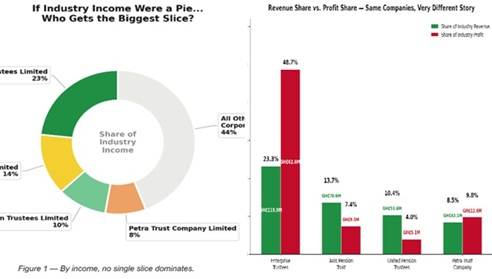
Picture the industry's income as one pie. Twenty-six even slices would be a healthy market. One firm taking half would not.
By income, the picture is healthy. Enterprise Trustees Limited leads with 23 per cent (GH₵119.9 million), Axis Pension Trust holds 14 per cent (GH₵70.6 million), United Pension Trustees 10 per cent (GH₵53.6 million) and Petra Trust Company 8 per cent (GH₵43.5 million).
The four together take just over half of the industry's GH₵514.6 million in income; the other 22 firms genuinely compete for the rest.
Round Two: A Very Different Story
Now slice the same pie by profit — what each firm keeps after costs.
Enterprise Trustees Limited, on 23 per cent of income, captures nearly half of all industry profit-GH₵62.6 million of the GH₵128.5 million earned by profitable trustees.
Add General Trust, Petra Trust and Axis Pension Trust, and four firms hold roughly three-quarters of all the profit. Many mid-sized trustees earn real income on thin margins.
Of the 26, three recorded a loss and two filed no profit figure, so this split covers the 21 that were profitable.
Same Companies, Two Different Stories
Side by side, the gap is impossible to miss.
Axis Pension Trust and United Pension Trustees each earn a smaller share of profit than of income.
Enterprise Trustees Limited's profit share is more than double its income share: it turns income into profit far better than anyone else.
Conclusion
So which is it — competitive, or not?
Both, and that is the real finding.
The street is genuinely competitive.
The profit is not evenly shared.
That is what NPRA's data can show the public — not just who is in the market, but how it really works.
The writer is a Data Analyst, National Pensions Regulatory Authority
