
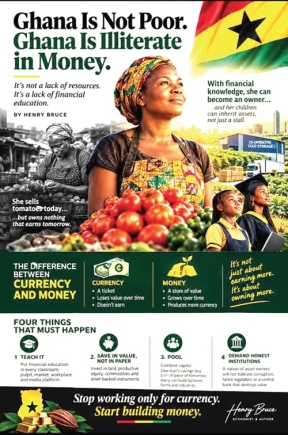
Every morning before the sun is fully up, a woman in a ghanaian market arranges her tomatoes in neat pyramids. she has done this for thirty years. she has paid school fees, buried relatives, and fed a household on the strength of her back and her bargaining.
By evening she counts her currency, and by the next morning most of it is gone.
After three decades of faithful labour, she owns a stall she rents, a phone she is still paying for, and not one asset that earns while she sleeps.
She is not lazy. she is not unintelligent. she is a victim of the biggest silence in our national life: nobody ever taught her the difference between currency and money.
The ticket and the treasure
Currency is a ticket. it is a promise printed by an institution, accepted today because everyone agrees to accept it, and weakened whenever the issuer is careless or the economy stumbles. money, in the true sense, is a store of value: something that holds its worth across time and, better still, produces more of those tickets without your sweat.
Most ghanaians spend their lives collecting tickets. the wealthy spend theirs collecting the machines that print tickets. a building prints rent. a share prints dividends.
A bond prints interest. a farm, a processing plant, a trade contract, a gold reserve, a cooperative stake: each of these prints currency whether the owner is awake or asleep. a salary prints currency only while your body shows up. that is the entire gap between poverty and wealth.
It is not intelligence. it is not effort. it is not even opportunity alone. it is knowledge, and we have withheld it from our own people.
Our own history is the sermon. across the decades, the cedi has surrendered most of its value against the dollar.
In 2022, inflation climbed above 50 per cent, and families who had saved dutifully in cash watched years of discipline dissolve within months. who suffered least?
Those who held land, goods, productive businesses and hard assets. who suffered most? those who trusted paper.
The market wrote a lesson in capital letters, and we filed it under bad luck.
Think about what that means. we have built a national culture of saving in the one thing guaranteed to lose against time. we tell our children to “save your money” when what we mean is “hold your currency,” and those are not the same instruction. holding currency in an economy with chronic inflation is not saving. it is a slow, polite robbery that we conduct against ourselves.
The silence in our classrooms
We teach children to read, to count and to recite. we do not teach them that wealth is what you own rather than what you earn.
We do not teach the difference between an asset and a liability, between consumption and capital, between interest paid and interest earned. a graduate can leave university with a degree in hand and never once have been taught how a bond works, what a dividend is, or why a cooperative can own what an individual cannot.
Then we are surprised when a generation of educated people lives from salary to salary, and when pensioners who gave forty years to the nation become dependants in their old age. an education system that produces job-seekers and not owners is not an education system. it is a labour-supply system for someone else’s wealth.
The trap on the other side
Now let me be provocative in the other direction, because half-knowledge is more dangerous than ignorance. ghanaians who sense that currency alone will not save them have rushed towards anything promising rapid multiplication: collapsed microfinance houses, vanished savings schemes, “double your money” promoters and glossy platforms with no real business behind them.
We have buried more life savings in these schemes than any decent nation should tolerate. a poor man who has been denied financial education is the perfect victim. he knows he must grow his money but was never shown how, so he hands it to the first smooth voice with a brochure.
Here is the rule that would have saved millions: anything that promises to multiply your currency without a real asset behind it is not an investment.
It is a transfer of your wealth to someone else. before any deal, ask one question: what real thing stands behind this? if nobody can point to it, walk away.
Four things that must happen
This cannot wait for government alone. we have been promised development for sixty-nine years of independence, and the household cannot keep waiting. it starts in the church, the market association, the village, the workplace and the cooperative.
First, teach it. put the difference between currency and money, income and assets, consumption and capital, into every classroom, every pulpit, every radio programme and every newspaper column, including this one.
Second, save in value, not in paper. convert a disciplined portion of every income into things that hold or grow their worth: land, productive equity, commodities, cooperative shares and genuinely asset-backed instruments.
Third, pool. one man’s savings buy a small piece of tomorrow.
A thousand men’s savings can own a factory, a farm, a fleet or a refinery. the wealthy do not win because they are cleverer.
They win because they combine their capital, and the poor are told to compete alone.
Fourth, demand honest institutions. a nation of asset owners will not tolerate a central bank that fails to defend its currency, a regulator that sleeps while savings schemes collapse, or a political class that treats public money as private spoil.
People who own something become the best guardians a country can have. ownership is the cheapest form of accountability ever invented.
The day everything changes
Imagine the market woman again, but now she has been taught. she sets aside a small portion every week, not into a drawer but into a pooled cooperative that owns cold storage for tomatoes, cutting the spoilage that eats her profit. her group buys land.
Her savings earn a return instead of a loss. in ten years, she is not merely selling tomatoes; she is a shareholder in the chain that moves them. her daughter inherits an asset, not a stall. multiply her by five million.
That is what happens on the day ghanaians learn to turn currency into money and let that money print currency for them. a salary-earner becomes an owner. a trader becomes a capitalist. a pensioner becomes an income earner rather than a dependant. a village becomes a shareholder in its own future, and development stops being something delivered to us and becomes something we do.
We do not lack gold, cocoa, oil, land, talent or sunshine. we lack the one lesson that converts all of it into lasting wealth. the lesson is free. the cost of refusing it is another generation on the treadmill. stop working only for currency. start building money.
