
Whenever I am in town, I look around for my favourite places.
These are the green patches along the road and on empty parcels of land and flower pots hugging people’s fence walls.
I enjoy watching the flower gardens dotted all over the city where horticulturists raise their beautiful plants.
In fact, one reason I would drive out of town rather than go by air is the satisfaction I derive from observing the greenery along the road—farms, forests, grasslands, wetlands, tall trees, shrubs and crops.
Having spent my early years in the rural areas, I am incurably rural in my upbringing.
This means I cannot be cured of my love for the countryside.
Since I now live in the city, I take delight in the flora I see around.
Therefore, I feel privileged to be living on the outskirts, where we compete with birds to enjoy the beautiful scenery that enhances our environment.
City farms
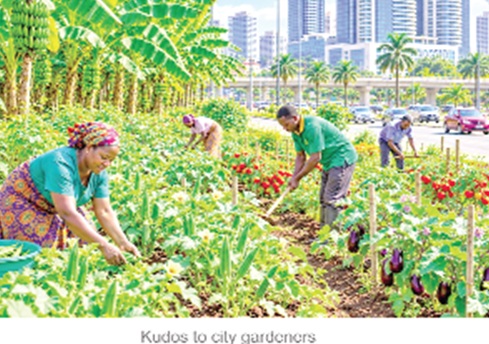
What a delight to observe the farms, crops, trees, and vegetable gardens in the city! Kudos to the gardeners who grow these crops, and everyone is invited to look and appreciate.
Along the major roads in the suburbs and on vacant plots, crops grow, such as mangoes, oranges, avocados, oil palms, coconuts, plantains and bananas.
While the products of city farmers help feed urban populations, the vegetation on their farms helps green the environment.
The gardeners also grow vegetables such as cabbage, lettuce, spinach, kontomire, tomatoes, garden eggs, okro, cucumber, sweet pepper, carrots, and onions.
For many of the urban farmers, these are “cash crops” because they sell their produce to market women and roadside table-top fruit and vegetable vendors.
One challenge of vegetable cultivation in the city is using polluted water from gutters and drains to irrigate crops.
The Agriculture Ministry and city authorities must monitor and curb this unsafe practice.
As a farmer’s son and a die-hard lover of farms, my backyard has mango, orange, palm, cocoyam, plantain and pawpaw.
The day I carried a basket of exotic mangoes to my church members, I felt good.
Another time, a plantain we harvested from our backyard had over a hundred fingers.
In the rainy season, we harvest kontomire (cocoyam leaves) regularly to supplement our tomato and agushi stews, not to mention the bitter leaves growing in our garden.
Other urban dwellers who use spaces in their compounds or the flower pots in front of their fence walls to grow crops are happy beneficiaries of these home-grown foodstuffs.
City gardens
Greater Kumasi has long been known as the Garden City of West Africa.
But that name dates back to a greener Kumasi.
The gardens have given way to brick and concrete buildings that have replaced the patches of trees and shrubs.
Except for the wetlands in parts of the city and the forestland of KNUST, much of the greenery that gave Kumasi its nice name as the Garden City does not exist anymore.
Somebody tell us we are wrong, and we would be happy to be proved wrong!
We must not forget that trees beautify the environment, protect roofs, provide shade for weary residents, shield buildings, and raise the value of urban homes.
Any mayor or regional minister who turns the towns and cities in their jurisdictions green will receive our applause and appreciation.
One natural advantage many cities in tropical Africa should have over cities in colder parts of the Western world is a climate favourable to lush vegetation.
Unfortunately, the rapid depletion of our forests is affecting the greenery in our cities, while many cities in the Western world are deliberately reclaiming urban spaces for trees, parks, and other forms of greenery.
When I lived in Tamale in the late seventies, I loved to sit on benches in parks and garden spaces—especially the one at the small library opposite the police events’ park.
Sitting frequently under the trees for fresh air and reading a book borrowed from the library was my unforgettable pastime.
Rooftop gardens
The first time I saw trees growing atop buildings, I was amazed and lauded the architects who incorporated greenery into their architectural drawings.
Examples of buildings with rooftop gardens in Accra include the Villaggio Vista near the Tetteh Quarshie Interchange and the Accra City Hall (AMA Head Office), which is called “Green Above the Skies of Accra.”
Rooftop gardening is certainly innovative and pleasant, but it benefits only a minority.
For the majority of us, ground greenery offers artistic beauty for the general public and is easily accessible for our enjoyment.
Next week: The good Lord willing, next week, we will look at God’s gift of arable land even in cities.
Then what became of the Department of Parks and Gardens that Dr Kwame Nkrumah elevated to ministry status?
What about the policy of Operation Feed Yourself and the recent advocacy for greener cities?
The writer is a publisher, author, writer-trainer/CEO, Step Publishers.
E-mail:
