
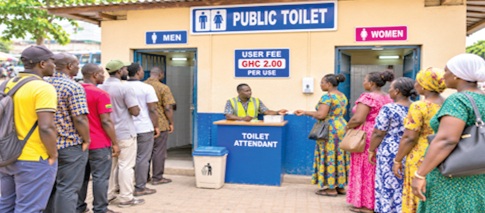
The real measure of a decent home is not simply the roof over its occupants’ heads, but whether the household can meet its most basic needs safely, privately and with dignity.
Ghana’s sanitation challenge, therefore, requires more than additional public toilets.
It requires a change in the way we understand the relationship between housing, health and personal responsibility.
One of the popular Fante proverbs captures the cultural meaning of sanitation with admirable simplicity: “Fie pa yɛ ahotɔ fie” — a good home is a home of comfort and cleanliness.
It expresses a principle that should sit at the centre of Ghana’s sanitation transformation: a home cannot fully offer comfort when the people who live in it have no safe and dependable place to relieve themselves.
If a good home is indeed a home of comfort and cleanliness, then a toilet should be regarded as part of the essential fabric of that home, not as a facility to be found somewhere outside it.
Ghana must gradually move from the familiar question, “Where is the nearest public toilet?” to a more fundamental expectation: “Where is the toilet in this house?”
That change may appear modest, but its implications are considerable.
It challenges an established pattern of domestic sanitation in which households depend on facilities owned or managed by others, and in which public toilet provision is sometimes treated as an acceptable substitute for adequate housing.
The issue is not that public toilets have no place in a modern society.
They are indispensable in markets, transport terminals, parks and other public spaces. The difficulty arises when they become the default answer to the everyday sanitation needs of entire households.
The question, therefore, is not simply how many public toilets a municipality can build. It is whether the country is creating the conditions in which every household can access a safe, functional, affordable and appropriate toilet of its own.
Census
The 2021 Population and Housing Census provides a more detailed picture of the challenge than a single national headline figure can convey.
Of approximately 8.36 million households covered in the Ghana Statistical Service sanitation analysis, 17.7 per cent had no toilet facility, while 23.1 per cent mainly used public toilets.
A further 59.3 per cent used household toilet facilities.
Yet, even within this last group, more than half shared their facility with other households.
These figures point to a problem that extends beyond open defecation.
A substantial number of Ghanaian households remain dependent on toilets they neither own nor fully control.
Shared facilities may provide an important service, but they do not always offer the privacy, convenience, reliability or degree of household control associated with a toilet within the home.
This distinction matters for policy.
If success is measured only by the reduction of open defecation, important dimensions of the sanitation challenge can remain hidden.
The national objective must be broader: to establish household access to safe, functional and appropriate sanitation as an ordinary feature of decent housing.
The geographical distribution of the challenge reinforces the point.
GSS reports that 31.3 per cent of rural households practise open defecation, compared with 8.9 per cent of urban households.
The lower urban percentage should not be mistaken for a negligible problem.
Given the size and density of urban populations, the census reported approximately 449,849 urban households without toilet facilities and about 1.3 million urban households using public toilets.
The census also looked beyond the simple category of households without toilets.
Its expanded sanitation questionnaire recorded whether people used chamber pots, polythene bags, beaches or water bodies, or bush, open fields and gutters. In most regions, bush, open fields and gutters were the predominant locations.
In some coastal regions, beaches and water bodies also featured prominently.
The picture is, therefore, not uniform; the form of deprivation varies across communities and requires responses informed by local conditions.
Argument
There is an economic argument for household toilet ownership that deserves greater attention.
Public toilets often require users to pay at each visit.
Consider a household of six in which each member pays GH¢ 2 for one visit a day.
The household would spend GH¢ 12 daily, approximately GH¢ 360 in a 30-day month and GH¢ 21,600 over five years.
This illustration excludes inflation and additional visits.
The calculation does not, on its own, establish that constructing a household toilet will always cost less; construction costs, maintenance, household circumstances and the suitability of the technology must also be considered.
It does, however, expose an important policy question.
Repeated payments for an essential daily service can become a substantial and continuing burden, particularly for low-income households.
Household sanitation expenditure should, therefore, be understood not merely as a recurring cost, but as a potential investment in domestic infrastructure.
Where a suitable system can be safely installed and maintained, the household gains an asset that offers greater control over access and reduces dependence on repeated user charges.
The economic case is not simply about money saved; it is also about the value of convenience, time, privacy and reliability.
The health case is equally important.
High-use communal facilities can face persistent hygiene and maintenance difficulties, particularly where water, cleaning materials, handwashing facilities and effective management are inadequate. Household toilets can give residents greater control over cleanliness and availability, although ownership must always be accompanied by proper use, cleaning, maintenance and safe management of waste.
Benefits
The benefits are especially significant for children, older persons, persons who are challenged and unwell people.
A facility that is close, accessible and suitable for the needs of household members can reduce the physical and practical difficulties associated with travelling to a distant or crowded public toilet.
Privacy and personal security provide another compelling reason.
A toilet within or immediately adjacent to the home reduces the need to walk to a separate facility, particularly after dark.
For women, girls and other vulnerable household members, that proximity can reduce exposure to unsafe routes and poorly lit surroundings.
Sanitation must, therefore, be understood as part of personal security and human dignity, not merely as the management of human waste.
A toilet is, in this sense, more than a piece of infrastructure. It is a daily expression of whether a home has been planned around the basic needs of the people who occupy it.
The absence of one can affect health, privacy, household expenditure and the dignity with which ordinary life is lived.
Several interconnected factors continue to sustain dependence on public toilets.
The first is weak enforcement of housing and sanitation standards.
Where rental accommodation is provided without adequate toilet facilities, tenants may have little choice but to depend on public or shared services, often at considerable recurring cost.
Metropolitan, municipal and district assemblies must, therefore, treat household sanitation as an integral element of housing regulation, rather than as an environmental health matter to be addressed only after occupation.
Landlord accountability is central to this effort.
Designated toilet spaces should not be converted into additional bedrooms or commercial areas simply to increase rental income.
Building approvals, inspections and enforcement must work together to ensure that the provision of adequate sanitation is not sacrificed to short-term property interests.
The second constraint is geographical and engineering-related.
In low-lying coastal communities and other flood-prone settlements, shallow groundwater and unstable soils can make conventional pit systems unsuitable or unsafe. In parts of northern Ghana, rocky or hard soils can make excavation costly.
• To be continued
The writer is a Fellow, West African Postgraduate College of Environmental Health (WAPCEH).
E-mail:
