
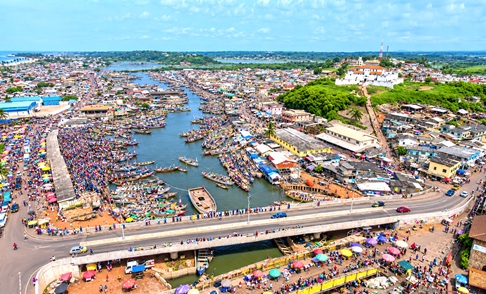
Situated about 13 kilometres west of Cape Coast, in the Central Region, Elmina is a historic coastal town whose story is closely linked to the discovery of the Benya Lagoon by a hunter named Kwaw Amankwaa.
According to local oral tradition, Amankwaa, who hailed from Eguafo, discovered a source of water during a hunting expedition and named it Anomansa, meaning an inexhaustible supply of water.
Following the stream, he eventually came upon a lagoon and exclaimed, “Be-enya”, meaning “I have found it”.
The lagoon subsequently became known as the Benya Lagoon. Amankwaa later returned with his people to establish a settlement in the area, which developed into present-day Edina, popularly known as Elmina.
The origin of the name Edina has different interpretations.
While it is generally recognised as the indigenous name of the settlement, another account suggests it may have evolved from the Portuguese word aldeia, meaning village.
Elmina, on the other hand, is traced to the Portuguese expression A Mina, meaning “The Mine”, a reference to the gold trade that attracted European merchants to the area.
The Portuguese arrived in 1471 and built Elmina Castle in 1482. Originally established as a trading post for gold, the castle later became an important centre of the transatlantic slave trade.
Captured by the Dutch in 1637 and transferred to the British in 1872, it remains one of Ghana's most significant historical landmarks and a UNESCO World Heritage Site.
Overlooking the castle is Fort St Jago, built by the Dutch in the 17th century to protect the settlement. Its elevated position offers visitors impressive views of the castle, the town and the Atlantic Ocean.
Beyond its colonial history, Elmina retains a vibrant cultural identity.
The Benya Lagoon and Mpoben Fishing Harbour remain central to the livelihoods of local fishermen and fishmongers.
Colourful canoes, busy fish markets and the preparation of fresh seafood give the town its distinctive coastal character.
The annual Edina Bakatue Festival is another major attraction. It marks the reopening of the Benya Lagoon for fishing after a period of customary restrictions.
Traditional rites, processions, music, dancing and canoe displays bring the community together to celebrate its rich cultural heritage.
With its historic landmarks, fishing traditions, indigenous institutions and coastal attractions, Elmina offers visitors an opportunity to experience a town where history, culture and everyday life meet.
