
Ghana now has a woman a heartbeat from the presidency.
Professor Naana Jane Opoku-Agyemang took the oath as Vice-President in January 2025, the first woman to hold the office.
The Criminal Investigation Department answers to a woman, COP Lydia Yaako Donkor.
Three women have held the office of Chief Justice, beginning with Georgina Wood in 2007.
One by one, the highest offices of the land have opened to women.
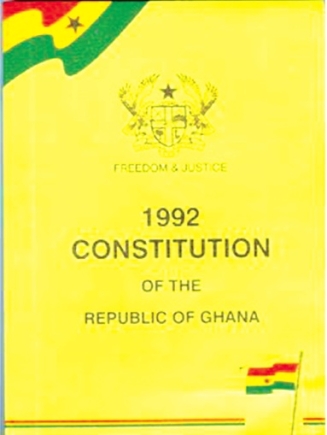
The constitution has not noticed. I counted every gendered pronoun in the 1992 Constitution.
The text says ‘he’, ‘him’, ‘his’ or ‘himself’ 427 times.
It says ‘she’ or ‘her’ only eight times.
The masculine words pile up in the chapters that create the presidency, Parliament and the courts.
Whoever holds office, the constitution says ‘he’.
The Vice-President is ‘he’.
The Chief Justice is ‘he’.
A woman sworn into these offices must read herself into a text that did not imagine her.
This habit is not ours. Twi has no ‘he’ or ‘she’.
The pronoun ɔno covers a woman and a man alike. Ga, Ewe and Dagbani do the same.
Habit
The habit came from English law. A British statute of 1889 told drafters that ‘words importing the masculine gender shall include females’. Colonial lawyers wrote our constitutions that way, and we have copied them ever since.
A private team proved the point in 2023 with a complete Akuapem Twi translation of the constitution.
Twi cannot reproduce the masculine bias at all. Our own languages refuse what the English text carries on every page.
Some defend the generic ‘he’ by pointing to scripture, where ‘men’ is said to include women and children.
A constitution is not scripture, and Ghana is not a theocracy.
The constitution binds Christians, Muslims, followers of African spirituality and citizens of no faith alike, and it owes every citizen its words.
The ‘he’ came from a British law book anyway, not from any pulpit.
Words alone
One caution matters here, and my research across eight African countries makes it plain.
Words alone do not seat women.
The Gambia has written ‘he or she’ throughout its constitution since 1997 and adopted no quota.
Women hold fewer than one seat in ten in its parliament.
Sierra Leone kept its masculine text, passed a 30 per cent quota law in 2022, and watched women rise to 28 per cent of its Parliament at the next election.
Kenya changed its language and its rules together in 2010, and its courts spent a decade enforcing the rules.
Rules that can be enforced move seats.
Language speaks to dignity.
A country serious about women’s representation needs both.
Ghana shows both truths at once.
The top is historic.
The base is thin.
Women hold roughly one seat in seven in our Parliament, behind Tanzania, Uganda, Kenya, Rwanda and Sierra Leone, all quota countries.
Our women leaders rose through the ballot and the choices of those who appoint.
Choices can change. Goodwill opens doors; only rules keep them open.
The Affirmative Action (Gender Equity) Act of 2024 was the right answer. Whether it delivers will depend on enforcement.
Fix
The moment to fix the words has arrived.
The Constitution Review Committee chaired by Professor H. Kwasi Prempeh submitted its report to President Mahama in December 2025, and implementation has begun.
Every amendment should be written in gender-neutral language.
Kenya showed how in 2010: name the office rather than the man.
The President. The Speaker.
A member of Parliament.
The reform costs nothing and can travel with amendments already being drafted.
Some will call this cosmetic.
They have it backwards.
Gender-neutral speech is not an import.
It is sankofa applied to the law.
Twi spoke of leaders without gender long before English insisted otherwise.
We should go back for the fairness of our own languages and write it into the English text that governs us.
Our National Pledge already knows better.
Every schoolchild promises loyalty to ‘Ghana my Motherland’.
We call the nation our mother, yet her founding law calls everyone who governs her ‘he’.
A constitution is a mirror a nation holds up to itself.
The Review Committee’s report gives us the chance to fix the words.
The Affirmative Action Act gives us the chance to fix the numbers.
The two tasks belong together, and neither should wait.
The writer is a PhD candidate in African Studies at Howard University, Washington, DC.
Email:
