
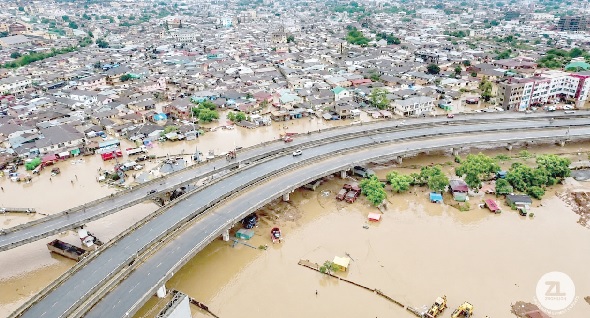
The first signs are familiar. Dark clouds gather. The rains begin. Traffic slows. Drains overflow. Within hours, roads become rivers, homes are submerged, and families scramble to rescue belongings from advancing floodwaters.
Soon, the reports arrive. A child swept away by a drain. A family trapped in a flooded house. Traders counting losses. Vehicles stranded. Businesses forced to close.
By evening, emergency teams are at work, officials are assessing damage, and social media is flooded with images of destruction.
Then the waters recede. Life resumes. Until the next rains arrive.
For many Ghanaians, flooding has become one of the most predictable emergencies in national life. Yet that predictability raises an important question: if we know flooding will occur, why does it continue to cause such devastating consequences?
The answer extends beyond the weather. It touches on planning, governance, enforcement and development choices made long before the rains begin.
One of the most troubling aspects of Ghana's flood challenge is that the causes are neither new nor mysterious. Engineers have identified them. Urban planners have warned about them. Environmental experts have studied them. Government agencies have repeatedly acknowledged them.
The country understands the problem. What remains elusive is sustained implementation of solutions.
Although Accra has become the most visible symbol of the crisis, flooding is a national challenge. From Kumasi to Kasoa, Tema to Tamale, and coastal communities facing rising sea levels, many parts of the country continue to experience recurring flood events.
The consequences go far beyond flooded streets. Education is disrupted. Livelihoods are destroyed. Public infrastructure is damaged. Health risks increase. Vulnerable households are pushed deeper into poverty.
For many families, the impact of a flood is measured not only by what is lost, but by how long recovery takes.
No discussion about flooding in Ghana can ignore June 3, 2015.
Heavy rains flooded parts of Accra before an explosion at a fuel station near the Kwame Nkrumah Interchange turned a flooding emergency into a national tragedy.
The images shocked the country. The grief united the nation. Many believed the disaster would become a turning point in Ghana's approach to flood management.
Yet more than a decade later, flooding remains a recurring feature of the rainy season.
June 3 demonstrated that flooding is not merely an inconvenience. Under certain circumstances, it can become a national disaster with devastating human consequences.
When floods occur, public attention naturally focuses on rainfall. Yet experts frequently point out that rain alone rarely explains the scale of destruction.
The real story often begins before the clouds appear.
It begins when watercourses are encroached upon. It begins when wetlands are replaced with concrete. It begins when drains become dumping sites. It begins when urban development outpaces infrastructure planning.
Every blocked drain reduces the ability of a city to move water efficiently. Every wetland lost removes part of nature's flood defence system. Every structure built on a watercourse narrows the path available to floodwaters.
When heavy rains arrive, water will follow the paths left available to it.
Unfortunately, those paths often lead directly into homes, businesses and communities.
Rapid urbanisation has further intensified the challenge. Ghana's cities have expanded significantly over recent decades, creating new opportunities but also placing enormous pressure on ageing infrastructure.
Many drainage systems were designed for smaller populations and different development patterns. Today, they must serve larger and denser communities than originally intended.
Climate change is raising the stakes even higher. Scientists warn that extreme weather events are becoming more frequent and intense, while rainfall patterns are becoming less predictable.
Infrastructure designed for yesterday's climate may not be adequate for tomorrow's conditions.
This means the cost of inaction continues to rise.
Ghana's emergency institutions, including NADMO, security agencies and local authorities, have repeatedly demonstrated commitment during flood emergencies. Their work saves lives and deserves recognition.
However, emergency response alone cannot solve a structural problem.
Rescuing victims after floods is essential. Preventing disasters before they occur is even more important.
Improvements
Evidence from around the world shows that flood risks can be reduced through infrastructure improvements, environmental protection, strict planning regulations and sustained public education.
The challenge is not whether flooding can be reduced.
The challenge is whether Ghana can maintain the long-term commitment required to implement solutions consistently.
One of the greatest dangers is treating flooding as a seasonal event rather than a permanent development challenge.
Each flood generates concern. Each flood produces promises. Then public attention shifts elsewhere. The cycle repeats.
Breaking that cycle requires institutional memory, effective enforcement and long-term planning.
Above all, it requires recognising that flooding is not simply about rain.
It is about the decisions made when the skies are clear.
The rains will come again. Meteorologists know it. Engineers know it. Government officials know it. Residents know it.
The uncertainty is not whether Ghana will experience future floods.
The uncertainty is whether the country will finally address the conditions that allow those floods to become disasters.
For decades, the water has been delivering the same message.
The question is whether Ghana is ready to listen.
E-mail:
