
Once upon a time in the Republic of Uncommon Sense, a Finance Minister announced that he was expecting a New Economy. It was supposed to be a bouncing economic baby, conceived in the fertile imagination of government, nourished by billions of dollars and destined to deliver prosperity to a nation that had spent decades attending the naming ceremonies of economic miracles without ever meeting them in adulthood.
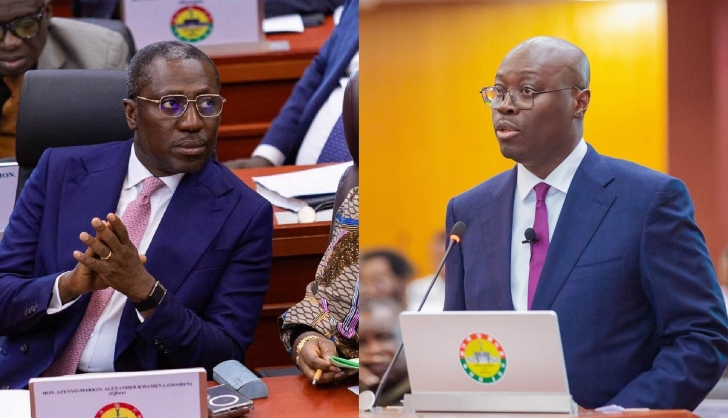
But before Dr Cassiel Ato Forson could carry his precious economic pregnancy into Parliament, the Minority, led by Alexander Afenyo-Markin, had already assembled at the maternity ward, demanding proof of paternity.
They wanted to know who fathered the New Economy, where the money for its upbringing would come from, and whether the baby was genuinely new or merely the much-publicised 24-Hour Economy returning from the barber's shop with a fresh haircut.
In Ghana, when a child bears a striking resemblance to the neighbour, the family does not immediately call a press conference. They first summon the elders. But in Parliament, where patience is a commodity rarely included in the national budget, the DNA test begins before the naming ceremony.
And so, even before the Finance Minister could say, "Mr Speaker," the opposition had begun asking whether the New Economy was legitimate, affordable and capable of surviving outside the comfortable incubator of government promises.
The first quarrel, interestingly, was not even about money. It was about bedtime.
The Finance Minister was scheduled to present his budget at six o'clock in the evening, and Afenyo-Markin raised concerns that Ghanaians would be too sleepy to follow proceedings.
Now, fellow Republicans, consider the magnificent irony. Here was a country preparing to operate a 24-Hour Economy, yet its Parliament was debating whether the national economy could be discussed after normal working hours.
Apparently, the factories may work through the night, the markets may trade until dawn, and the transport operators may keep moving while the rest of the nation sleeps. But when the Finance Minister opens his briefcase at six in the evening, democracy must first consult its pillow.
In Ghana, even funeral committees can organise an all-night wake-keeping without consulting the sleeping habits of the mourners. But apparently, Parliament requires special arrangements to discuss a 24-Hour Economy after sunset.
Perhaps this was the first practical examination of the 24-Hour Economy, and Parliament was already requesting permission to sit the paper in daylight.
Eventually, the budget was presented, and the New Economy emerged from the delivery ward with an impressive birth weight of ten billion dollars spread over four years. Its parents promised industrialisation, agricultural transformation, energy development, technological advancement and enough economic opportunity to make unemployment reconsider its permanent residency in Ghana.
The Finance Minister spoke of growth, investment, productivity and transformation. The figures marched across the budget statement with the confidence of soldiers on Independence Day.
But no sooner had the baby been displayed to the nation than Afenyo-Markin and his colleagues began examining its fingers, toes and economic chromosomes.
They questioned the financing, challenged the promises and wondered whether the government's New Economy was simply the old 24-Hour Economy dressed in expensive political kente.
Former Finance Minister Mohammed Amin Adam joined the interrogation, raising concerns about the repackaging of existing economic initiatives.
The situation was becoming serious. Ghana had moved from economic policy to economic genealogy.
One could almost imagine Parliament establishing a special committee to determine whether the New Economy and the 24-Hour Economy shared the same father, mother and political grandfather. The committee would naturally require sitting allowances, foreign study tours and a supplementary budget to complete its investigation.
Meanwhile, the ordinary Ghanaian was waiting outside the maternity ward, wondering whether the child would eventually grow up and find him a job.
For the truth is that Ghana has never suffered from a shortage of economic names. We have had programmes, visions, transformations, revolutions, recoveries, resets and enough policy acronyms to establish a separate Ministry of Abbreviations.
What has often been in shorter supply is the patience required to turn attractive announcements into measurable improvements in people's lives.
The Minority, for its part, described the government's achievements as an economy that looked impressive on paper but was less convincing in the pockets of ordinary citizens.
And here, the political comedy encountered a rather stubborn economic reality.
At Kejetia Market, nobody has yet succeeded in buying three tubers of yam with a favourable GDP growth projection. The woman selling tomatoes does not accept fiscal consolidation as legal tender, and the trotro mate will not give you change because inflation has declined.
Try telling a market woman that the economy is growing at an encouraging rate while she is struggling to sell her goods, and she may politely ask whether the growth is occurring in her market or somewhere inside the Finance Minister's calculator.
But the Minority must also tread carefully. In Ghana, opposition politicians have a remarkable ability to discover the suffering of ordinary citizens immediately after leaving government. Their eyesight improves, their hearing becomes sharper, and their memories suddenly recover every promise made by their successors.
The same potholes they once described as temporary inconveniences become national emergencies. The same economic indicators they previously celebrated become suspicious statistics. And the same citizens whose complaints once sounded like political propaganda suddenly become reliable witnesses for the prosecution.
Our elders say that when the cooking pot changes hands, the man who previously complained about impatient diners becomes the first to demand that the soup be served.
Then came another intriguing mystery: the Women's Bank.
Afenyo-Markin questioned why the much-publicised initiative had not featured in the budget presentation. Had the bank gone on leave? Had it changed its name? Or had it joined the long list of government promises that occasionally disappear from public conversation without submitting resignation letters?
In a country where even a missing goat can attract announcements from the community information centre, surely a promised bank deserves a proper explanation.
Yet beneath the parliamentary exchanges lies a question more important than the identity of the New Economy's parents.
What exactly will this economic child accomplish that its numerous predecessors could not?
Will it create sustainable jobs for young graduates? Will farmers gain access to affordable inputs, reliable markets and functioning roads? Will manufacturers find the energy, financing and infrastructure needed to expand production? Will small businesses experience the transformation in their balance sheets rather than merely hearing about it on television?
These are questions that deserve answers, whether they come from the government benches or the Minority side of Parliament.
Because, fellow Republicans, economic transformation is not a naming competition. A hungry man does not become satisfied because his empty plate has been renamed a National Food Security Transformation Platform.
Neither does unemployment disappear because a government has commissioned a beautifully designed logo and announced a programme with a sufficiently ambitious title.
The real examination begins after the speeches, when the microphones have been switched off, the parliamentary arguments have ended, and ordinary Ghanaians return to their daily struggle to earn a living.
And so, the New Economy has finally been delivered. The Finance Minister has assured the nation that the child has a promising future. The Minority has demanded its DNA results, questioned the cost of its upbringing and warned that its impressive birth certificate may not guarantee a healthy adulthood.
The rest of Ghana can only watch and wait.
But perhaps there is one final question worth asking.
If the government insists that the economy is new, and the Minority insists that it is merely the old economy wearing new clothes, could somebody kindly tell us when either version will start reporting for duty?
For in the Republic of Uncommon Sense, governments announce economies, oppositions interrogate economies, and ordinary citizens spend their lives searching for the economies they keep hearing about.
And until the promised prosperity arrives, the Ghanaian taxpayer will continue to perform the one economic activity that never requires a parliamentary debate: paying the bills.
Jimmy Aglah writes for the Republic of Uncommon Sense, where common sense is a scarce commodity, absurdity is government policy, and irony is the only thing that never goes on strike.
