

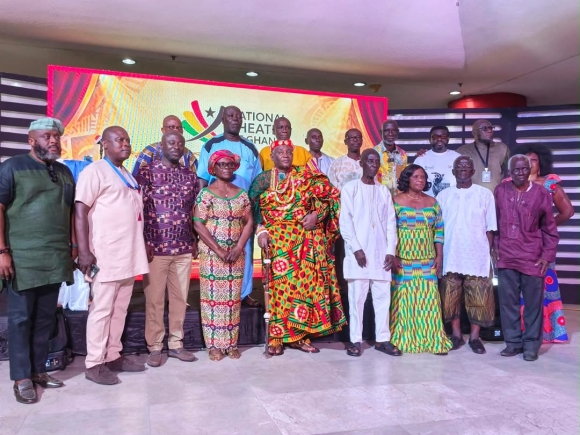
It was an evening of recognition, nostalgia and a few impressive dance moves as the National Theatre honoured renowned playwright James Ebo Whyte, popularly known as Uncle Ebo Whyte, and ten other former employees for their contributions to the institution and Ghana’s creative industry.
It was an evening of recognition, nostalgia and a few impressive dance moves as the National Theatre honoured renowned playwright James Ebo Whyte, popularly known as Uncle Ebo Whyte, and 10 other former employees for their contributions to the institution and Ghana’s creative industry.
The ceremony, dubbed “Celebrating Our Own,” was held on Tuesday, September 29, 2026, at the National Theatre in Accra. It formed part of the second edition of the Theatre’s recognition initiative and its third-week celebration, running from September 28 to October 4.
The event brought together National Theatre management, former employees, creative industry personalities, partners and members of the media to celebrate people who have played a part in the Theatre’s journey.
The honourees were recognised across different areas of the National Theatre’s work, including drama, dance, symphony and the institution itself.
Under Drama, the honourees were Emmanuel Oblitey Tetteh and Nelson Dzandu, while David Amoo and Grace Djabatey were recognised under Dance.
The Symphony category had Humphery Kuto and Theresa Tetteh, while Nii Ashikwei Kwabotswe II, Daniel Lamptey, Bossman Amoako and Seth Otumfo were recognised under the National Theatre of Ghana (NTG) category.
The Distinguished Award went to James Ebo Whyte, in recognition of his outstanding contribution to Ghanaian theatre and the creative industry.
Speaking at the ceremony, Executive Director of the National Theatre, Henry Herbert Malm, said the dedication, passion and excellence of the honourees had helped shape the institution and laid a strong foundation for generations coming after them.
He described Uncle Ebo Whyte’s contribution to Ghanaian theatre as “monumental”, saying his productions had shown that theatre could “heal, educate, entertain and inspire” society.
Mr Malm also encouraged current staff and practitioners to remain committed to their work.
“Whatever you put into what you’re doing, others will watch you. So if you do it well, there will be a time when they’ll call you and say, thank you, good job,” he said.
Uncle Ebo Whyte, Artistic Director and Lead Writer of Roverman Productions, expressed gratitude to the National Theatre for the recognition and encouraged young people to take the arts seriously.
But he also had a special gesture for his fellow honourees.
He pledged lifetime tickets to his stage productions for the other honourees.
“I pledge lifetime tickets to my stage shows for all the other honourees,” he said.
Another honouree, David Amoo, expressed appreciation for the recognition and said he and his colleagues remained available to support the National Theatre with their experience, advice and suggestions.
The formalities did not stop the former workers from having a little fun. At one point, some of the honourees took to dancing, showing off their moves and bringing a burst of energy to the gathering.
The moment drew cheers and laughter, with the former workers proving that the years may pass, but the love for the performing arts can remain very much alive.
The National Theatre also acknowledged partners and supporters including Ghana Textile Prints (GTP), Twellium Industries, Trafix Catering, Unilever and Verna Water.
GTP, the clothing partner for the celebration, gave clothing items to the honourees as part of the gifts presented to them. The honourees also received citations and product packages.
Performances by the Ghana Dance Company, National Drama Company and National Orchestra added music, dance and drama to the celebration.
For one evening, the spotlight was firmly on the people who had spent years helping to keep the National Theatre and Ghanaian performing arts alive.
And as the honourees danced, laughed and celebrated together, “Celebrating Our Own” truly lived up to its name.
