

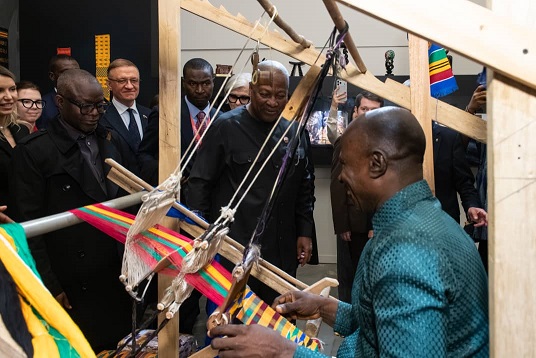
Ghana's iconic kente textile has found a prominent international stage in Moscow, where President John Dramani Mahama has underscored the power of cultural heritage in building enduring relationships between nations.
From the intricate geometry of its patterns to the stories woven into its colours, Ghana's kente carries a cultural language that transcends borders. In Moscow, that language is finding a new audience.
President John Dramani Mahama has visited Woven Meanings, an exhibition dedicated to Ghana's celebrated traditional textile, at the All-Russian Museum of Decorative Arts, where the artistry and cultural significance of kente are being presented to Russian audiences.
The exhibition offers more than an encounter with an exceptional textile tradition. It provides an opportunity to appreciate the history, craftsmanship and values that make kente one of the most recognisable expressions of Ghanaian identity.
Organised with the participation of the Centre for Public Diplomacy (CPD), and with the direct assistance of the Russian House of the Centre for Public Diplomacy in Ghana, the exhibition forms part of the International Festival of African Culture and Cinema, Africa: Together into the Future. It is also included in the cultural programme of the Third Russia-Africa Summit.
During his visit, President Mahama explored the collection, which features different samples of kente, alongside a traditional weaving loom of the type still used by artisans in the Kumasi area.
Two exhibits carry particular historical and national significance: a kente cloak associated with Ghana's first President, Dr Kwame Nkrumah, and another belonging to President Mahama himself.
Their presence connects Ghana's political history with a cultural tradition that has endured across generations.
Kente is distinguished by its vibrant colours, intricate patterns and symbolic meanings. Beyond its visual appeal, each design can communicate historical experiences, social values and cultural beliefs, making the textile an important repository of Ghanaian heritage.
The exhibition also explores the continuing relevance of this traditional craftsmanship in contemporary fashion, design and cultural expression.
For President Mahama, however, the significance of the occasion extended beyond the celebration of Ghanaian artistry. It was an opportunity to reflect on the importance of cultural understanding in international relations.
“Although we have established intergovernmental contacts and relations between our two countries, the strongest and most enduring ties are those between people. And these ties can only be strengthened through an understanding of each other's cultures,” he said.
He expressed gratitude to the organisers and partners for bringing the exhibition to Moscow, particularly noting the interest it had generated among Russian visitors and the provision of explanatory texts in Russian to help audiences appreciate the exhibits.
That interest appears substantial. Tatyana Rybkina, Director of the All-Russian Museum of Decorative Arts, disclosed that the exhibition had attracted more than 11,000 visitors in less than two weeks.
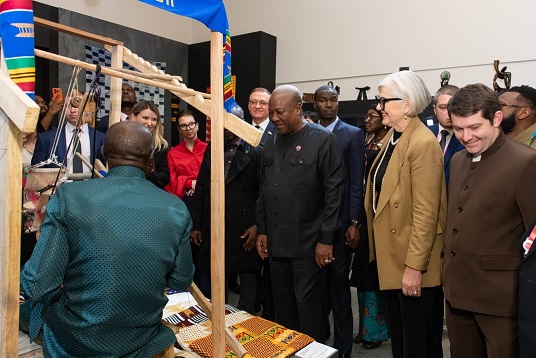
Dmitry Savelyev, First Deputy Chairman of the State Duma Committee on International Affairs and Director General of the Centre for Public Diplomacy, used the occasion to highlight the historical foundations of relations between Ghana and Russia, particularly the educational connections established during the Soviet period.
He also acknowledged the museum's partnership and support in hosting the exhibition.
The direct assistance of the Russian House of the Centre for Public Diplomacy in Ghana reflects its continuing commitment to promoting Ghanaian culture in Russia and facilitating humanitarian and cultural exchanges between the two countries.
The initiative is part of a wider approach to public diplomacy that places cultural understanding, education and people-to-people engagement alongside conventional government relations.
For Ghana, the international presentation of kente is particularly significant. As the country continues to promote its cultural heritage to global audiences, the textile offers a powerful expression of national identity and the creativity of its people.
Its appearance in Moscow also demonstrates how cultural diplomacy can create spaces for engagement that political and economic discussions alone may not always achieve.
In a world where international relationships are increasingly shaped by strategic interests, cultural exchanges offer a different but equally important pathway to cooperation: the opportunity for people to understand, appreciate and connect with one another.
In Moscow, Ghana's kente is doing precisely that, telling a distinctly Ghanaian story while creating another thread in the enduring relationship between the two countries.
