

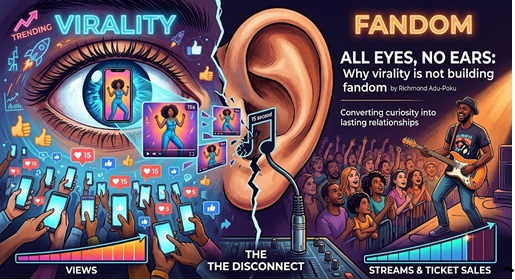
In Ghana’s music industry, a song can attract 500,000 views overnight, trend on TikTok by lunchtime and inspire thousands of dance videos before the weekends. Suddenly, the artiste is everywhere. Two weeks later, the internet has moved on.
Welcome to the exciting but unpredictable world of virality, where everybody knows the dance, everybody sings the chorus, but surprisingly few people may remember the artiste’s name, stream the full song or buy a concert ticket.
This raises a critical question for Ghana’s music industry: Are we building music fans or simply entertaining social media users?
The 15-Second Hit and the Disappearing Fan
Research by MIDiA found that 52 percent of consumers had streamed music in the previous month after discovering it on social media. Encouraging as that sounds, 48 percent had not made that move.
The implication is simple: hearing a song online does not guarantee that listeners will search for it on Spotify, Audiomack, Apple Music or YouTube.
Consider a Ghanaian artiste whose song explodes through a dance challenge. Influencers participate, content creators’ cash in, and the song dominates social media.
Yet, how many viewers can identify the artiste without seeing a caption? How many know the second verse? And how many would pay GH₵150 to watch the performer live?
That is the difference between popularity and fandom. Virality brings attention; fandom builds loyalty. In the music business, loyalty sustains careers long after the internet discovers its next favourite thing.
TikTok Is Not Your Record Label
Social media has revolutionised music promotion, giving emerging artistes access to audiences and opportunities once reserved for those with substantial marketing budgets.
However, MIDiA’s findings suggest that social video increasingly competes with streaming instead of consistently directing listeners towards it. Some consumers feel they have heard enough of a song on social media and see little reason to stream it separately.
It is like smelling waakye every morning until you feel you have eaten. The aroma may be irresistible, but the seller still needs customers.
For Ghanaian artistes, posting the same song snippet 40 times is not necessarily a strategy. It could simply mean entertaining people who never leave the app.
Social media should be the invitation, not the entire party.
Views, Streams and Empty Pockets
Ghana’s entertainment industry loves impressive numbers. A million views look good in a press release, a trending hashtag attracts attention, and a viral dance can generate interviews, brand enquiries and bookings.
These achievements matter, but problems arise when vanity metrics become the ultimate measure of success.
An artiste with fewer followers may command a more valuable audience: people who stream every release, attend concerts and purchase merchandise. Meanwhile, an online sensation may struggle to fill a modest venue.
Views, streams and revenue are not interchangeable. Earnings depend on factors including platform, audience location, monetisation arrangements and rights ownership.
A viral video is not a financial statement. A trending song cannot automatically pay producers, clear music video debts or finance another album.
The real question is what those impressive numbers produce after the excitement fades.
Stop Chasing Everybody. Start Building Somebody.
MIDiA recommends that artistes focus on where their fans are rather than endlessly publishing content in the hope of reaching everyone.
Ghanaian musicians should take this seriously. If audiences love live performances, offer memorable sessions. If they connect with storytelling, share the inspiration behind the music. If personality attracts them, let them meet the human being behind the microphone.
Most importantly, make the next step easy. Link directly to full songs, encourage listeners to follow official pages and build WhatsApp or email communities with appropriate consent. Share behind-the-scenes moments, release updates and concert announcements that give people reasons to return.
Labels and managers must also connect discovery to listening, repeated engagement and commercial opportunities. The objective is not to abandon social media but to stop treating it as the destination.
Radio, Events and Real Connections
Ghana has an advantage that should not be overlooked: music discovery extends beyond digital platforms.
Radio presenters, DJs, campus events, church gatherings, live bands, television and word-of-mouth recommendations can transform casual listeners into committed supporters.
A radio interview can direct audiences to streaming platforms. A live performance can introduce new music. A social media clip can promote a concert, while that concert generates fresh content and attracts new listeners.
Digital and traditional promotion should therefore work together, with every channel leading somewhere.
Promoters, brands and event organisers should also look beyond online popularity when booking artistes. Audience loyalty, performance quality, engagement and the ability to attract paying customers deserve serious consideration.
From Viral Moments to Lasting Careers
There is encouraging news in MIDiA’s findings: 55 percent of consumers aged 16 to 24 said they had become more interested in discovering new music.
The appetite exists. The challenge is converting curiosity into lasting relationships with music and the people who create it.
Ghanaian music does not lack talent, creativity or ambition. What it needs is a stronger system for turning attention into sustainable value. Artistes must create music people revisit. Managers must build careers, not just campaigns. Labels must invest in audiences, not merely releases. Media practitioners must tell the stories behind the songs.
When the dance challenge ends, the hashtag disappears and the algorithm changes its mind, the artiste still needs an audience.
The goal is not simply to make Ghana dance for 15 seconds. It is to make Ghana listen, remember, return and pay.
That is how a viral moment becomes a music career, moving an artiste from being everywhere online to actually going somewhere in the industry.
