
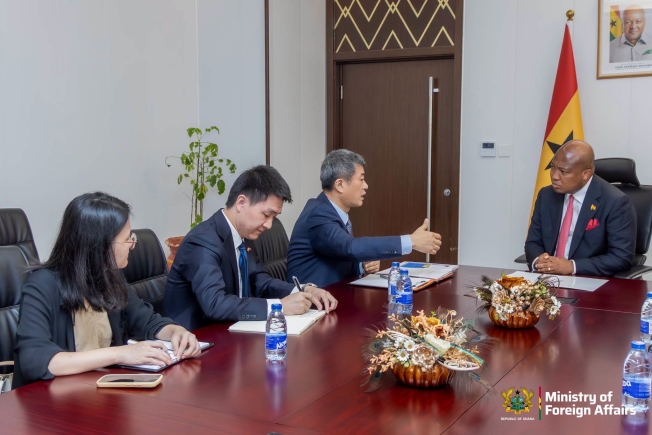
Ghana's decision to formally apply to belong to the BRICS bloc, as announced by the Foreign Minister, Samuel Okudzeto Ablakwa, on October 6, and clarified by President John Dramani Mahama is one of the most significant foreign policy shifts in recent years.
"We seek wider opportunities for trade, investment and industrialisation and also value addition, while sustaining our longstanding relationships and working relations with our traditional partners," President Mahama told the newly commissioned ambassadors at the Jubilee House on October 16.
In other words: Ghana is not leaving the West.
It is hedging, diversifying and seeking new leverage.
That is a deliberate, mature strategy. It deserves support, but also scrutiny.
First, let us be clear about what BRICS is and what it is not.
BRICS — now 11 full members, namely Brazil, Russia, India China, South Africa, Egypt, Ethiopia, Iran, Indonesia, Saudi Arabia and the UAE, with 10 partner countries, including Nigeria and Uganda — is not a military alliance.
It is not an ideological club. It is an economic platform of the Global South seeking to reshape a global order that has often disadvantaged developing nations.
Its core agenda is simple: more trade among themselves, more development financing outside the Bretton Woods conditionalities, more voice in global governance and more value addition to raw materials.
For Ghana, that agenda resonates deeply.
For decades, the nation’s development partnership has been heavily tilted towards traditional Western partners — the European Union (EU), the United Kingdom (UK), the United States (US), and the Bretton Woods institutions, the World Bank and the International Monetary Fund (IMF).
Those partnerships have brought aid, investment and market access, but also persistent complaints: raw cocoa exported and chocolate imported, raw gold exported and jewellery imported, IMF programmes that stabilise but also squeeze, trade terms that preach value addition but reward raw commodity exports.
BRICS offers an alternative narrative. China is already Ghana’s largest trading partner and infrastructure financier.
India is a major source of pharmaceutical products and technology.
Brazil has expertise in engineering and tropical agriculture that our nation desperately needs.
The UAE and Saudi Arabia have sovereign funds dedicated to African agribusiness and energy investments.
The BRICS New Development Bank (NDB) offers infrastructure loans without the kind of political conditionalities that often accompany Western lending.
President Mahama is, therefore, right to frame this as broadening partnerships and deepening South-South cooperation, guided by Article 40 of the 1992 Constitution which enjoins the nation to promote its interests and contribute to a just and equitable international order.
But strategy must be more than symbolism.
Applying to be a partner country — a status that allows participation in meetings without full obligations — is prudent.
It gives us time to learn and negotiate.
However, partner status alone does not automatically bring factories or markets.
Nigeria has been a partner since January 2025.
What has it gained that Ghana can learn from?
We must have a clear BRICS trade and industrialisation strategy: Which specific value chains — cocoa processing, bauxite refining, lithium battery production, garment manufacturing — will we push with BRICS partners?
Which tariffs will we seek to reduce? Will the NDB fund our railways and industrial parks at better rates than other lenders?
Our government must ensure that any new BRICS financing is transparent, concessional, and aligns with our debt sustainability framework.
Diversification should not mean swapping one dependency for another.
We must avoid the trap of pledging our lithium, bauxite, cocoa or any resource for quick loans.
The nation’s strength has always been its non-aligned, principled foreign policy — friend to all, enemy to none.
BRICS include Russia and Iran, both under heavy Western sanctions.
We must make it clear that economic partnership does not mean diplomatic alignment in the conflicts in Ukraine and the Middle East.
We cannot afford to be seen as taking sides in a new Cold War.
In the end, our BRICS application reflects a global reality: the unipolar world is gone.
The future is multipolar.
Middle powers like our country must navigate by interest, not sentiment.
Joining BRICS does not mean abandoning the Commonwealth or ECOWAS or our EU trade agreements.
It means Ghana is finally acting like a sovereign nation that shops for the best deal for its people.
The President has set the direction. It is now up to our diplomats, trade negotiators and economic managers to turn the association into factories, jobs and value for our farmers and the youth.
