
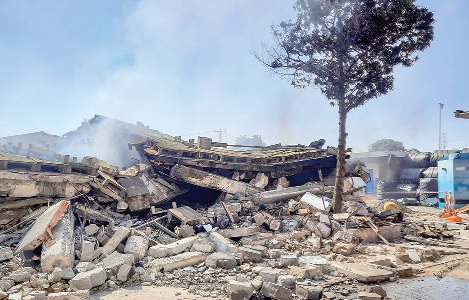
The pictures tell the story.
Thick black smoke billowing over the Accra skyline.
Warehouses burning.
Water tanks melting. Makeshift wooden structures reduced to ash.
For more than eight hours last Thursday, the North Industrial Area at Avenor was an inferno.
The Ghana National Fire Service (GNFS), with support from the Ghana Police Service, the 48 Engineer Regiment of the Ghana Armed Forces, the National Disaster Management Organisation, the National Ambulance Service, the Accra Metropolitan Assembly and private water tankers, battled to confine the fire that started at about 7 a.m. from wooden structures squeezed between Ashfoam Ghana, a mattress and furniture manufacturing company and Duraplast Limited, a plastics manufacturer.
Two people are feared dead. Eyewitnesses said it started with a small gas cylinder used by one of the squatters exploding.
One cylinder, one spark and an entire industrial enclave went up in flames.
That, in itself, is the indictment.
Avenor is not a slum at the edge of town.
It is the North Industrial Area — the heart of Accra’s light manufacturing. It houses foam factories, plastics factories, cable manufacturers, warehouses full of high-capacity plastic water tanks and other highly combustible materials.
These employ thousands.
They supply markets across West Africa.
Yet, between these factories, we have allowed wooden structures, squatters and informal settlements to grow unchecked.
It emerged that a team was initially dispatched from the Kwame Nkrumah Interchange Fire Station and arrived promptly, but its access to the fire front was severely impeded.
Numerous trucks parked along the road prevented direct access, forcing the team to take a longer route to approach from the rear.
The question is: why were they allowed there in the first place?
This is the failure of spatial planning and enforcement.
The Accra Metropolitan Assembly, the Town and Country Planning Department, the Factory Inspectorate and the owners of the industrial facilities all share responsibility.
If we had enforced the law, the cylinder explosion might have burned one structure, not threatened Duraplast and Ashfoam.
Warehouses close to the affected structures contained large quantities of combustible materials that could have fuelled the fire further.
Firefighters were able to salvage some items and the value of property saved was significant.
But they should have been able to salvage everything.
We must commend the emergency services while equipping them better.
Dozens of fire engines and private water tankers were deployed.
Squatters and residents were evacuated.
The coordination was exemplary.
But we must ask: does the GNFS have enough fire hydrants with adequate pressure in the industrial area?
In many parts of Accra, firefighters arrive and find hydrants dry or absent, forcing them to shuttle water.
Private tankers filled the gap last Thursday, but that is not a sustainable system.
The 48 Engineer Regiment’s role also shows how firefighting in congested Ghanaian cities has become a military engineering operation.
That is not normal. Access roads should already exist.
And there is the environmental cost.
Burning plastics releases dioxins and other toxic fumes.
Thursday’s thick plumes were not just smoke.
They were poison drifting over Accra.
The AMA must conduct a full audit of all industrial enclaves in Accra — North Industrial Area, South Industrial Area, Abossey Okai, Kaneshie — and demolish all unauthorised structures in buffer zones, not after fires but before them.
The Accra Metropolitan Chief Executive, Michael Kpakpo Allotey, has given an assurance that squatters will not be allowed to return and debris will be cleared.
That assurance is welcome, but we have heard it before after Kantamanto and Agbogbloshie.
Factory owners must take responsibility for their perimeters.
They cannot rent out or ignore encroachment on their borders.
The GNFS must publish a fire risk map of Accra and be empowered to close down facilities and settlements that pose imminent danger.
Prevention is cheaper than response.
The Avenor fire was not an accident.
It was a tragedy foretold. We knew the risk.
We saw the wooden structures between two factories full of combustibles.
We saw trucks blocking access.
We knew gas cylinders were being used in shacks.
Now that it has happened, let us not simply clear debris and move on until the next fire.
Let us clear the rot in our enforcement system.
