

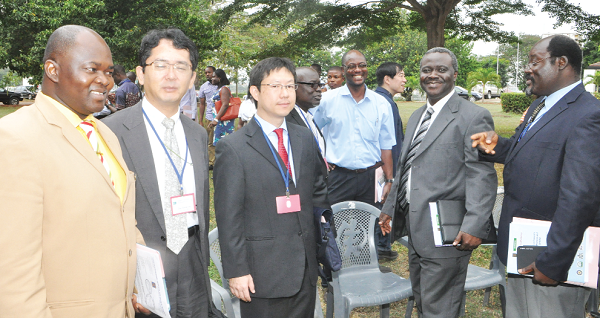
 Director of Institutional Care of the Ghana Health Service (GHS), Dr Samuel Kaba, has urged the government to focus more on research, since it was the key to national development.
He said whereas developed countries such as the United States of America (USA) spent a lot on research, the same could not be said of Ghana.
Dr Kaba said this at the opening of a day’s workshop on ‘Establishment of Effective Research Network for Infectious Diseases and Medicinal Plants in Ghana,’ organised by the Noguchi Memorial Institute for Medical Research (NMIMR) and the Japan International Cooperation Agency (JICA) under its Science and Technology Research Partnership for Sustainable Development (SATREPS) project.
The SATREPS project is a Japanese Government programme that promotes international joint research targeting global issues. In Ghana, it is a collaborative research endeavour among Noguchi, the Mampong Centre for Scientific Research into Plant Medicine, the Tokyo Dental and Medical University and Nagaski International University.
The workshop, which was part of the 65th anniversary celebration of the University of Ghana, was aimed at bringing together researchers to discuss and share ideas on plant medicines.
Dr Kaba, who represented the Director-General of the GHS, Dr Ebenezer Appiah Denkyira, said it was time the country encouraged and prioritised research as part of its educational culture, since that was the gateway to development.
Statistics
Giving statistics, Dr Kaba said the US Government in 2004 spent $18.3 billion on medical research while the European Union, which had a larger population, spent $3.7 billion and observed that this was the reason why the whole world depended on the US for health care and for other things.
According to him, America leads the world virtually in every discipline including health care and that the American medical research industry produces more than half of the $175 billion of healthcare technology products purchased globally.
He said it was only through research that the country could avoid the many painful deaths due to the syndrome of ‘no beds’, and the numerous pregnant women who die in labour because there was no blood or there was a late referral.
Dr Kaba also said the GHS was fully committed and would support the private sector, as well as any form of service delivery including traditional health for better service delivery for the people.
The Chief Representative, JICA Ghana Office, Mr Jiro Inamura, said while the goal of scientific research of medicinal plants was straightforward, achieving it required interdisciplinary research, development of tight network among researchers of diverse fields and continued strong support by governments.
He also said the workshop would result in synergy of different institutional perspectives and experiences, as well as better understanding of microbiology and phytochemistry, which would certainly contribute to new discovery and improved public health through more efficient control of infectious diseases.
The Deputy Director, Noguchi Memorial Institute for Medical Research, University of Ghana, Professor Kwabena Mante Bosompem, said “herbal medicine has its roots at the very beginning of human history on every continent and enthusiasm for this ancient form of medicine has never been less”.
He added that the institute’s research into plant medicine was making good progress, with the discovery of a potential treatment for sleeping sickness, known as trypanosomiasis.
The Pro-Vice Chancellor, University of Ghana, Professor John Owusu Gyapong, who chaired the opening session, called on the government and the GHS to be more open on the use of plant medicine as an alternative form of treatment in the country.
By Rebecca Quaicoe-Duho/Daily Graphic/Ghana
Writer’s email:
