

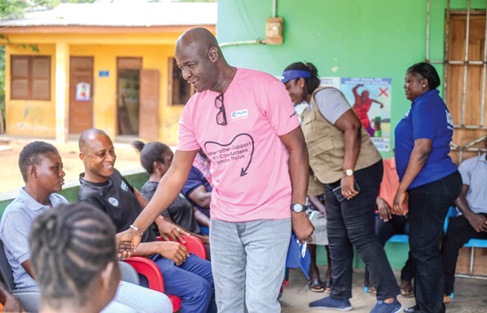
Girls in 20 basic schools in the Oti and North East regions of the country have been provided with girl-friendly latrines with changing rooms to help keep them in school even when menstruating.
Ten of the facilities are in basic schools in the Jasikan Municipality, and the other 10 are in basic schools in the West Mamprusi Municipality.
Plan International Ghana, a development NGO that promotes children’s rights and equality for girls, provided the latrines under its Integrated Package for Sustainable Development Project (IPADEV).
Under its Southern Programme Influencing and Impact Area (SPIIA) project, Plan International Ghana is additionally constructing two girl-friendly latrines and renovating four for some basic schools in the Oti Region, namely Likpe Todome, Gbledi Chebi, Gbledi Gbogarme, Liati Wote, Santrokofi Gbordome and Fodome Woe.
The Project Manager of Plan International Ghana IPADEV project, William Domapielle, disclosed this during a three-day media training organised by Plan International Ghana at Ho in the Volta Region.
The training was to equip the journalists with a comprehensive knowledge of Plan International Ghana’s projects and initiatives to enable them advocate power for most vulnerable children.
Why provision
Explaining why his outfit provided those basic schools with the girl-friendly latrines, Mr Domapielle said they realised that most of the basic schools in those districts did not have latrines, while for those that had, they were the local ones that did not offer privacy for girls when they wanted to use them.
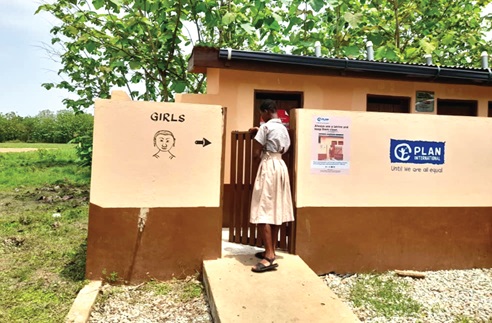
A female student of Atonkor MA JHS, entering a girl-friendly latrine provided by Plan International Ghana
In addition, while some of those local latrines in those schools had caved in, others were in a dilapidated state and naturally did not have changing rooms that the girls could use.
As a result, he explained, for many of the girls, when they were in school and menstruating, they went to the bush to change themselves, which exposed them to harm.
He said others also chose never to come to school until they finished menstruation, while others also went home with the excuse of going to change themselves, but never returned to school.
"Many of them, when they are in their menses, stop attending school because they fear they may go and stain their uniforms.
So they wait until after their menses are over and start attending school, and that affects them academically.
So that is why we feel that there should be a specialised place in the school where they could feel free to go and change," Mr Domapielle said.
Girl-friendly latrines
He pointed out that the provision of girl-friendly latrines was a problem for basic schools and, therefore, advised contractors to follow the policy on school construction by ensuring that all the structures that were needed in schools were provided during construction, adding that there should be the classrooms, furniture and latrines.
"If you are constructing a school, it’s a whole set - There must be the classroom, furniture, and there should be latrines.
But these things are not being followed," he stated.
During a visit to Atonkor in the Buem Traditional Area of the Jasikan Municipality, Daily Graphic learnt from the Headmaster of Atonkor M/A JHS, George Adzaklo, that hitherto before the construction of a girl-friendly latrine in the school, school attendance was not encouraging because the girls feared that when they came to school in their menstruating state and soiled themselves, they would be laughed at, for which reason they stayed away from school till they were done.
He stated that formerly about five girls could absent themselves from school at a time when they were menstruating, but this was no longer the case with the construction of the girl-friendly latrine and changing room by Plan International Ghana.
A JHS Three female pupil of the school, Martha Giozah, thanked Plan International Ghana for the provision of the girl-friendly latrine in her school, stating that it had gone a long way to help them as girl-children.
She explained that formerly, when the school did not have the facility, she had to go home and change herself and return to school anytime she was menstruating.
She confessed that although she was not using menstruation and the absence of a convenient place to change herself as an excuse to skip classes or school, she knew some female colleagues who were doing that.
