

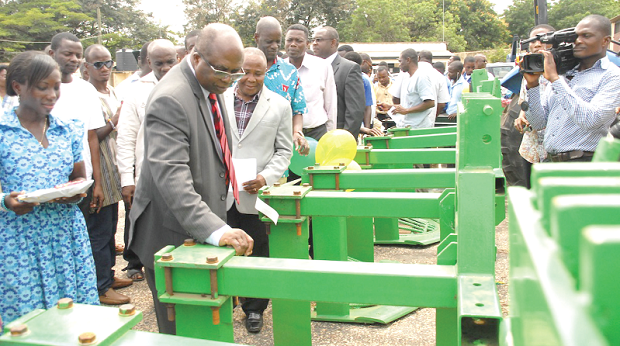
 The Ministry of Food and Agriculture (MoFA) has taken delivery of five mechanical cassava harvesters to boost the production of cassava in the country.
The equipment, designed and manufactured by the Kwame Nkrumah University of Science and Technology (KNUST), is aimed at increasing efficiency and productivity in cassava production and reducing the drudgery and fatigue involved cassava farming.
It was handed over to MoFA by the Council for Scientific and Industrial Research (CSIR), the implementing agency of the West Africa Agriculture Productivity Programme (WAAPP), which funded the manufacture of the equipment.
Speaking at a short ceremony in Accra yesterday, the Minister of Food and Agriculture, Mr Clement Kofi Humado, said the equipment was in line with the ministry’s policy to promote cassava production, processing and marketing.
“For some time now cassava cultivation has predominantly been practised on a subsistence scale with the application of rudimentary technology, resulting in low productivity.
“However, with the introduction of improved high-yielding cassava varieties through the Root and Tuber Improved Marketing Programme (RTIMP), we need to move cassava production from the subsistence to the commercial level,“ he said.
Mr Humado said currently, demand for cassava was increasing to meet the demands of the brewery industry and for the export of starch, adding, “Guinness Ghana Limited and Accra Brewery have made innovative strides in using cassava starch in the preparation of beer.”
According to him, Ghana had also signed a sanitary and phytosanitary (SPS) agreement with China for the export of cassava starch, making demand for cassava to go up.
He, therefore, expressed the hope that the new technology would be transferred to local manufacturers to fabricate “this model of the harvesters for farmers”.
The Director of the Agriculture Extension Services Department of MoFA, Mr Joseph Kwasi Boamah, in his welcome address, said the equipment would increase the production of cassava.
He said the equipment, when fully adopted by farmers, would not only make cassava farming appealing to the youth but also improve the well-being of rural farmers.
By Dominic Moses Awiah/Daialy Graphic/Ghana
