


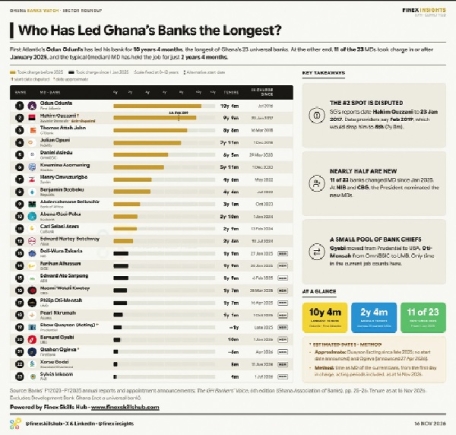
Of the country’s 23 universal banks, 11 are currently headed by managing directors or chief executives who took charge from January 2025 onward. That is almost 48 per cent of the entire industry.
Yet, at the other end of the spectrum sits a small group of long-serving executives, led by the First Atlantic Bank Managing Director Odun Odunfa, who has been in charge for more than a decade.
The result is a banking leadership landscape divided between veterans and relative newcomers.
The First Atlantic Bank records show that Odun Odunfa joined as managing director and chief executive officer in July 2016. By November 16, 2026, his tenure had reached approximately 10 years and four months.
He is followed by the GTBank Ghana Managing Director Thomas Attah John, who took charge in March 2018 and the Fidelity Bank’s Julian Opuni, who became Managing Director in December 2018.
Société Générale Ghana’s Hakim Ouzzani comes next. Although some of the bank’s later corporate records associate his name with a January 2017 appointment date, its 2017 annual report shows that he was then a non-executive director, while Sionle Yeo remained Managing Director. Other corporate records place Ouzzani’s assumption of the CEO role in February 2019.
Distinction matters
Nearly half of Ghana’s bank chiefs arrived since 2025.
The more striking story, however, is not who has stayed the longest. It is how many leadership changes have taken place recently.
Since the beginning of 2025, the NIB, the GCB Bank, the ADB, the Consolidated Bank Ghana, the UMB, the Access Bank, the Prudential Bank, the UBA Ghana, the FirstBank Ghana, the Standard Chartered Ghana and the First National Bank Ghana have all experienced changes at the top.
The reasons vary
Some were ordinary succession exercises. Pearl Nkrumah succeeded Olumide Olatunji at the Access Bank in October 2025. Sylvia Inkoom replaced Warren Adams at the First National Bank in July 2026. Xorse Godzi succeeded Mansa Nettey at the Standard Chartered in June 2026.
Others involved executives moving between Ghanaian banks. Bernard Gyebi moved from the Prudential Bank to become the UBA Ghana’s MD in January 2026. Philip Oti-Mensah, previously an executive at the OmniBSIC, took over at the UMB in April 2025.
Leadership changes at some state-linked institutions also coincided with Ghana’s change of government.
President John Mahama nominated Doli-Wura Zakaria to lead the National Investment Bank and Naomi Wolali Kwetey to head the Consolidated Bank Ghana in early 2025.
The result is a sector where institutional memory at the top varies dramatically from bank to bank.
The median bank chief has served for only two years four months.
When the tenures of all 23 current bank chiefs are ranked, the midpoint is only about two years and four months.
That statistic captures the scale of the recent turnover better than the average would.
Eleven current bank chiefs have been in their positions for less than two years. Only six have served for more than five years.
This creates an interesting leadership structure. Some institutions have executives who have steered them through the banking-sector clean-up, the COVID-19 shock, Ghana’s sovereign-debt crisis and the Domestic Debt Exchange Programme. Others are being led by executives who inherited their institutions after the most difficult part of that cycle.
Regulatory clock
Longevity in banking leadership is not unlimited.
Bank of Ghana’s Corporate Governance Directive provides that the tenure of a bank’s managing director or chief executive officer is subject to a maximum of 12 years, generally structured as up to three terms of four years each.
That makes Odunfa’s tenure particularly noteworthy.
At approximately 10 years and four months as of November 2026, he remains below the regulatory ceiling, but the succession question will increasingly become relevant as he moves closer to 12 years, subject to the terms of his appointment and applicable regulatory approvals.
Ghana’s banking sector is entering a new leadership era.
The numbers point to more than a ranking of individual executives.
Ghanaian banking is entering a period in which many of the people running the country’s largest financial institutions are relatively new to their roles at the same time.
Opportunity
New leadership can accelerate digital transformation, reshape lending strategies and bring different approaches to customer experience and risk management.
But frequent leadership changes also make strong boards, succession planning and institutional systems more important, because banks cannot afford for strategy to depend excessively on one individual.
For customers and investors, the real question is ,therefore, not simply who has served longest.
It is which banks can combine leadership continuity with the ability to renew themselves when the time comes.