


Oko ‘See Before’ is a well-known fisherman in Jamestown, an indigenous Ga fishing town in the city of Accra.
With over 30 years of plying the fishing trade in the community, Oko is readily able to make out new faces around.
It was with this precision that he approached the GRAPHIC BUSINESS team which was at the James Town beach to capture the business mood, challenges and prospects of the buffeted fishing sub-sector. Oko had a lot to share and leads to provide.
After about an hour of interaction and accompanied walk around the ‘fishing harbour,’ it was clear how rising cost of fishing inputs, including premix fuel, unapproved fishing methods, poor sanitation and climate change have conspired to rob fishermen and fishmongers dearly of their livelihoods and economic prospects.
“Fishing is no longer lucrative. We go fishing all night and this is all we had,” Oko ‘See Before’ told the GRAPHIC BUSINESS, pointing to a sizeable catch of about two kilogrammes as the toil of about five fishermen.
The fisheries industry is an important sub-sector, being the preferred source of animal protein in Ghana. It accounts for an estimated 25 kg per capita consumption per annum and also contributes to 60 per cent of animal protein intake.
The agriculture sector, of which fisheries is a sub-sector, doubled its growth rate of 2.3 per cent in 2012 to 5.2 per cent in 2013. The growth drivers for that year were the crops sub-sector (which grew by 5.9 per cent), livestock subsector (5.3 per cent) and the fishing subsector (5.8 per cent).
The sub-sector also employs over two million fishermen, processors and traders, according to the Ministry of Food and Agriculture. About 75 per cent of the total domestic production of fish is consumed locally.
Conspicuously absent during the visit on September 15 was the usually busy, noisy and singing of traditional songs that accompany the pulling of nets onshore.
As of 6:30 a.m. when most of the canoes had returned from the high seas, there was a few catch for the small number of fishmongers, mostly women, who had been waiting since dawn to get some fish stock for resale.
And only a few people were seen standing on the shore to observe or buy from source, unlike formerly when half of the community awaited the return of the fishermen from sea.
Fishing is a major source of livelihood for most inhabitants of Jamestown. The place is also a central source of fish stock for customers who travelled there from other communities to buy in bulk.
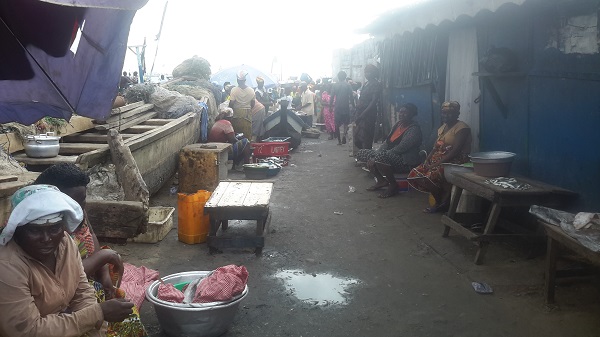
The GRAPHIC BUSINESS team observed that most of the canoes returned with very little catch, just like Oko had pointed to earlier.
Other fishermen corroborated the account of ‘See Before’, saying fishing was now a real nightmare and catching large stock and other seafood was a miracle even during the peak period of between June and September.
Consequently, the proceeds they get fall far short of the cost of fishing.
Cost of fishing inputs
Prices of their working tools have gone up in equal measure. They told the GRAPHIC BUSINESS that an outboard motor which used to sell between GH¢7,000 and GH¢8,000 now goes for GH¢13,000. That applied to fishing net, the price of which has risen to GH¢130 from GH¢60 last year.
A gallon of pre-mix fuel has increased from GH¢5.70 to GH¢7.10. In the absence of subsidised premix fuel, they said, they bought petrol from the open market and mixed it with engine oil before it was ready for sea.
“Normally, during the peak fishing season, we get the subsidised premix fuel twice a week but this is not enough so we need to increase the frequency to at least thrice a week,” the Chief Fisherman of Jamestown, Nii Okai Okaishie III, said.
He said the absence of subsidised inputs was having a toll on their business and did not also ensure the regular supply of fishing inputs which has been the case for the past two years.
Now, due to irregular supply, he said they are forced to buy the needed tools for their trade at open market price, something he said was having a negative impact on their businesses.
He thus appealed to the government to help their business by sustaining subsidies on the tools they use.
“The petrol is not enough. The fishermen are more than the fuel. At first, a supply of 2,000 gallons can last a week or more depending on the season, but now the same quantity lasts just three to four days,” fisherman Oko explained.
Challenges
Other challenges they mentioned included irregular supply of premix and the bad fishing practices by some unscrupulous fishermen who engage in using light bulbs to attract fish.
The fisher folk also face a unique challenge of climate change, which has brought in its wake false predictions as to the appropriate periods for making huge catch.
“Now we don’t even know the season and so we are not sure when we will get bumper harvest. I think that climate change thing they are talking is also a factor,” Oko said.
The GRAPHIC BUSINESS team realised that Jamestown beaches are not lit with streetlights and that allows miscreants and other criminals to use the beaches as hide-out.
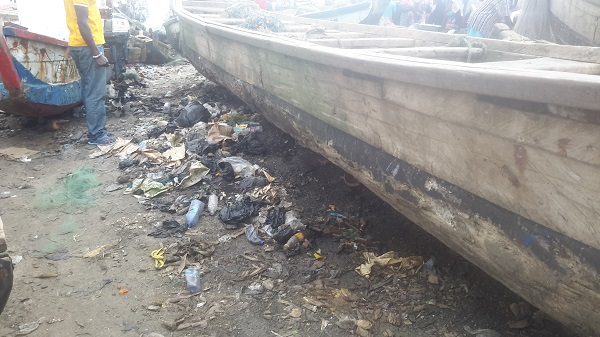
These miscreants leave behind piles of debris which contribute to low catch, the fishermen revealed.
“The sanitation in the area is not good. There are no lights here. No one can pour refuse or defecate here if there is light. We will clean the beach and the next morning, people will come to mess this place up,” he lamented.
They said the recent demolition of the Mensah Guinea slum, near the National Arts Centre, had worsened the situation as the affected residents have now moved to the beach.
The cry of fishmongers
Most of the women said they now dread they might not get fish to buy in bulk and resell.
Madam Eleanor Mensah, one of the fishmongers, said her business was in its worst moments after more than 32 years in the business of buying, smoking and storing fish for retail.
She said they equally shared in the woes of the fishermen, explaining that “when business is good I am able to sell about 15 to 20 cartons of fish a day.”
However, due to declining catch, a carton of fish, which costs between GH¢100 and GH¢150, depending on the weight, now sells for GH¢200 or above due to scarcity.
Food and agriculture
Fish is one of the country’s non-traditional export commodity and the fisheries sub-sector accounts for about five per cent of the agricultural Gross Domestic Product (GDP), according to the Ministry of Food and Agriculture.
Export earnings from fish and fishery products on average account for US$60 million annually.
The fishing industry in Ghana is based on resources from the marine, inland (freshwater) and aquaculture sectors.
The Volta Lake, reservoirs, fishponds and coastal lagoons are the main sources of freshwater fish. GB
Writer’s email: