


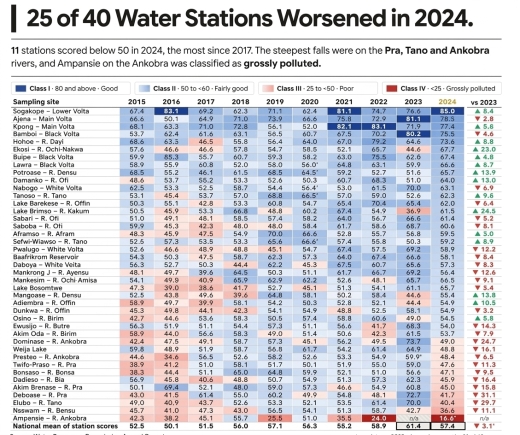
For six years, the numbers moved in the right direction. In 2015, 16 of Ghana's 41 river and lake monitoring stations scored below 50 on the Water Resources Commission's (WRC) Water Quality Index, the line between “fairly good” and “poor” water. By 2021, only three did.
In 2024, that run ended. Of the 40 stations sampled in both 2023 and 2024, 25 recorded lower scores. Eleven stations finished the year below 50, the most since 2017. Ampansie, on the Ankobra River, scored 19.8 and was classified “grossly polluted”, the index's worst category.
The national average of station scores fell from 61.4 to 57.4. That figure overstates the slide slightly, because Ampansie could not be sampled in 2023. Comparing the same 40 stations in both years, the average fell 3.1 points, from 61.4 to 58.3.
Where the water got worse
The steepest falls were in the south-west. Daboase on the River Pra dropped 31.1 points, Elubo on the Tano 29.7 and Dominase on the Ankobra 24.7. These are the river basins where the WRC and successive governments have linked pollution to illegal gold mining or galamsey.
The index alone cannot prove cause. Each annual score averages just two samples, taken in February and July, and rainfall can swing a single reading. But the pattern matches what the people who treat this water report.
From index to invoice
Daboase is not only a monitoring station. The town is also home to a Ghana Water Limited (GWL) intake on the Pra that feeds a treatment plant serving the Takoradi area. In August 2026, raw water there was reported at 11,955 NTU of turbidity (a measure of how cloudy water is), about 24 times the permitted 500 NTU. Only two of the four intake pumps were working.
Muddy water is expensive water. The GWL's Managing Director, Adam Mutawakilu, said in January that the utility has switched from alum to poly-electrolyte to treat cloudier water, at about four times the cost. In October 2025, he put the cost of desilting major intakes at about GH¢300 million, excluding the Barekese Dam.
The GWL's operating spending rose from about GH¢4.1 billion in 2023 to GH¢5.5 billion in 2024, according to figures from its tariff proposal reported by JoyNews. Not all of that is pollution. Inflation reached 23.8 per cent by December 2024 and a weaker cedi raised the cost of imported chemicals and equipment. Adjusted for inflation, the rise is about eight per cent, not the headline 34 per cent. It is still a real increase and the GWL names treatment chemicals among the drivers.
The utility asked the regulator for a 280 per cent tariff increase in 2025.
The Public Utilities Regulatory Commission approved 4.02 per cent for 2025 and 15.92 per cent for 2026. The rest of the cost does not disappear. It is carried by the utility's finances, by the state, and by households that buy sachet water when the taps run dry.
What to watch
There is some good news. The WRC reports that the national index recovered to 60.6 in 2025, with 25 stations improving and 16 declining. It credits enforcement by the National Anti-Illegal Mining Operations Secretariat (NAIMOS). But the commission also says it needs about GH¢500 million a year to monitor and protect the country's water properly.
Three things deserve attention. First, the WRC should publish its 2025 station-level data so the recovery can be checked river by river, not only as a national average. Second, enforcement must hold on the Pra, Tano and Ankobra, where the 2024 damage was deepest. Third, the WRC needs funding: an index sampled twice a year can raise the alarm, but it cannot fix the problem.
A final word on what the index measures. The Water Quality Index describes the condition of rivers and lakes at monitoring sites. It does not tell us whether tap water is safe to drink. It does tell us how hard and how costly it has become to make that water safe.
The writer is the Lead Trainer at Finex Skills Hub
Email: