


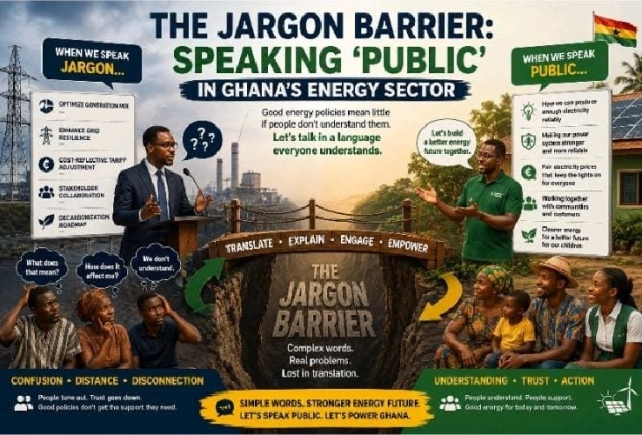
“When the public does not understand the "why” behind the cost, they resist the "how" of the payment”
Navigating Ghana's energy sector requires understanding a unique blend of engineering terms, financial concepts, and local policy frameworks. From the structural challenges of power agreements to the emerging opportunities in green industrialisation, technical jargon is common. This article breaks down complex industry jargon into simple, accessible language.
The technical communication challenge
Consider discussions on various media channels about tariff adjustments or power outages. When energy sector experts and practitioners explain these events using terms like "Dependable Capacity," "Commercial Losses," or "Take-or-Pay" contracts, they deliberately make it unclear and hard for the average Ghanaian consumer to understand.
The kitchen table test
The Kitchen Table Test could be standard for all external communication in the energy sector.
The premise is simple: Before issuing a press release, publishing a tariff notice, or granting an interview, test the content. Can a non-energy professional read it and, without assistance, understand exactly what it means for their livelihood and their pocket? If the answer is no, the communication needs to be reviewed.
Passing the Kitchen Table Test requires stripping away the engineering veneer to reveal the economic human story underneath. It requires analogies that resonate with daily Ghanaian life.
From the boardroom to public
To help policymakers, journalists, and corporate communications teams, this translation framework explains a few of the sector's most misunderstood concepts.
Concept 1: Take-or-pay contracts
The jargon:
"Take-or-Pay is a contractual obligation where the buyer (Ghana) must pay for a specified quantity of gas or power, regardless of whether it is actually utilised when dispatched."
The "Public" translation (the unused hotel room):
"Imagine you book a hotel room for a week but decide to sleep at home instead. The hotel still charges you for the room because you held the reservation. 'Take-or-Pay' means Ghana pays for gas and power capacity whether we turn the light switch on or not. We are paying for the 'reservation' to ensure power is available when we need it."
Concept 2: Commercial losses
The Jargon:
"Commercial losses refer to the difference between the amount of electricity supplied to the grid and the amount for which payment is received, excluding technical losses. It includes theft and billing inefficiencies."
The "Public" Translation (The Leaky Pipe):
"Think of the national grid like a giant water pipe serving a community. 'Commercial Losses' happen when people drill illegal holes into the pipe to steal water, or when the meters measuring the water are broken. The water company treats and pumps the water, paying all the costs, but never receives money for a large portion of it. Every cedi lost to commercial theft is a cost that must be covered by honest customers."
Concept 3: Installed vs. dependable capacity
The Jargon:
"Installed Capacity is the maximum theoretical output a plant can generate. Dependable Capacity is the actual output available for peak demand, accounting for maintenance and fuel constraints."
The "Public" Translation (Speedometer vs. Actual Speed):
"Your car's speedometer might show that the car can go up to 220 km/h—that is the 'Installed Capacity.' However, due to traffic, bad roads, or fuel quality, you can only safely drive at 100 km/h—that is the 'Dependable Capacity.' We have power plants that can produce a lot of electricity, but due to fuel issues or maintenance needs, among others, the reliable power we actually have available is often less."
Cost-reflective tariffs
Electricity prices that are set high enough to cover the actual, total cost of generating, transmitting, and distributing the power. When tariffs are not cost-reflective, the government usually has to step in and pay the difference (subsidise) to keep the power companies from going bankrupt.
Distribution losses
The amount of electricity that is generated but never paid for by a consumer. This happens for two reasons: "technical losses" (power lost as heat while travelling through old wires, etc) and "commercial losses" (power lost due to electricity theft, illegal connections, or unpaid bills, etc).
Independent power producers (IPPs)
Private companies that own and operate power plants to generate electricity, which they then sell in bulk to the national grid (usually to the government or a state-owned utility company).
Installed capacity
The absolute maximum amount of electricity that all the power plants in a country could produce if they were all turned on and running perfectly at the exact same time.
Load shedding
The deliberate, temporary, and scheduled turning off of electricity in certain areas. This prevents the national power grid from collapsing when demand exceeds available supply.
Peak demand
The specific time of day, or season of the year, when a country's population and businesses are using the highest amount of electricity.
Stranded assets
Expensive equipment or infrastructure (like power plants) that lose their value or become useless before they have paid for themselves. This usually happens due to poor planning, changes in technology, or lack of supporting infrastructure.
Take-or-pay obligations
A strict contract term in which the buyer (usually the government) agrees to pay for a specific amount of electricity or gas from a producer, regardless of whether the buyer actually uses it or needs it.
Transformation finance
Funding that goes beyond just building clean energy projects; it specifically aims to build local factories, transfer technology, and create domestic jobs. The goal is to transform the local economy, not just reduce carbon emissions.
Transition finance
Funding provided by international organisations or banks specifically to help a country move away from fossil fuels and deploy cleaner energy sources. Its primary goal is usually meeting global climate targets rather than local industrial growth.
Carrying the public along
By adopting the Kitchen Table Test and using these analogies, the sector can transform the public into informed partners. When citizens understand that "Take-or-Pay" is a sunk cost we already pay, or that "Commercial Losses" are theft that drives up their individual bills, the conversation shifts from blame to collective responsibility. Let us break the jargon barrier.