


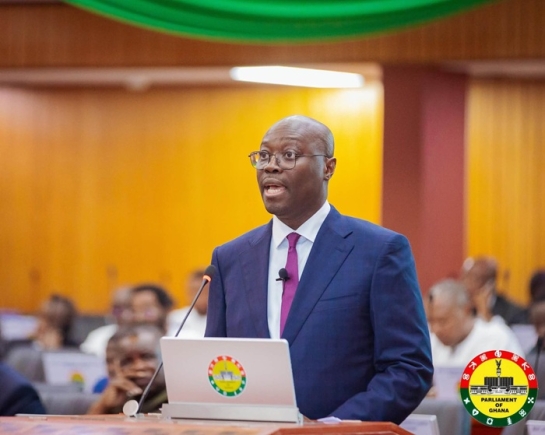
The Minister of Finance, Dr Cassiel Ato Forson has reaffirmed the government’s commitment not to introduce new taxes in 2027, assuring households and businesses that the administration will focus on improving revenue mobilisation and closing leakages rather than imposing additional tax burdens.
Presenting the 2027 Budget Statement and Economic Policy to Parliament on Thursday, November 12, 2026, Dr Forson said the decision forms part of the government’s broader efforts to ease the financial burden on households, support businesses and create a more favourable environment for economic growth.
"This 2027 Budget will not introduce any new tax. Our task is to collect what is lawfully due, close the leakages and make the revenue system work better," he stated.
He noted that since assuming office in 2025, the government had implemented several tax policy measures aimed at reducing the financial obligations of individuals and businesses, including the abolition of the Electronic Transfer Levy, the withholding tax on betting and lottery winnings, the COVID-19 Levy, the Emissions Levy and Value Added Tax on motor vehicle insurance.
"Since 2025, we have acted to give families breathing space and businesses room to grow," he said.
Dr Forson announced plans to review and modernise several tax laws and administrative frameworks in 2027, covering the Income Tax Act, the Revenue Administration Act, stamp duty administration and the Communications Service Tax framework.
The government also intends to review customs tariff and duty concessions on selected raw materials, machinery and other inputs to support local industries, while regulations will be developed to promote consistent application of the reformed tax laws.
Additionally, the Finance Minister said Ghana's Double Taxation Agreements would be reviewed in line with the United Nations Framework Convention on International Tax Cooperation to address tax evasion and treaty abuse while protecting legitimate investment.
He added that the government would strengthen dispute resolution mechanisms to make tax compliance simpler and less costly. "Taxpayers deserve clear rules, fair treatment and timely decisions," he stated.