


When the topic of geopolitical realignments comes up in public discourse, it frequently seems far away, confined to ministerial briefings, global communiqués, and diplomatic banquet halls.
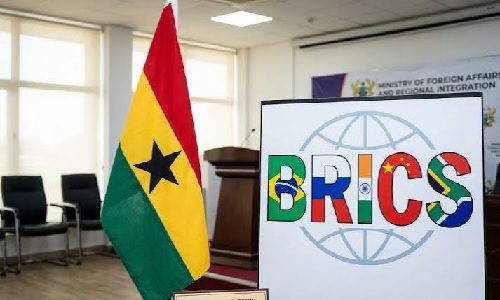
Ghana has made a bold diplomatic turn by formally announcing its intention to join the BRICS alliance. A deliberate plan to diversify bilateral dependence beyond conventional Western routes is indicated by the expansion of economic frontiers across Brazil, Russia, India, China, South Africa, and its more recent members.
However, when diplomatic spectacle is removed, macroeconomic realignments only matter in terms of how they impact regular business.
Every significant foreign policy choice must be considered at the shop floor, the agro-processing hub, and the local goods desk in an economy where micro, small and medium-sized firms (MSMEs) account for more than 70 per cent of GDP and more than 80 per cent of employment. I have discussed below how the BRICS will impact small business owners.
Currency cushioning
Foreign exchange volatility has traditionally been the main source of cash flow disruption for Ghanaian traders and small manufacturers. When the local currency undergoes significant cycles of depreciation, sourcing intermediate products, machinery, or inventories denominated in US dollars frequently erodes working capital.
Facilitating bilateral local currency settlement methods is a key architectural ambition of the extended BRICS framework.
Ghanaian small firms can avoid double-conversion markups and lessen their reliance on hard currency liquidity if institutionalised trade channels allow them to clear invoices directly in trading partner currencies such as the Chinese yuan or Indian rupee. Operational predictability greatly increases when a clothing manufacturer purchasing fabrics from Surat or an auto-parts dealer in Abossey Okai may settle transactions immediately without waiting in queue for limited commercial bank dollar allocations.
Multilateral financing access
The biggest obstacle facing Ghanaian business owners is still getting access to reasonably priced credit. Patient research, technology adoption and capital-intensive growth are all severely discouraged by local commercial loan rates, which frequently surpass 30 per cent.
The SME ecosystem is directly impacted by secondary ripple effects, even though multilateral lenders primarily fund state projects. The structural overhead costs that small farmers bear are lessened by investments in decentralised energy generation, cold-chain agricultural storage and logistical corridors.
Reverse-engineered innovation
The capital costs of patented technologies, proprietary software and Western industrial equipment sometimes exceed the balance sheets of domestic firms. In contrast, the BRICS economies are excellent at "frugal innovation," creating durable, affordable, and highly scalable industrial machinery that is designed to resist changing market operating conditions. Strengthening relationships with nations such as China and India creates organised channels for technology transfer in biotechnology, light-scale manufacturing, precision tooling and solar irrigation.
Affordable fabrication units, spare parts and digital enterprise tools designed for emerging economies can be imported by Ghanaian engineering firms, renewable energy installers and modular food processors. Local business owners can use useful, reasonably priced industrial systems that instantly increase shop floor productivity instead of waiting decades to adopt costly premium technologies.
Direct supply-chain diversification
Global supply disruptions over recent years underscored the vulnerability of small operations dependent on narrow, single-origin procurement corridors. When geopolitical tensions or maritime bottlenecks constrain conventional maritime routes, small businesses bear the brunt through inventory shortages and prohibitive freight charges. Joining an interconnected Global South alliance provides Ghanaian importers and exporters with a more diversified, resilient network of trade partners. Purchasing industrial chemicals and agricultural fertilisers from Brazil or technical components from India increases supplier possibilities and gives local distributors more negotiating power. At the same time, local high-value processors, such as artisanal chocolate makers, shea butter extractors, and specialty clothing designers, open unconventional export markets outside of North America and the European Union by gaining organised market access to large consumer middle classes throughout South America and South Asia.
Synergistic alignment with AfCFTA
As the African Continental Free Trade Area's (AfCFTA) institutional headquarters, Ghana is positioned as an operational link for the integration of commerce and manufacturing throughout the continent.
Combining the industrial might of the BRICS states with the regional trade liberalisation of the AfCFTA offers domestic businesses a special strategic platform. To meet regional rules-of-origin requirements and gain tariff-free access to continental consumer markets, BRICS multinational corporations are actively seeking to build production and assembly hubs inside Africa.
Ghanaian small and medium-sized enterprises (SMEs) in the fields of packaging, light logistics, outsourced component manufacturing, and professional services are well-positioned to form supply-chain connections and joint ventures with new industrial operators. Local businesses can integrate themselves as tier-two and tier-three suppliers into high-volume manufacturing value chains throughout West Africa rather than continuing to operate as independent vendors selling completed items.
Conclusion
Geopolitical agreements just create the diplomatic and legal framework that allows trade to occur; they do not automatically produce economic wealth. The state must combine diplomatic intent with strict domestic policy execution if Ghana's small business sector is to see significant benefits from BRICS membership. To safeguard local producers while optimising access to new markets, trade facilitation frameworks, strict product quality requirements, customs digitisation and trade-negotiation desks must be actively customised.
Moving toward a wider multipolar trading network is no longer an abstract geopolitical gesture when it is backed by purposefully constructed financial railroads, useful technological capacity-building and strong market linkages. Rather, it turns into a useful accelerator for domestic industrialisation, allowing Ghanaian business owners to create robust, internationally integrated and structurally sound businesses.
The writer is a
Senior Lecturer/SME Industry Coach
Coordinator (MBA Impact Entrepreneurship and Innovation)
University of Professional Studies Accra
IG: andy_ayiku
@AndrewsAyiku
F: Andyayiku