


An energy project in Africa may be technically sound and economically vital yet fail to materialise if the financing is too expensive. The cost of capital—driven by interest rates, perceived country risk, currency volatility, political instability and regulatory uncertainty sits at the very centre of Africa's energy future.
When investors demand higher returns to compensate for perceived risks, the consequences are tangible. Financing a solar, wind or gas project at a high interest rate requires much higher consumer tariffs or heavy government subsidies than financing the same project with cheaper, long-term capital. Consequently, Africa's energy challenge is fundamentally a financing challenge. To overcome this, policymakers and financial institutions are increasingly turning to specialised financing approaches.
Financing models
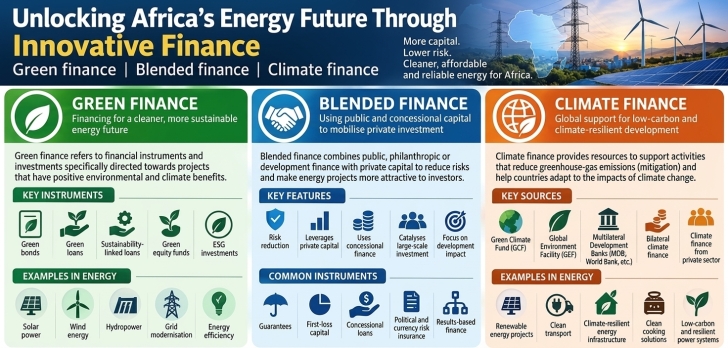
Green finance: Turning environmental objectives into investment opportunities
Green finance encompasses capital directed toward environmentally sustainable projects, including renewable energy generation, grid improvements and sustainable transport. Instruments such as green bonds, green loans, and sustainability-linked financial products let African governments and utilities tap a growing pool of global capital driven by Environmental, Social and Governance (ESG) mandates.
However, a critical misconception persists: green finance is not automatically cheap finance. A project labelled "green" does not inherently eliminate underlying financial risks such as creditworthiness, currency depreciation or political instability. For nations such as Ghana, leveraging green finance requires building credible, investment-ready project pipelines and establishing robust regulatory frameworks that instill investor confidence.
Blended finance: Catalysing private capital through public resources
Blended finance is arguably the most strategic tool available for African energy infrastructure. It combines public, philanthropic, or development finance resources with private investment to derisk projects and attract commercial capital. Mechanisms include guarantees, concessional loans and first-loss capital from Development Finance Institutions (DFIs).
This model is vital because Africa does not need public institutions to fund the entire energy transition. Instead, limited public capital acts as a catalyst. For example, if commercial banks view a renewable energy project as too risky due to off-taker concerns, a DFI guarantee can lower the risk profile enough to crowd in private institutional investors.
Blended finance must be meticulously designed. If governments absorb excessive downside risk while private investors reap most of the upside, it creates hidden public liabilities. Transparency, rigorous value-for-money assessments, and strong project governance are non-negotiable.
Climate finance: Bridging development needs and the global climate agenda
Despite contributing minimally to historical global greenhouse gas emissions, African nations are disproportionately vulnerable to climate change. Climate finance funds mitigation and adaptation efforts, offering a pathway to expand energy access and industrial capacity while transitioning to low-carbon systems.
To effectively utilise climate finance, African countries must shift their strategic approach. Climate finance should not be viewed merely as a pool of grants for isolated projects. Instead, nations must develop comprehensive, investment-ready programs backed by credible climate strategies and transparent systems for measuring environmental and social outcomes. The institutional capacity to prepare bankable projects is now as critical as the availability of the funds themselves.
Structural challenges
Foreign exchange risk is a pervasive threat to energy financing in Africa. Many energy projects generate revenue in local currencies (e.g., the Ghanaian Cedi or Kenyan Shilling) but are financed through debt denominated in US dollars or Euros. If the local currency depreciates, servicing foreign debt becomes much more expensive, undermining project viability and straining national utilities.
Addressing this requires innovative financing models that incorporate local-currency financing, currency guarantees, hedging instruments and the broader development of regional financial markets.
Moving from projects to platforms and leveraging domestic capital
Historically, Africa's energy investment has been approached on a fragmented, project-by-project basis. A more sustainable strategy involves creating energy investment platforms that aggregate multiple projects and pool risk-sharing mechanisms, government support, and private capital to mobilise billions at competitive rates.
Furthermore, Africa must look inward. African pension funds, insurance companies, and institutional investors control massive pools of domestic capital. With appropriate regulatory and risk-management frameworks, this capital can be channeled into long-term infrastructure, reducing reliance on foreign-currency borrowing and allowing African citizens to directly profit from their continent's development.
What’s next
The debate over Africa's energy future cannot be reduced to a binary choice between fossil fuels and renewables. The ultimate objective is to achieve reliable, affordable, sustainable and financially viable energy systems. Green, blended and climate finance are powerful tools, but their impact will be muted if the underlying cost of capital remains excessively high.
To derisk energy investments and ensure capital is affordable, patient and predictable, African policymakers particularly in nations such as Ghana should adopt a multi-faceted financing strategy:
Anchor capacity to reform: Ensure that new green generation capacity is matched with prior reforms in distribution infrastructure and tariff cost-reflectivity to prevent the creation of stranded assets.
Mandate technology transfer: Contractually specify local content requirements, skills transfer and domestic maintenance obligations in all international financing frameworks.
Deploy blended structures wisely: Utilise DFI guarantees and first-loss capital to crowd in private investment while maintaining strict transparency to protect public balance sheets.
Mobilise domestic institutional capital: Reform financial regulations to allow domestic pension and insurance funds to safely invest in local energy infrastructure platforms.
Mitigate FX risk: Prioritise local-currency financing and regional hedging mechanisms to protect projects from currency depreciation.
The energy transition requires technology, policy and infrastructure. But above all, it requires finance at the right price. That is the battleground where Africa's next energy revolution will be won or lost.