


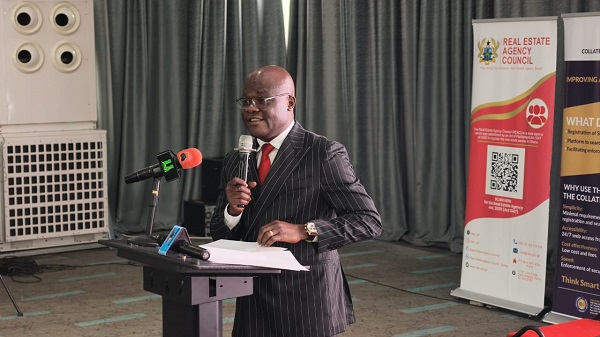
The Minister of Works, Housing and Water Resources, Ahmed Ibrahim, has called on the Bank of Ghana (BoG) to support the establishment of a dedicated development bank to provide affordable and long-term financing for the real estate and housing sector.
He explained that access to sustainable financing remained one of the major constraints to housing delivery, limiting the capacity of developers to acquire land, undertake construction projects and expand their operations.
He cited the former Bank for Housing and Construction, which supported the development of estates such as Dansoman, Kaneshie and Achimota, as an example of the role specialised financial institutions could play in accelerating housing delivery.
Opening a sensitisation programme on the Borrowers and Lenders Act, 2020 (Act 1052) in Accra on August 19, the minister urged the central bank to strengthen and resource Republic Bank or support the creation of a specialised housing development financing institution to mobilise private capital and help address Ghana's widening housing deficit.
"I want the Bank of Ghana to give us a development bank that will be anchored on providing the needed access to credit for the real estate sector.
“Growing up, I used to hear about the Bank for Housing and Construction. That is where Achampong was able to build the Dansoman Estate, Kaneshie Estate, Achimota and the Kumasi Low-Cost Houses,” he added.
Background
The sensitisation programme was organised by the Bank of Ghana in collaboration with the Real Estate Agency Council (REAC) to deepen practitioners' understanding of the Borrowers and Lenders Act, 2020 (Act 1052), and the operations of the Collateral Registry.
It was aimed at equipping estate agents and brokers with the knowledge to conduct proper due diligence, verify security interests and minimise risks associated with property transactions.
The programme also sought to strengthen collaboration between financial regulators and real estate practitioners to promote transparency, improve access to credit and build confidence in the real estate sector.
Housing deficit
The minister said the country's housing deficit, estimated at 1.8 million units in 2021, had since widened, making it imperative for the country to explore innovative financing mechanisms to accelerate housing delivery.
He stressed that the government alone could not bridge the gap and that greater private sector participation, supported by affordable credit, was necessary to meet the growing demand for residential, commercial and industrial properties.
He said the Borrowers and Lenders Act and the operations of the Collateral Registry provided opportunities for developers to leverage a wider range of assets to secure financing and undertake projects.
Mr Ibrahim said the framework would also improve transparency in credit transactions, reduce lending risks and strengthen confidence among financial institutions and investors in the real estate market.
He urged developers and other industry players to take advantage of the legal and financial arrangements to mobilise private capital, expand housing delivery and create sustainable employment opportunities.
Property transaction transparency
The Assistant Director at the Collateral Registry Department of BoG, Alexander Koomson, said the registry was helping to improve transparency in property transactions by enabling real estate practitioners to establish whether properties or other assets offered as collateral were already subject to existing financial obligations.
He explained that the facility would enable estate agents and brokers to conduct proper due diligence before facilitating property transactions, thereby protecting clients against financial losses, disputes and reputational risks.
He said the sensitisation programme was intended to deepen practitioners' understanding of the Borrowers and Lenders Act, 2020 (Act 1052), the operations of the Collateral Registry and the procedures for conducting searches and registering security interests.
Mr Koomson stated that the registry, which was operationalised by the BoG on February 1, 2010, was established to address information gaps in the credit market and improve lenders' ability to verify assets pledged as security for loans.
He called on participants to actively engage in the programme to acquire the necessary knowledge to strengthen due diligence, improve transaction security and promote confidence in Ghana's real estate market.
REAC pushes
For his part, the Acting Chief Executive Officer of the Real Estate Agency Council (REAC), Emmanuel Jeffrey, underscored the need for real estate practitioners to strengthen due diligence, transparency and regulatory compliance to protect clients and build public confidence in the industry.
He said the engagement with the BoG would enable practitioners and regulators to share experiences, identify emerging risks and address practical challenges confronting the sector.
Mr Jeffrey added that participants must apply the knowledge acquired to improve professional standards, strengthen collaboration and promote a more transparent and trusted real estate market.