


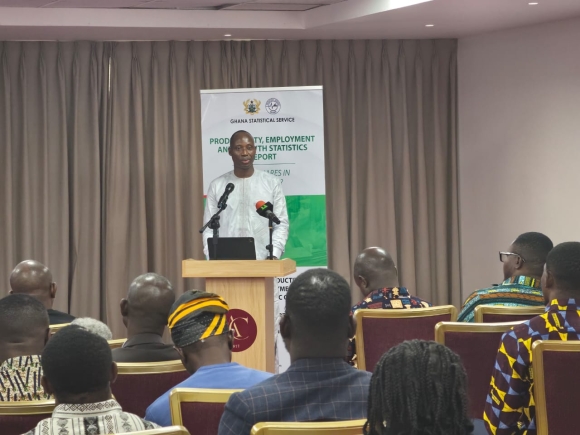
Ghana has recorded a 178 per cent increase in labour productivity over the past 34 years, but the improvement has yet to translate into commensurate earnings and secure employment for millions of workers, according to the Ghana Statistical Service (GSS).
The latest Productivity, Employment and Growth (PEG) Statistics Report, covering 1991 to 2025, shows that the average worker generated GH¢15,197 worth of economic output in 2025, compared with approximately GH¢5,000 in 1991.
Despite the significant improvement in output per worker, average annual earnings stood at GH¢9,388 in 2025, highlighting a persistent gap between the value generated by workers and what they receive in remuneration.
The findings were presented by Government Statistician Dr Alhassan Iddrisu at the launch of the second edition of the report at the Accra City Hotel on Friday, November 20, 2026.
The report provides a 35-year assessment of Ghana's productivity performance, examining developments across industries, employment conditions, youth participation and the relationship between productivity and workers' earnings.
Speaking at the launch, Dr Iddrisu said Ghana had made considerable progress in generating more economic value from its workforce but faced the challenge of ensuring that the benefits reached ordinary workers.
He stressed that economic growth alone was insufficient to improve living standards unless accompanied by sustained productivity improvements and better-paying employment opportunities.
The report indicates that approximately 13.3 million people are employed in Ghana, but the quality of available jobs remains a major concern.
About 86 per cent of workers are engaged in the informal sector, while 72 per cent are in vulnerable employment, characterised by limited income security and inadequate employment protection.
The figures underscore the structural weaknesses of Ghana's labour market, where rising employment numbers have not necessarily translated into stable livelihoods and improved working conditions.
Agriculture accounts for significant employment despite declining output share
The report also identifies a widening imbalance between the contribution of different sectors to economic output and their share of employment.
Agriculture's contribution to national output has declined from 49 per cent in 1991 to 23 per cent in 2025, although the sector continues to employ 37 per cent of the workforce.
Meanwhile, information and communication recorded annual productivity growth of approximately 23 per cent per worker but accounted for only 0.4 per cent of employment.
The disparity suggests that some of Ghana's most productive industries are generating relatively few jobs, while sectors employing substantial numbers of people continue to face productivity challenges.
Dr Iddrisu said the country needed to extend productivity-enhancing investments to agriculture and the informal economy, where a considerable proportion of the population earns its livelihood.
He argued that improving productivity in sectors employing the largest number of people would be essential to making economic growth more inclusive.
Youth unemployment exposes education-employment gap
Ghana's improving overall unemployment figures also mask persistent difficulties confronting young people entering the labour market.
Although the national unemployment rate declined for three consecutive years to 12.8 per cent in the first quarter of 2025, approximately one in three economically active young people aged 15 to 24 remained unemployed.
The situation was particularly concerning among secondary school leavers, whose unemployment rate stood at 36.2 per cent.
The findings raise questions about the alignment between educational outcomes and the skills demanded by employers, as well as the economy's capacity to create sufficient opportunities for new labour market entrants.
Dr Iddrisu called on employers to expand apprenticeship programmes and provide more opportunities for young people to secure their first jobs.
He also urged educational and training institutions to align their programmes with the changing requirements of the economy.
Slow investment in equipment threatens productivity gains
Another concern identified in the report is the sluggish growth in equipment available to workers.
Capital intensity, measured by equipment per worker, is increasing by only about one per cent annually, suggesting that businesses are making limited progress in providing workers with additional productive resources.
Dr Iddrisu said Ghana's next phase of productivity improvements would require more efficient use of existing resources, alongside greater investment in technology, skills and management practices.
He urged employers to prioritise workforce development and technological improvements, while calling on organised labour to use productivity evidence during wage negotiations to ensure that workers benefit when output increases.
The Government Statistician also called on government to make productivity a national development priority and establish consistent annual monitoring of key indicators.
PEG report to support economic policymaking
The second edition of the PEG Statistics Report builds on the inaugural publication launched in February 2025, extending its coverage from 1991–2022 to 1991–2025.
It incorporates more recent findings from the Quarterly Labour Force Survey and provides deeper industry-level analysis, with particular attention to employment quality, youth unemployment and the relationship between productivity and earnings.
The report is also intended to support monitoring of Sustainable Development Goal 8, particularly indicator 8.2.1, which measures annual growth in real GDP per employed person.
Dr Iddrisu said the GSS would continue publishing and updating productivity statistics annually, including regional analyses and detailed data tables, to strengthen evidence-based policymaking.
He called on government institutions, employers, organised labour, educational institutions and development partners to use the findings to improve productivity and employment outcomes.
The launch brought together representatives of the Bank of Ghana, government ministries and agencies, employer associations, organised labour, private sector operators, academia and development partners.
The programme featured remarks from the Swiss Embassy, represented by Magdalena Wüst, Deputy Head of Cooperation, followed by the presentation of the report, stakeholder discussions and its official launch.
The initiative received technical and financial support from the International Labour Organisation (ILO), with funding support from the Government of Switzerland through the ILO's Productivity Ecosystems for Decent Work programme.
Dr Iddrisu said Ghana's ability to compete under the African Continental Free Trade Area (AfCFTA), advance industrialisation and implement its 24-hour economy ambitions would depend significantly on the productivity of its businesses and workforce.
He said the ultimate objective should be an economy that creates not merely more jobs but better-quality employment, with improvements in productivity reflected in workers' earnings and living conditions.