


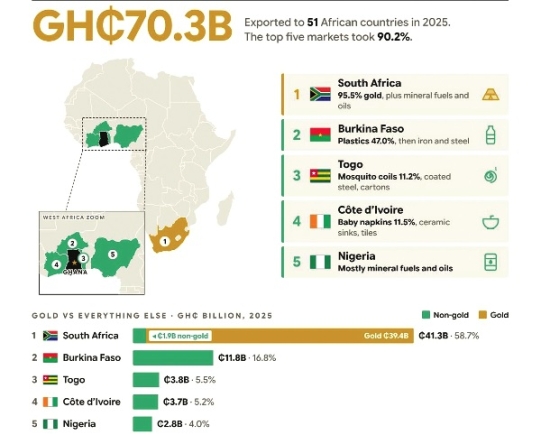
The country’s growing trade with neighbouring West African countries is providing a market for its manufactured and processed goods, with Burkina Faso, Togo and Côte d’Ivoire emerging as major destinations once gold exports to South Africa are excluded from the country's continental trade figures.
The country exported GH¢70.3 billion worth of merchandise to 51 African countries in 2025, equivalent to about US$4.5 billion, recording a substantial trade surplus with the continent.
However, the figures were heavily influenced by gold shipments to South Africa, which accounted for 58.7 per cent of Ghana's total exports to Africa, valued at approximately GH¢41.3 billion.
Gold bullion represented 95.5 per cent of those shipments, meaning that South Africa's position as Ghana's biggest African export destination did not necessarily reflect the strength of trade in locally manufactured products.
When gold is excluded, Ghana's exports to South Africa fall to approximately GH¢1.9 billion, leaving Burkina Faso as the country's largest non-gold African export market, with imports of Ghanaian goods valued at GH¢11.8 billion.
The figures point to a different picture of Ghana's continental trade, with neighbouring markets providing significant demand for products manufactured and processed locally.
Plastics accounted for approximately 47 per cent of Ghana's exports to Burkina Faso, alongside iron and steel products, fertilisers, ceramics and beverages.
Togo was the country's third-largest African export destination, importing goods valued at GH¢3.8 billion, representing about 5.5 per cent of total continental exports.
Its import basket included steel, plastics, chemicals, paper products and beverages, while Côte d’Ivoire imported approximately GH¢3.7 billion worth of Ghanaian goods, including ceramic products, tiles, sanitary fixtures and other consumer goods.
Nigeria ranked fifth, with imports valued at GH¢2.8 billion, although mineral fuels and oils accounted for slightly more than half of Ghana's shipments to that market.
Together, the five leading destinations, South Africa, Burkina Faso, Togo, Côte d’Ivoire and Nigeria, accounted for approximately 90.2 per cent of Ghana's exports to the continent.
Neighbouring markets matter
The Executive Director of the AfCFTA Policy Network Group, Louis Yaw Afful, said the composition of Ghana's exports and the tariff concessions available under the continental trade arrangement were important in understanding the figures.
He said tariff liberalisation had helped reduce the cost of exporting certain Ghanaian products, allowing businesses to improve their competitiveness and access markets that were previously difficult to penetrate.
"We have to look at the composition of the GH¢70 billion in exports. If a significant proportion is gold, we must separate that from the non-traditional products to understand what Ghanaian businesses are actually selling across the continent," he said.
Mr Afful said the growth in trade with Burkina Faso, Togo and Côte d’Ivoire was also influenced by geographical proximity, transportation costs and developments in the regional political and economic environment.
He explained that Ghana's position as a transit route for landlocked Burkina Faso had strengthened the commercial relationship between the two countries.
Expanding opportunities
Mr Afful said AfCFTA had nevertheless created opportunities for small and medium-sized enterprises (SMEs) to identify products for export and participate in regional value chains.
He said the availability of certificates of origin had enabled qualifying Ghanaian products to benefit from preferential tariff treatment in participating markets.
Using shea butter as an example, he said one business could supply the raw material, another could undertake processing, while other businesses could handle procurement, packaging and export.
Trade picture
The concentration of exports in gold raises questions about how Ghana measures its progress in expanding trade under the African Continental Free Trade Area (AfCFTA).
Although gold remains an important source of foreign exchange, its dominance in the export figures can obscure the performance of other sectors and the extent to which Ghanaian businesses are penetrating African markets.
The value of bullion shipments is also influenced by movements in international gold prices. Consequently, an increase in export earnings does not necessarily indicate a corresponding increase in the volume of goods produced or exported.
This means that the growth of trade with neighbouring countries has implications beyond the value of goods crossing Ghana's borders. It also provides an indication of the market available to local industries and the potential to expand production.
Founder and lead trainer of Finex Skills Hub, Bernard Obeng Boateng, said the value of intra-African trade should not be assessed solely by comparing its size with Ghana's exports to Europe or Asia.
"The distinction is important because manufactured exports have the potential to support several stages of domestic economic activity, from sourcing raw materials and processing to packaging, transportation and distribution". He said.
For Ghana, sustaining demand for these products in neighbouring countries could help manufacturers expand capacity and improve their competitiveness in the regional market.
Transport costs
The President of the Ghana Union of Traders' Associations (GUTA), Clement Boateng, also identified proximity and transportation costs as major reasons Ghanaian businesses traded more readily with neighbouring West African countries.
However, he cautioned that the continental trade arrangement had not yet delivered all the expected benefits to Ghanaian businesses.
He said traders and manufacturers continued to encounter tariff-related difficulties and regulatory requirements that made it difficult to enjoy the full benefits of the agreement.
"Although we are supposed to enjoy tariff-free trade, we are not there yet. There are still tariff issues and regulatory measures that businesses have to go through before they can benefit fully from the AfCFTA protocols," he said..