


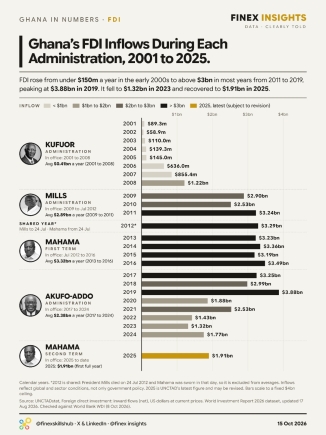
In 2002, foreign investors put $58.9 million into Ghana. In 2019, they put in $3.88 billion, sixty-six times more. Four years later, the figure had fallen to $1.32 billion before recovering to $1.91 billion in 2025, according to UNCTAD's latest data.
It is tempting to read that 25-year arc as a scorecard of presidents. Our chart groups the years by administration, and the bars do rise and fall with changes of government. But the bars are not report cards. Foreign direct investment (FDI) follows oil discoveries, gold prices, global capital cycles and the country's own credit rating far more closely than it follows who sits at Jubilee House. Three turning points explain most of the chart.
Turning point one: Oil arrives
The first leap came in 2008 and 2009, when inflows jumped from $855 million to $2.9 billion in two years. Those were the years foreign oil companies were building the Jubilee field, which pumped its first oil in November 2010.
A second offshore project kept the money flowing. The TEN fields began producing on 18 August 2016, served by a production vessel that alone cost about $1 billion. Between 2011 and 2019, Ghana received more than $3 billion in eight of nine years.
That plateau spans three presidents: Mills, Mahama and Akufo-Addo. It is the clearest sign that the bars track big projects on the ground, not party colours. Large capital projects take years to plan, build and pay for, and they rarely respect electoral calendars.
Turning point two: Two shocks in four years
In 2020, inflows halved to $1.88 billion as COVID-19 froze investment plans worldwide. They bounced to $2.53 billion in 2021, then fell again.
The second blow was home-grown. On 19 December 2022, the government suspended payments on its Eurobonds, commercial loans and most bilateral debt. A sovereign default raises the risk premium on every foreign investment in the country: investors worry about currency losses, capital controls and getting profits out. Inflows sank to $1.43 billion in 2022 and $1.32 billion in 2023, the lowest since 2008.
Turning point three:A cautious rebound
Inflows rose to $1.77 billion in 2024 and $1.91 billion in 2025, the most since 2021. The detail matters more than the headline. Bank of Ghana data show that about 95 per cent of 2025's net FDI came from reinvested earnings: profits that firms already in Ghana chose to keep here rather than send home.
That is a vote of confidence from existing investors, but it is not yet a wave of new money. Fresh equity from new investors remains thin.
Readers may also have seen a different number. The 2025 Annual Investment Report put FDI at $2.62 billion. That figure adds up registered projects, upstream petroleum spending and free-zone investment. The $1.91 billion used here is the balance-of-payments measure, which UNCTAD and the World Bank use to compare countries. Both numbers are valid; they simply count different things.
What to watch
The same report tracks about $11.48 billion in announced and pipeline investments, and projects inflows of $2.80 billion in 2026 and $3.11 billion in 2027. Announcements are not inflows, so three questions will tell us whether the recovery is real:
1. Does new equity grow? A rebound built on reinvested profits can reverse quickly if conditions sour.
2. Does investment broaden beyond oil and mining? A wider base makes inflows less exposed to swings in commodity prices.
3. Do the numbers hold? UNCTAD has already revised 2021, 2022 and 2024. The 2025 figure may move too.
The lesson of 25 years is simple. Ghana attracts big money when it has big projects and a stable macroeconomy. Getting back above $3 billion a year depends less on who governs than on keeping both.
The writer is the Lead Trainer at Finex Skills Hub
Writer’s email: