


Ghana has been producing oil for two decades now. In all that time, the industry has attracted billions of dollars in investment, leading to substantial government revenues, job creation and a growing community of Ghanaian professionals and businesses.
However, as the momentum now shifts towards the next phase of petroleum development, the sector is still in search of answers. Questions including the strength of Ghanaian businesses operating in the sector and how well positioned they are to capture the opportunities ahead still linger.
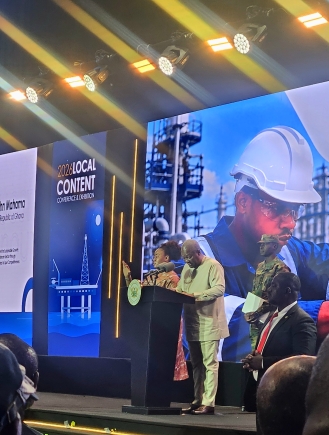
These questions were central to discussions at the recent 2026 Local Content Conference and Exhibition in Takoradi, where government officials, regulators, industry operators and local businesses gathered to examine the future of Ghana’s petroleum sector.
President John Dramani Mahama, speaking as Guest of Honour, challenged industry operators to deepen technology transfer, improve opportunities for qualified Ghanaian suppliers and strengthen the capacity of local businesses to compete for more complex contracts. His message spoke to a growing expectation that the benefits of Ghana’s petroleum resources must translate into stronger indigenous enterprises and a more capable workforce. Tullow Ghana’s Managing Director, Jean-Médard Madama, also used the conference to reaffirm the company’s commitment to local content development, skills transfer and sustained investment in Ghana. His remarks brought an important industry perspective to the debate, particularly given Tullow’s two decades of operating in the country.
The company’s record provides some useful context. Tullow reports that it spent US$869 million with indigenous Ghanaian and joint-venture companies in 2025 alone, out of total expenditure of US$904 million, representing approximately 96 per cent. The company also reports that Ghanaians account for approximately 93 per cent of its workforce. These numbers raise a more interesting question about the future of local content; whether Ghanaian companies can move further up the value chain and take on increasingly sophisticated assignments within the industry. This is where supplier development becomes particularly important. Tullow’s Supply Chain Academy, Supplier Market Day engagements and pre-tender workshops with the Petroleum Commission are intended to help local businesses understand procurement requirements, identify opportunities and strengthen their readiness to compete.
A recent engagement this year, for instance, covered engineering fabrication and installation, consumables and fabric-maintenance services. Such interventions address practical challenges facing many Ghanaian suppliers operating in the sector.
Of a truth, Ghana has made progress with its local content framework since commercial oil production began in 2010. The next phase should focus on building businesses capable of taking on larger and more complex contracts, developing expertise that can travel beyond Ghana and create enterprises that remain commercially viable over the long term. That is the real test of the country’s local content ambition.
Of course, the industry needs investment to create these opportunities, and here, Ghana faces an important challenge. Production from existing fields naturally declines over time, making continued drilling, improved recovery and fresh investment essential to sustaining the sector. Tullow’s experience illustrates the scale of the opportunity. The company reports that more than US$23 billion has been invested in the Jubilee and TEN fields since their development, generating over US$9.5 billion in revenues for the Government of Ghana. The extension of the petroleum licences to 2040 provides a longer framework for investment, with the potential for up to US$2 billion in additional investment over their lifetime.
The company completed its 2025–26 drilling campaign in September, bringing six Jubilee production wells and one water-injection well onstream. It has also secured a rig contract for up to five wells across Jubilee and TEN in 2027, with an option for five additional wells. For Ghanaian businesses, these plans have practical implications. Drilling and field-development activities create demand for engineering, fabrication, logistics, equipment, maintenance and specialist technical services. The extent to which local companies can participate will depend on their readiness, access to finance and the willingness of operators to create meaningful opportunities for them.
This brings us to another issue that has featured prominently in the relationship between government and the industry, which is investor confidence.
The recent arbitration between Tullow Ghana and the Government of Ghana over the taxation of business interruption insurance proceeds was an important test of that relationship. In September 2026, an International Chamber of Commerce tribunal upheld the Government’s tax assessment, including a 100 per cent applicable penalty.
The outcome ignited concerns about the next steps in the engagement between the parties. President Mahama’s subsequent announcement at the Local Content Conference, that the Government and Tullow had sat down and agreed on a mutually acceptable roadmap, is therefore significant. The specific terms of the roadmap have not been made public. However, the President’s remarks indicate that both parties have engaged following the arbitration and are seeking an agreed way forward. This should signal to current and prospective investors that the country is able to manage disagreements amicably and is very open for business.
Ghana has every right to pursue taxes due to the state and enforce its laws. Investors also need clarity, consistency and confidence in the fiscal and regulatory arrangements governing their operations. These interests must be managed within a stable and predictable investment environment.
There are also other challenges Ghana must address; local businesses continue to face financing constraints, while access to technology, specialised skills and international expertise remain critical to their growth. All key stakeholders in the energy sector have a role to play. The President’s call for deeper local participation should therefore be matched by practical measures to help Ghanaian businesses access finance and execute larger contracts.
After two decades of petroleum operations, Ghana has a considerable foundation on which to build. The country has established production assets, regulatory institutions, experienced professionals and businesses with a growing presence across the value chain. Recently, Planet One and partners (GNPC and GOIL Plc) also announced a hydrocarbon discovery at its Nya-Gyidie-1X exploration well in the Deepwater Cape Three Points (DWCTP) block offshore Ghana; opening new future exploration possibilities.
What happens next will depend on the quality of investment decisions, the strength of local participation and the ability of government and industry to resolve disputes effectively. There is surely a significant opportunity ahead for Ghana in whether it can turn the next phase of petroleum investment into stronger indigenous businesses, deeper technical expertise and a more competitive energy industry.