


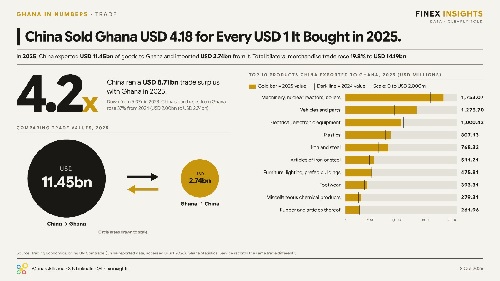
Ghana ran a trade deficit of US$8.71 billion with China in 2025, importing more than four times the value of goods it exported to the world’s second-largest economy, according to UN Comtrade data published by Trading Economics.
Chinese imports of manufactured goods outpaced exports of crude oil and minerals, exposing the challenge of turning stronger trade ties into a more balanced economic relationship.
The imbalance is putting the spotlight on efforts by the Bank of Ghana (BoG) to simplify payments to Chinese suppliers, while raising broader questions about the country’s ability to produce more of the goods it currently imports.
The central bank said a payment arrangement through Stanbic Bank Ghana allows eligible importers to pay Chinese suppliers from their cedi accounts, with settlement in Chinese yuan.
The service uses China’s Cross-Border Interbank Payment System (CIPS), reducing the need for importers to obtain US dollars before making payments.
BoG Governor Dr Johnson Pandit Asiama said GCB Bank PLC was preparing to introduce a similar service.
The arrangement offers businesses another route for settling trade transactions, but it does not address the underlying imbalance between what Ghana buys from China and what it sells to the country.
The initiative could make payments to Chinese suppliers easier for Ghanaian businesses, but the country’s large trade deficit reflects a deeper problem: Ghana buys a wide range of manufactured goods from China while selling mainly crude oil and mineral ores to the market.
The Chinese Ambassador to Ghana, Cong Song, also put bilateral trade at about US$14.1 billion in 2025, representing a 19.3 per cent increase over the previous year.
“In 2025, our bilateral trade reached a record 14.1 billion US dollars, reflecting a 19.3 per cent year-on-year growth,” he said.
Total bilateral merchandise trade rose 19.8 per cent to US$14.19 billion. China’s exports to Ghana reached US$11.45 billion, while Ghana’s exports to China totalled US$2.74 billion.
China sold Ghana about US$4.18 worth of goods for every US$1 it bought, narrowing the ratio from about US$5.07 in 2023. Chinese purchases from Ghana rose 37 per cent from US$2 billion in 2024, outpacing the roughly 16 per cent growth in its exports to Ghana.
Imports from China
Ghana’s imports from China comprise machinery, vehicles, electrical and electronic equipment, plastics, iron and steel, as well as other manufactured goods used by households, businesses and the construction industry.
In 2025, machinery, nuclear reactors and boilers were the largest import category, valued at US$1.75 billion.
Vehicles and parts followed with US$1.28 billion, representing an increase of 47 per cent over 2024. Electrical and electronic equipment accounted for US$1 billion, while plastics were valued at US$807 million and iron and steel at US$768 million.
The top 10 import categories accounted for about 66 per cent of China’s total exports to Ghana. Other significant products included articles of iron and steel, furniture, footwear, chemicals and rubber.
The breadth of the imports reflects Ghana’s reliance on China for industrial equipment, transport products, construction materials and a range of finished goods.
Limited export base
Ghana’s exports to China, by contrast, are concentrated in a few primary commodities.
Mineral fuels, mainly crude oil, accounted for about US$2.05 billion, while ores such as manganese were valued at approximately US$567 million in 2025.
Together, mineral fuels and ores represented about 96 per cent of Ghana’s exports to China. Cocoa, one of the country’s best-known export commodities, generated only about US$51 million in sales to the Chinese market.
The concentration means Ghana earns much of its export revenue from a narrow range of raw materials, while importing a wider variety of products that have undergone manufacturing and processing.
Opportunity
China’s decision to remove import tariffs on products from 53 African countries with which it has diplomatic relations, including Ghana, took effect on May 1, 2026.
The policy opens up an opportunity for Ghanaian exporters to improve their access to the Chinese market. Ghanaian cocoa previously attracted tariffs ranging from eight to 22 per cent, according to Mr Cong.
However, the opportunity to export more will depend on Ghana’s ability to produce goods that meet market requirements and can be supplied consistently at scale.
Processed cocoa products, cashew, shea butter and other agro-processed goods are among the products that could help diversify Ghana’s exports. Expanding these exports would require investment in processing, quality standards, production capacity, logistics and access to finance.
Value addition
In an interview with the Graphic Business, an economist and former Head of the Economics Division of the Institute of Statistical, Social and Economic Research (ISSER) at the University of Ghana, Professor Peter Quartey, attributed the imbalance largely to Ghana’s dependence on raw material exports and its limited value addition.
He urged the government to support local industries to process more raw materials into finished products for domestic consumption and export.
Prof. Quartey said stronger domestic production and value addition were necessary to enable Ghana to benefit more from its trade relationship with China.
He also explained that when businesses found it cheaper to import goods than manufacture them locally, domestic production could suffer, limiting opportunities for local workers.
“We are creating jobs in China at the expense of Ghana’s economy,” he said.
On BoG’s efforts, Prof. Quartey said the initiative could help address the foreign exchange challenge but would not resolve the underlying problem of weak domestic production.
He said the government therefore needed to complement the payment initiative with measures to strengthen domestic production.