


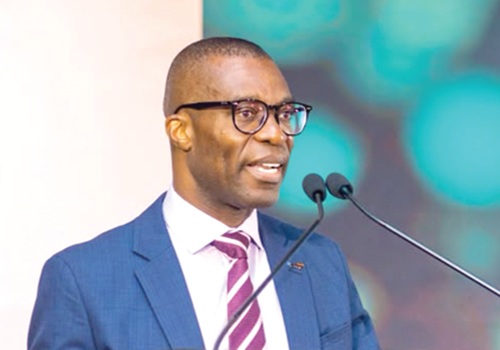
The Country Senior Partner(CSP) of PwC Ghana, George Arhin, has urged businesses to take advantage of emerging investment opportunities in Ghana’s economy, particularly in agriculture, manufacturing and value addition.
He said improving economic conditions, easing monetary policy and declining policy rates presented an opportunity for businesses to expand operations, invest in new ventures and seek cheaper financing from banks.
“The New Economy must be central to Ghana's next phase of growth.
Its pillars sit in the productive economy, making it the largest opportunity for transformational growth that is sustainable, inclusive and creates jobs.
Businesses need to leverage easing monetary conditions as an opportunity to refinance and fund capacity expansion,” he said.
Post-Budget Forum
Mr Arhin gave the advice at the 2027 Post-Budget Forum organised by PwC in Accra yesterday.
The event, which was on the theme: “What Government says, the reaction of business, and what PwC thinks”, brought together industry players, policymakers and academia to deliberate on the 2027 Budget and Economic Policy presented to Parliament last Thursday by the Finance Minister, Dr Cassiel Ato Forson.
New Economy
The minister said Ghana would invest $10 billion in a domestically funded New Economy programme over four years, starting in 2027, to boost production, export and job creation across key sectors, including agriculture, energy, technology, textiles and critical minerals.
The initiative, he said, aimed to transform the economy by expanding productive capacity, developing strategic infrastructure, attracting enterprise and creating decent jobs to ensure sustainable economic growth and lasting prosperity.
"Government will preserve stability, provide strategic infrastructure, prepare bankable projects and create predictable conditions for enterprise," he promised.
Mr Arhin highlighted agriculture as a key sector with significant potential, pointing to an estimated $3 million investment in the sector and urged businesses to explore opportunities in agricultural production and processing.
Mr Arhin also called for stronger collaboration between the government and the private sector, stressing that businesses had an important role to play in driving Ghana’s economic transformation.
He explained that the improving business environment and relatively favourable monetary conditions made it an appropriate time for companies to approach financial institutions for refinancing and funding to support expansion.
On local manufacturing, the PwC Ghana CSP encouraged businesses to promote Made-in-Ghana products, saying locally produced goods should be positioned as quality products capable of competing in international markets.
He said businesses should take advantage of opportunities available in the national budget to strengthen local production and grow their operations.
Mr Arhin reaffirmed PwC’s commitment to supporting businesses with research, guidance and insights to help them navigate the changing economic environment and maximise emerging opportunities.
An Associate Director at Fitch Solutions, Mike Kruiniger, said Ghana’s improved macroeconomic stability must now translate into increased private-sector investment, job creation and higher incomes if the gains made in stabilising the economy were to have a lasting impact.
He said the next critical step for Ghana was to convert the recent improvements in its economic fundamentals into real investment, particularly foreign direct investment (FDI), capable of expanding businesses and creating employment opportunities.
He said the country had recorded successive credit rating upgrades and improved investor confidence, creating a stronger foundation for private sector-led growth.
He projected the economy to remain one of the better-performing economies in the region, despite a moderation in growth.
“We forecast that Ghana's economic growth will slow from 5.9 per cent in 2026 to 5.0 per cent in 2027.
Even so, growth will stay above the averages for Sub-Saharan Africa and the wider emerging market space, meaning Ghana will remain a regional and EM outperformer,” Mr Kruiniger stated.
He attributed the continued growth partly to increased government investment, with capital expenditure expected to rise to about five per cent of Gross Domestic Product (GDP) in 2027.
He, however, stressed that sustaining growth would require greater participation from the private sector, particularly as the economy moved beyond the period of macroeconomic stabilisation.
Public financial management
For his part, the Economic Advisor to the President, Seth Terkper, said the country might stabilise the economy and return to growth, but without strong public financial management systems, sustaining those gains would remain a challenge.
“As we move from stabilisation to growth, strengthening financial accounting cannot be an afterthought. It must be part of the foundation for sustaining our economic reforms,” he said.
The Technical Advisor at the Ministry of Finance, Dr Theophilus Acheampong, said the 24-Hour Economy was private sector-led and incentive-based while the New Economy was led by the Ministry of Finance and publicly funded, stating that the first waited for firms to respond and the second built first and invited firms in.