


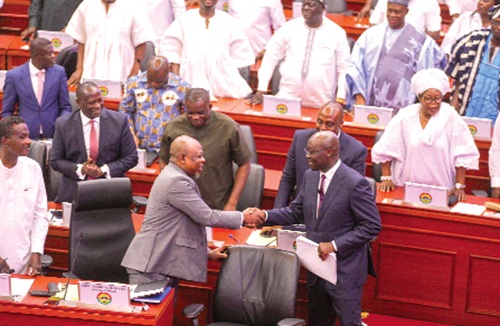
After an anxious wait for the 2027 Budget Statement, the Minister of Finance, Dr Cassiel Ato Baah Forson, stepped up in Parliament at exactly 6:18 p.m. yesterday and delivered a 115-page speech in a motion that spells out a plan to change the structure of the economy towards the path of real growth and ensure prosperity for all Ghanaians.
The 2027 budget, which is the government's third revenue and expenditure estimation instrument, ushers in a new dawn, dubbed the New Economy, aimed at transforming the structure of the economy, expanding productive capacity, creating decent jobs and ensuring lasting prosperity for all the citizenry.
It follows two previous budgets in 2025 and 2026, which helped to stabilise the economy after the fiscal slippages experienced between 2022 and 2024, with inflation falling from 23.8 per cent to 5.4 per cent by the end of 2025, the primary balance improving from a deficit of 4.1 per cent of gross domestic product (GDP) to a surplus of 2.5 per cent, public debt declining to 44.7 per cent of GDP and gross international reserves rising to 5.7 months of import cover.
In a virtually two hour and thirty minutes long presentation characterised by occasional cheers from the Majority side, Dr Forson stated that the New Economy Programme would inject $10 billion into the economy over four years, from 2027 to 2030, to drive structural transformation, expand production and create jobs.
The Minister of Finance rallied Ghanaians to support the policy to bequeath the nation a fully developed first-world country as it marks 70 years after independence.
He said next year alone, the government would invest 1.5 per cent of GDP, equivalent to GH¢30 billion, as the beginning of implementing the New Economy.
“This demands a fundamental shift in our thinking, our priorities and our actions.
Therefore, over a four-year period, from 2027 to 2030, government will spend $10 billion to create a modern Ghanaian economy for jobs and prosperity,” Dr Forson said.
He mentioned the eight connected pillars, including macroeconomic stability and affordable finance; commercial agriculture; energy infrastructure; critical minerals value addition; and tourism, culture and creative arts.
The rest are textiles and garments; pharmaceuticals and biomanufacturing; and the technology economy.
Dr Forson said the eight pillars together constituted one production system that would guide the use of fiscal space, while the private sector would lead investment, innovation, production and sustainable job creation.
“Mr Speaker, I call on Ghanaians to make a defining national choice about the future we want to build.
We can spend the recovery as though history has taught us nothing or invest in a productive base strong enough to carry the next generation.
“We can allow this recovery to pass or use this period of stability to change what Ghana produces and sells to the world,” the Finance Minister told parliament.
Dr Forson explained that the government would use the fiscal space created by economic recovery to provide strategic infrastructure, prepare bankable projects and create predictable conditions for businesses to thrive, while ensuring that government support was transparent, time-bound and linked to verifiable results.
He stressed that the programme would be implemented under strict fiscal discipline and greater accountability, with its success measured by the number of jobs created, improvements in living standards and the pace of development across communities.
Raising $10bn
The Finance Minister said the funding would be mobilised through adjustments to the primary surplus target and revenue expected from tax reforms and improved compliance, while ensuring that fiscal discipline was maintained.
Commercial agriculture
Under the commercial agriculture pillar, Dr Forson said the government would invest $3 billion to develop eight agricultural value chains, namely rice, sugar, poultry, maize and soya feed, aquaculture, oil palm, vegetables and cocoa processing.
He said the interventions would include developing rice production hubs across the country, achieving sugar self-sufficiency by 2030, expanding poultry production, addressing the country's fish supply deficit and establishing 100,000 hectares of new oil palm plantations.
The programme would also involve a $1 billion investment in the Pwalugu Multi-purpose Dam to irrigate more than 25,000 hectares for vegetable production, while the government targets processing 50 per cent of cocoa locally by 2028 and 100 per cent by 2030.
$2.2bn Energy infrastructure
Dr Forson said the government would invest $2.2 billion in energy infrastructure to improve electricity generation, strengthen transmission and distribution networks and reduce the cost of power for businesses and households.
The investment would support the construction of a 1,200-megawatt (MW) state-owned thermal power plant in the Central Region, a 600MW solar power plant with 2,000 MW-hours of battery storage, and a $500 million transmission modernisation programme.
He said the government would also commit $200 million to a 24-month nuclear-readiness programme, including training more than 2,000 scientists, as part of efforts to secure reliable and affordable baseload power.
The government would also phase out emergency power plants by 2030.
$1.5bn critical minerals value addition
Under the critical minerals pillar, Dr Forson said the government would invest $1.5 billion to develop local processing capacity for manganese, bauxite, lithium and gold, shifting the country from exporting raw minerals to retaining more value locally.
He said the government would target refining all artisanal and small-scale gold locally by December 2028, process at least 50 per cent of manganese and bauxite locally by the end of 2028 and achieve full local processing of the two minerals by 2030.
The programme would also include developing a 24-hour critical minerals processing enclave in the Western Region and constructing a railway line from Takoradi to Nyinahin from 2027, with plans to extend it to Hamile by 2030 to facilitate the transportation of minerals for processing and export.
“A modern inland port at Hamile will serve Burkina Faso, Mali, Niger and the wider Sahel.
This railway must power Ghanaian industries, support local processing and create jobs for our people.
“We must move our minerals towards greater value and our people towards greater prosperity,” Dr Forson said.
Tourism, culture, creative arts
Under the tourism, culture and creative arts pillar, Dr Forson said the government would invest $1 billion to develop the country into a year-round tourism destination, attract international visitors and increase foreign exchange earnings.
The Finance Minister said the investment would support heritage tourism, the Black Star Experience, an international convention centre at the La Trade Fair Centre, five-star hotels in Accra and Kumasi, and four-star hotels in the Cape Coast and Elmina heritage corridor, the Volta Region and northern Ghana.
The programme would also include the completion of a new National Theatre in Kumasi and the establishment of a medical tourism hub, with the government providing targeted tax incentives and infrastructure to attract private investment.
Textiles and garment
The Finance Minister said the government would invest $1 billion to transform the country's textile and garment industry into a competitive manufacturing and export sector under the 24-Hour Economy and Accelerated Export Development Programme.
He said the funding would support the modernisation of textile mills, expansion of garment factories and establishment of dedicated industrial enclaves equipped with reliable power, water, laboratories, warehouses and other shared infrastructure.
Dr Forson said the government would also amend public procurement laws to require public institutions to purchase locally manufactured uniforms, hospital textiles, bedding and protective clothing, as part of efforts to expand domestic demand, create jobs and position Ghanaian fashion brands in international markets.
Pharmaceutical
Under the pharmaceutical and biomanufacturing pillar, Dr Forson said the government would invest $1 billion to strengthen domestic medicine production, reduce import dependence and establish a pharmaceutical manufacturing and export hub in West Africa.
He said the programme would establish pharmaceutical and biomanufacturing hubs in the Eastern and Central regions, with a state-owned special purpose vehicle expected to begin construction in 2027.
The government would also introduce local procurement preferences for medicines produced in Ghana, subject to quality standards, with a target of manufacturing between 60 per cent and 80 per cent of the country's essential medicine requirements locally by 2030 and creating approximately 20,000 direct and indirect jobs.